
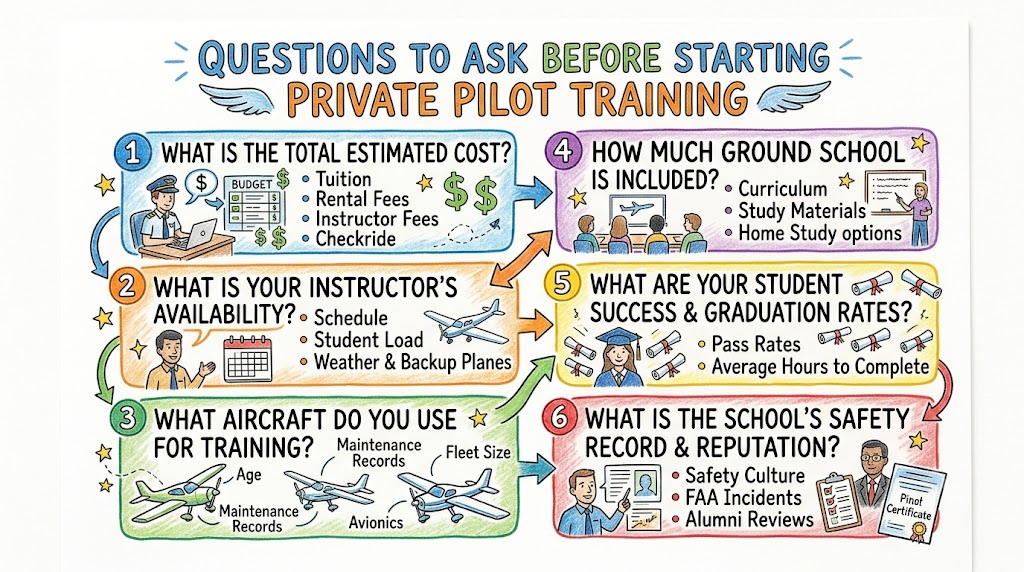
Introduction
Private pilot training can be one of the most exciting and rewarding experiences of your life. It gives you the opportunity to understand aviation, control an aircraft, travel to new destinations, and develop skills that require discipline, confidence, and sound judgment.
However, learning to fly also requires a considerable investment of time, money, preparation, and personal responsibility. Joining the first flight school you find or choosing a program only because it advertises a low price can lead to scheduling difficulties, unexpected expenses, interrupted training, or disappointment.
Before enrolling, you should understand what private pilot training involves and ask detailed questions about the school, instructors, aircraft, medical requirements, training schedule, and complete cost.
What Is Private Pilot Training?
Private pilot training is a structured combination of aviation ground study and practical flight instruction.
Ground training helps students understand subjects such as:
- Aviation regulations
- Aircraft systems
- Aerodynamics
- Weather
- Airspace
- Navigation
- Flight planning
- Aircraft performance
- Weight and balance
- Airport operations
- Radio communication
- Emergency procedures
- Aeronautical decision-making
Practical flight instruction teaches students how to inspect and operate an aircraft safely. It generally covers taxiing, takeoffs, landings, climbs, descents, turns, navigation, night flying, basic instrument reference, emergency procedures, and cross-country operations.
Students must also gain supervised solo experience, pass an aviation knowledge test, receive the necessary instructor endorsements, and successfully complete a practical test commonly called a checkride.
A private pilot certificate is mainly intended for personal and recreational aviation. It allows broader privileges than a student or sport pilot certificate, but it does not automatically authorize a pilot to provide commercial air transportation or fly for compensation.
Questions to Ask Yourself Before Beginning
Before comparing schools, aircraft, or prices, begin by considering your own goals and circumstances.
1. Why Do I Want to Become a Private Pilot?
Your reason for learning to fly should influence the type of training program you select.
Some people want to fly for personal enjoyment. Others want to travel with family, own an aircraft, join a flying club, or begin a professional aviation career.
Ask yourself whether your main goal is:
- Recreational flying
- Personal transportation
- Family travel
- Aircraft ownership
- Building aviation knowledge
- Beginning a professional pilot career
- Preparing for advanced ratings
- Completing a personal life goal
There is no wrong reason for learning to fly, but your goal should be realistic.
Someone who wants to fly occasionally for recreation may prefer a flexible local training program. A student planning an aviation career may benefit from a more structured course with clear progression toward instrument, commercial, and instructor qualifications.
2. Is a Private Pilot Certificate Right for My Goals?
A private pilot certificate offers useful privileges, but it may not be the only training option.
Someone who wants limited recreational flying may also explore sport pilot training. A person who wants to become a professional pilot will eventually need additional certificates, ratings, experience, and medical qualifications beyond the private pilot level.
Private pilot training may be suitable when you want to:
- Fly qualifying aircraft for personal purposes
- Carry passengers under applicable rules
- Conduct cross-country flights
- Fly during the day or at night
- Access a wider range of aircraft
- Pursue an instrument rating later
- Build a foundation for professional training
Before enrolling, explain your goals to a qualified instructor. The instructor can help you understand whether private pilot training is the most appropriate starting point.
3. Am I Ready for the Time Commitment?
Flight training includes much more than time spent inside the aircraft.
A typical lesson may involve:
- Studying before arriving
- Reviewing the lesson objective
- Checking weather
- Inspecting the aircraft
- Completing a preflight briefing
- Conducting the flight
- Completing a post-flight review
- Recording the lesson
- Studying corrections before the next flight
Students also need time for ground school, practice tests, flight planning, chair flying, and reviewing procedures.
Weather, aircraft maintenance, instructor availability, and airport conditions can also cause delays. Before beginning, decide whether your work, family, education, and financial commitments allow you to train consistently.
4. Can I Attend Lessons Regularly?
Consistency is one of the most important factors in efficient flight training.
When students leave long gaps between lessons, they may spend a significant part of each flight reviewing previously learned skills. Regular training can improve:
- Skill retention
- Confidence
- Aircraft familiarity
- Checklist discipline
- Radio communication
- Landing consistency
- Training momentum
Many students benefit from scheduling two or more lessons per week. However, the ideal schedule depends on weather, finances, school availability, and the student’s ability to prepare properly.
Ask the school whether it can provide the lesson frequency you need before making a financial commitment.
5. Can I Afford the Complete Training Cost?
Do not base your budget only on the advertised minimum price.
Training cost depends on several factors, including:
- Aircraft rental
- Fuel
- Instructor charges
- Ground instruction
- Number of flight hours
- Training frequency
- Weather delays
- Aircraft availability
- Learning progress
- Study materials
- Medical examination
- Knowledge test
- Examiner charges
- Aircraft rental for the checkride
- Headset and equipment
- Insurance requirements
The regulatory minimum flight time is not a guaranteed completion time. Every student must demonstrate the required knowledge, skill, risk management, and judgment before an instructor can recommend them for the practical test.
Create a financial plan that includes additional training hours and unexpected expenses.
6. Am I Comfortable With the Responsibility?
Pilots are responsible for making safe decisions before and during every flight.
This includes evaluating:
- Personal fitness
- Aircraft condition
- Weather
- Fuel
- Weight and balance
- Runway length
- Airspace
- Airport conditions
- Passenger needs
- Legal requirements
- Personal limitations
A safe pilot must sometimes delay, divert, or cancel a flight. Private pilot training requires students to accept feedback, follow procedures, use checklists, and avoid taking unnecessary risks.
Questions About Eligibility and Medical Requirements
Medical and eligibility questions should be addressed early, particularly before paying a large amount in advance.
7. What Is the Minimum Age?
You may begin taking flight lessons before reaching the minimum age for certification.
For an airplane, a student generally must be at least 16 years old to fly solo and at least 17 years old to receive a private pilot certificate.
Beginning lessons early can be useful, but very young students should consider whether they will be able to maintain their skills until they become eligible for solo flight and certification.
There is generally no standard maximum age for learning to fly. Older students can become successful pilots when they meet the applicable requirements and can operate the aircraft safely.
8. Do I Meet the English-Language Requirements?
A private pilot applicant must generally be able to read, speak, write, and understand English.
English is important in aviation because pilots must understand:
- Air traffic control instructions
- Aircraft documents
- Weather reports
- Airport signs
- Checklists
- Regulations
- Navigation information
- Emergency instructions
Students who are not native English speakers should ask the school whether aviation English support is available.
9. Do I Need a Student Pilot Certificate?
A student pilot certificate is generally required before conducting a solo flight.
You usually do not need it simply to take introductory lessons with an instructor because the instructor remains responsible for the flight. However, the application should be completed early enough to avoid delaying solo training.
Ask the school:
- When should I apply?
- Who will verify my identity?
- Will an instructor help with the application?
- How long should I allow for processing?
- Which documents should I bring?
The student pilot certificate and medical certificate are separate documents.
10. What Medical Certificate Will I Need?
A person pursuing ordinary private pilot privileges in an airplane generally needs to meet the applicable FAA medical requirements.
Many private pilot students obtain a third-class medical certificate through an FAA-authorized Aviation Medical Examiner.
The medical examination is intended to determine whether the applicant meets the health standards needed to operate safely. It may address areas such as:
- Vision
- Hearing
- Cardiovascular health
- Neurological health
- Medications
- Medical history
- Substance-related history
- Mental health history
- Conditions that may affect consciousness or judgment
Medical eligibility can be more complex than a simple physical examination. Students should not guess whether a particular condition or medication is acceptable.
11. Should I Complete My Medical Examination Before Training?
It is usually sensible to investigate medical eligibility early.
You may be able to take dual flight instruction before receiving a medical certificate, but you generally need the appropriate medical qualification before solo flight in an airplane.
Completing the process early may help you discover a concern before spending a large amount on training.
Students with complicated medical histories should seek appropriate guidance before submitting an application. An incorrectly completed application or incomplete documentation can create delays.
Do not hide medical history or stop prescribed medication merely to qualify for training. Medical decisions should be discussed with qualified healthcare and aviation medical professionals.
12. Could My Medical History Cause a Delay?
Certain medical conditions, treatments, medications, or previous incidents may require additional review.
Examples may include a history involving:
- Heart conditions
- Seizures
- Loss of consciousness
- Significant vision problems
- Hearing limitations
- Diabetes
- Sleep disorders
- Mental health treatment
- Attention-related medication
- Substance dependence
- Driving-related alcohol or drug incidents
- Previous medical certificate denial
A condition does not always mean that certification is impossible. However, additional records, evaluations, testing, or FAA review may be required.
Resolve these questions before committing to a costly training package.
Questions to Ask a Flight School
A professional flight school should welcome reasonable questions and explain its policies clearly.
13. Does the School Train Under Part 61 or Part 141?
Flight training in the United States is commonly provided under Part 61 or through an FAA-approved Part 141 school.
Part 61 Training
Part 61 training is often more flexible. Lessons may be arranged around the student’s schedule, and the instructor can adapt the training sequence to individual progress while still meeting regulatory requirements.
It may suit:
- Working professionals
- Weekend students
- Recreational learners
- Students needing scheduling flexibility
- People training at a smaller local airport
Part 141 Training
Part 141 schools use an FAA-approved syllabus and structured training program. They must satisfy specific requirements for curriculum, supervision, records, facilities, and course management.
Part 141 may suit:
- Full-time students
- Career-focused learners
- Students using certain education benefits
- Learners who prefer a highly structured program
- Students attending an aviation college
One option is not automatically better than the other. The quality of instruction, aircraft availability, student effort, safety culture, and scheduling reliability may matter more than the training regulation alone.
14. Does the School Use a Written Syllabus?
A written syllabus provides a clear training path.
It should help students understand:
- The purpose of each lesson
- Required preparation
- Maneuvers being introduced
- Completion standards
- Ground topics
- Stage checks
- Solo requirements
- Cross-country preparation
- Checkride preparation
Without a structured plan, students may repeat lessons unnecessarily or have difficulty understanding their progress.
Ask whether you will receive access to the syllabus and how the school records completed lessons.
15. How Many Aircraft Are Available?
Aircraft availability has a direct effect on training consistency.
A school with only one aircraft may still provide excellent training, but maintenance or scheduling conflicts could interrupt progress.
Ask:
- How many aircraft are used for primary training?
- How many students share each aircraft?
- How far in advance must lessons be booked?
- Is a replacement available during maintenance?
- Can students switch between similar aircraft?
- Are evening and weekend slots available?
Frequent cancellations can increase the amount of review needed and raise the overall cost.
16. Which Aircraft Will I Fly?
Common primary training aircraft are designed to be stable, predictable, and economical.
Ask about:
- Aircraft model
- Seating and cockpit space
- Useful load
- Instrument panel
- Traditional gauges or glass cockpit
- Rental rate
- Aircraft availability
- Maintenance history
- Suitability for your height and mobility
- Fuel policy
A newer aircraft is not automatically a better training aircraft. An older airplane can be entirely suitable when it is properly maintained and equipped.
Cockpit comfort also matters. A discovery flight can reveal whether you can reach the controls, see outside clearly, and sit comfortably during longer lessons.
17. How Are the Aircraft Maintained?
Training aircraft are used frequently and should be supported by a professional maintenance program.
Students should expect the school to take maintenance concerns seriously.
Observe whether:
- Aircraft appear clean and organized
- Checklists are available
- Reported defects are recorded
- Instructors inspect aircraft carefully
- Maintenance questions receive clear answers
- Aircraft documents are managed professionally
- Defects are corrected rather than dismissed
Cosmetic wear is common in training aircraft. It is different from neglected maintenance or an unsafe operating culture.
18. What Happens When an Aircraft Becomes Unavailable?
Ask how the school responds to unexpected maintenance.
Possible arrangements may include:
- Moving the lesson to another aircraft
- Conducting ground instruction
- Using an approved training device
- Rescheduling without penalty
- Assigning an equivalent aircraft after transition training
A school should not pressure a student or instructor to accept an aircraft with an unresolved safety concern merely to maintain the schedule.
19. What Is the School’s Safety Culture?
Safety culture is reflected in everyday behaviour.
Positive signs include:
- Consistent checklist use
- Careful weather evaluation
- Thorough preflight inspections
- Clear briefings
- Conservative fuel planning
- Respect for student limitations
- Professional aircraft reporting
- Willingness to cancel unsafe flights
- Open discussion of mistakes
- No pressure to rush solo or testing
Be cautious when a school treats safety questions as inconvenient or encourages students to fly in conditions that exceed their ability.
20. Can I Take a Discovery Flight?
A discovery flight is an introductory lesson that lets you experience the aircraft and training environment before enrolling.
It may include:
- Meeting an instructor
- Reviewing basic controls
- Inspecting the aircraft
- Discussing safety procedures
- Taxiing
- Handling the controls under supervision
- Performing gentle turns, climbs, or descents
- Observing airport operations
- Discussing the training process afterward
Use the experience to evaluate the instructor’s communication, the aircraft’s comfort, the condition of the facility, and your own reaction to flight.
Questions to Ask About Your Flight Instructor
The relationship between a student and instructor can strongly influence progress.
21. Who Will Be My Primary Instructor?
Ask whether one instructor will manage most of your training or whether you will be assigned to several instructors.
Training with a primary instructor can improve continuity because that person understands your strengths, weaknesses, and progress.
Occasional lessons with another instructor may also be valuable. A second instructor can offer a different explanation and provide an independent evaluation before solo flight or the checkride.
22. How Much Instructional Experience Does the Instructor Have?
Total flight time is only one measure of instructor quality.
Ask about:
- Experience teaching beginners
- Experience in the training aircraft
- Familiarity with the local airport
- Knowledge of nearby training areas
- Student solo preparation
- Cross-country instruction
- Checkride preparation
- Communication style
A less experienced instructor can still be excellent when properly supervised, prepared, patient, and committed to teaching.
23. Is the Instructor Available Consistently?
Some flight instructors are building experience before moving to another aviation job. Instructor turnover is therefore possible.
Ask:
- What days does the instructor work?
- How many students does the instructor manage?
- How far ahead is the schedule booked?
- Is the instructor planning to leave soon?
- Who provides training during an absence?
- How are records transferred to a replacement?
A written syllabus and accurate lesson records can reduce disruption when an instructor changes.
24. How Will My Progress Be Evaluated?
A good instructor should explain what you did well, what needs improvement, and what to prepare for next time.
Each lesson should ideally include:
Preflight Briefing
The instructor explains the objectives, procedures, risks, and expected standards.
Flight Instruction
The student observes demonstrations, practises skills, receives corrections, and develops decision-making ability.
Post-Flight Review
The instructor discusses performance, records the lesson, identifies weaknesses, and assigns preparation.
Feedback should be specific and professional rather than vague or discouraging.
25. Can I Change Instructors?
Not every instructor and student will be an ideal match.
Differences may involve:
- Communication style
- Pace of instruction
- Scheduling
- Personality
- Teaching method
- Expectations
- Feedback style
Changing instructors should be handled professionally. Before changing, discuss the concern with the instructor or school manager. A reputable school should care more about effective training than forcing an unsuitable pairing.
Questions to Ask About Training Costs
A low hourly rate does not necessarily mean a low total cost.
26. What Is the Aircraft Rental Rate?
Ask whether the aircraft is rented using:
- A wet rate that includes fuel
- A dry rate that excludes fuel
- Engine or meter time
- Flight time
- Another defined method
You should know when billing begins and ends. Taxi delays at a busy airport can affect cost when aircraft time continues to accumulate on the ground.
27. How Are Instructor Charges Calculated?
Instructor time may include more than the flight itself.
Ask whether you will be charged for:
- Preflight briefing
- Aircraft inspection support
- Flight time
- Post-flight discussion
- Ground instruction
- Flight planning
- Simulator sessions
- Checkride preparation
- Administrative time
A higher instructor rate may still offer better value when lessons are well organized and productive.
28. What Additional Expenses Should I Expect?
A complete budget may include:
- Aviation medical examination
- Knowledge-test fee
- Ground-school course
- Books
- Logbook
- Headset
- Navigation tools
- Charts or digital subscriptions
- Flight computer
- Plotter
- Renter’s insurance
- Examiner fee
- Aircraft rental for the checkride
- Additional training
- Repeated testing when necessary
Ask the school to separate mandatory expenses from optional equipment.
29. Is the Estimate Based on Minimum Flight Time?
For a typical private pilot airplane certificate under Part 61, the regulatory minimum includes at least 40 hours of flight time. The experience must contain specified instructor, solo, cross-country, night, instrument-reference, and practical-test preparation requirements.
An approved Part 141 private pilot course may have a lower programmed minimum.
However, minimum eligibility and actual checkride readiness are not the same. Students often require additional experience before they can perform consistently at the required standard.
A realistic school should explain this rather than guaranteeing certification at the minimum number of hours.
30. Should I Pay the Entire Amount in Advance?
Large advance payments should be considered carefully.
Before paying, review:
- Written refund policy
- Account-balance protection
- Expiration rules
- Withdrawal conditions
- School financial stability
- Aircraft availability
- Instructor availability
- Transfer policy
- Cancellation fees
- What happens if the school closes
- What happens if medical certification is delayed
Paying incrementally may reduce financial risk, although package discounts or structured programs may operate differently.
Never rely only on verbal promises. Request written terms.
31. Are Payment Plans or Financing Available?
Financing can make training more accessible, but it also increases the financial commitment.
Compare:
- Interest rate
- Total repayment amount
- Origination fees
- Monthly payment
- Grace period
- Refund process
- Conditions following withdrawal
- Whether payments continue during training interruptions
- Whether the loan covers advanced training
Do not assume that completing a private pilot certificate will immediately create income sufficient to repay a loan.
32. What Is the Cancellation Policy?
Flight lessons may be cancelled because of weather, maintenance, illness, instructor availability, or personal circumstances.
Ask:
- How much notice must a student provide?
- Is there a late-cancellation fee?
- Who determines whether weather is acceptable?
- Is there a charge when the aircraft becomes unavailable?
- Can a cancelled flight become a ground lesson?
- What happens when an instructor cancels?
- How are repeated cancellations handled?
A fair written policy protects both the student and the school.
Questions About Scheduling and Training Continuity
A well-maintained schedule can reduce delays and repeated training.
33. How Frequently Should I Fly?
Many students benefit from flying two or three times per week.
Frequent lessons can help maintain:
- Aircraft-control skills
- Landing technique
- Radio confidence
- Checklist flow
- Situational awareness
- Procedural memory
Scheduling more lessons than you expect to complete may be useful in areas with frequent weather cancellations. However, avoid creating a schedule that leaves no time for study or recovery.
34. How Long Will the Training Take?
There is no single answer.
Completion time depends on:
- Lesson frequency
- Weather
- Aircraft availability
- Instructor availability
- Student preparation
- Learning pace
- Airport traffic
- Maintenance
- Knowledge-test timing
- Checkride availability
A full-time student may progress more quickly than someone flying occasionally. However, speed should never take priority over competence.
Ask for a realistic range based on the school’s actual scheduling capacity rather than a promotional promise.
35. Can I Train Around My Job or Education?
Confirm whether lessons are available:
- Early in the morning
- During the day
- In the evening
- On weekends
- During holidays
Morning flights may offer smoother air in some locations, while afternoon schedules may be more vulnerable to heat, wind, or thunderstorms.
Weekend-only students should investigate demand carefully because those time slots may fill quickly.
36. What Happens During Bad Weather?
Weather cancellations are a normal part of learning to fly.
Poor flying weather can still be used productively for:
- Ground instruction
- Weather analysis
- Flight planning
- Aircraft systems
- Radio practice
- Navigation exercises
- Simulator training
- Knowledge-test preparation
- Emergency-procedure review
A professional school should teach students how to understand cancellation decisions instead of treating weather as an inconvenience.
Questions About Ground School
Ground knowledge is essential for safe flight operations.
37. Is Ground School Included?
Some schools include structured ground instruction in a package. Others allow students to use an online course or independent study while receiving individual instruction from their flight instructor.
Ask:
- Which course is recommended?
- Is the cost included?
- Is classroom instruction available?
- How is progress tracked?
- Who answers questions?
- Does the course include practice tests?
- How much individual ground instruction should I expect?
Online courses can be convenient, but students still need to understand and apply the material.
38. What Subjects Will I Study?
Private pilot ground training generally includes:
Regulations
Pilot privileges, limitations, airspace rules, aircraft documents, right-of-way, weather minimums, and operating requirements.
Aerodynamics
Lift, drag, thrust, weight, angle of attack, stability, stalls, and aircraft control.
Aircraft Systems
Engine, fuel, electrical, instruments, controls, landing gear, propeller, and aircraft-specific equipment.
Weather
Reports, forecasts, clouds, wind, visibility, turbulence, thunderstorms, icing, pressure, and hazardous conditions.
Navigation
Charts, headings, distance, time, fuel, pilotage, dead reckoning, and electronic navigation.
Aircraft Performance
Takeoff distance, landing distance, climb performance, density altitude, runway conditions, and operating limitations.
Weight and Balance
Loading limits, centre of gravity, stability, and performance.
Human Factors
Fatigue, stress, medication, hazardous attitudes, visual illusions, oxygen limitations, and decision-making.
Emergency Procedures
Engine failure, equipment malfunction, weather deterioration, navigation problems, and abnormal situations.
39. When Should I Take the Knowledge Test?
Some students complete the knowledge test early. Others take it after gaining practical flight experience that makes the material easier to understand.
Ask your instructor to recommend a suitable timeline.
Taking the test early may reduce workload during checkride preparation, but memorizing answers without understanding the material is not enough.
The knowledge must later be applied during:
- Flight planning
- Weather decisions
- Oral examination
- Aircraft operation
- Navigation
- Risk assessment
Questions About Practical Flight Training
Understanding the training sequence can help students set realistic expectations.
40. What Skills Will I Learn?
Private pilot flight training normally develops skills in areas such as:
- Preflight preparation
- Aircraft inspection
- Cockpit organization
- Checklist use
- Taxiing
- Airport signs and markings
- Takeoffs
- Landings
- Climbs and descents
- Straight-and-level flight
- Turns
- Slow flight
- Stall recognition and recovery
- Ground-reference maneuvers
- Traffic patterns
- Crosswind operations
- Go-arounds
- Navigation
- Diversions
- Lost procedures
- Night operations
- Basic instrument reference
- Emergency approaches
- Aeronautical decision-making
The student must demonstrate both physical control and sound judgment.
41. When Will I Be Allowed to Fly Solo?
Solo flight is a major milestone, but it should not be rushed.
Before authorizing solo flight, an instructor must determine that the student understands the relevant rules and can safely perform the required procedures and maneuvers.
Readiness may include:
- Consistent takeoffs and landings
- Traffic-pattern awareness
- Radio communication
- Checklist discipline
- Stall recovery
- Emergency procedures
- Go-around decisions
- Wind awareness
- Judgment
- Local airspace knowledge
Students progress at different rates. Reaching solo later than another student does not mean you are failing.
42. What Is Cross-Country Training?
In aviation, cross-country training involves planning and conducting flights between airports while meeting applicable distance and landing requirements.
Students learn to manage:
- Route selection
- Weather
- Airspace
- Charts
- Headings
- Wind correction
- Time calculations
- Fuel
- Alternate airports
- Airport information
- Navigation
- Diversions
- Unexpected changes
Cross-country training develops independence and decision-making rather than simply teaching the student to follow a line on a screen.
43. Is Night Training Included?
Private pilot airplane training includes applicable night experience.
Night flying introduces challenges such as:
- Reduced visual references
- Airport-lighting identification
- Greater dependence on instruments
- Visual illusions
- Difficulty identifying terrain
- Emergency landing considerations
- Fatigue
- Weather interpretation
Ask how the school schedules night lessons, particularly during seasons when darkness occurs late.
44. Will I Learn to Fly Using Instruments?
Private pilot training includes basic flight by reference to instruments, but it does not provide an instrument rating.
The purpose is to help the student maintain control and respond appropriately after an unexpected loss of outside visual reference.
A private pilot without an instrument rating must not intentionally enter instrument conditions merely because basic instrument training was completed.
45. Will I Train at Controlled Airports?
Training at or near a tower-controlled airport can help students develop:
- Radio communication
- Clearance understanding
- Taxi awareness
- Traffic sequencing
- Airspace knowledge
- Professional communication habits
Training at a quieter airport may provide more time for takeoff, landing, and maneuver practice.
Some schools combine both environments. Ask whether you will receive experience at airports different from your home base.
Questions About the Knowledge Test and Checkride
Certification requires more than completing flight hours.
46. How Will the School Prepare Me for the Knowledge Test?
A strong preparation program should help you understand the material rather than only memorize answers.
Preparation may include:
- Reading assignments
- Video lessons
- Instructor explanations
- Practice calculations
- Chart exercises
- Weather analysis
- Practice tests
- Review of weak topics
- Instructor endorsement
Ask what passing standard the school expects on practice tests before recommending the actual examination.
47. What Is a Private Pilot Checkride?
The checkride is the practical test for the certificate.
It generally includes:
- Application review
- Eligibility verification
- Logbook and endorsement review
- Aircraft-document review
- Oral questioning
- Flight-planning discussion
- Risk-management evaluation
- Preflight inspection
- Flight evaluation
- Emergency procedures
- Post-flight discussion
The examiner evaluates knowledge, risk management, judgment, and flight proficiency.
The goal is not to perform like an airline captain. The applicant must demonstrate the standard expected of a safe new private pilot.
48. Who Conducts the Checkride?
A practical test is commonly conducted by an FAA-designated pilot examiner or an authorized FAA inspector.
Ask the school:
- How is an examiner selected?
- How far ahead must the test be scheduled?
- What does the examiner charge?
- Which documents are required?
- Is aircraft rental included?
- What happens when weather cancels the test?
- Does the school conduct a mock checkride?
Checkride scheduling delays may add cost if the student needs additional flights to remain proficient.
49. What Happens If I Do Not Pass?
An unsuccessful test does not automatically end your aviation goal.
The examiner should identify the areas that did not meet the required standard. You will generally need:
- Additional instruction
- Practice in the deficient areas
- A new instructor endorsement
- A retest
- Payment of applicable fees
Treat the result as specific feedback rather than a judgment of your overall potential.
Questions About Life After Certification
Training should prepare you to continue learning after the checkride.
50. What Can I Do With a Private Pilot Certificate?
Subject to regulations, ratings, endorsements, currency, and aircraft qualifications, a private pilot may use the certificate for activities such as:
- Recreational flying
- Personal transportation
- Carrying passengers
- Cross-country travel
- Building flight experience
- Renting aircraft
- Joining a flying club
- Beginning advanced training
The certificate does not eliminate operating limitations. Pilots must continue to evaluate weather, aircraft performance, airspace, personal fitness, and legal requirements before every flight.
51. Can a Private Pilot Be Paid to Fly?
Private pilots generally may not act as pilot in command of an aircraft carrying passengers or property for compensation or hire.
Rules involving shared expenses, business travel, charitable flights, aircraft sales, and other special operations can be complex.
Do not assume an arrangement is legal simply because it is informal or because the payment is described as fuel money. Obtain qualified guidance before accepting compensation, reimbursement, or business-related benefits.
52. Can I Rent an Aircraft After Passing?
Many flight schools and rental organizations allow private pilots to rent aircraft, but they may have additional requirements.
These may include:
- Aircraft checkout
- Minimum experience
- Recent flight time
- Insurance requirements
- Written examination
- Instructor approval
- Model-specific training
- Recurrent checkout
Rental requirements may be stricter than the basic legal requirements.
53. How Do I Remain Current and Proficient?
Currency means meeting legal recent-experience requirements. Proficiency means having the practical ability to conduct a flight safely.
A pilot can be legally current but not fully prepared for:
- Strong crosswinds
- Busy airspace
- Night operations
- Long cross-country flights
- Unfamiliar aircraft
- Short runways
- Challenging weather
Maintain proficiency through:
- Regular flying
- Instructor refresher flights
- Continuing ground study
- Conservative personal limits
- Aircraft-specific practice
- Emergency-procedure review
- FAA safety education
- Flight reviews
54. What Can I Pursue Next?
After earning a private pilot certificate, possible next steps may include:
- Instrument rating
- Complex-airplane endorsement
- High-performance endorsement
- Tailwheel endorsement
- Seaplane training
- Glider training
- Commercial pilot certificate
- Multi-engine rating
- Flight instructor certificate
Your next step should reflect your interests and goals. Recreational pilots do not need to follow a professional training path to continue improving.
Warning Signs When Choosing a Flight School
Be cautious when you encounter:
- Guaranteed completion at minimum hours
- Guaranteed checkride success
- Pressure to pay a large amount immediately
- Refusal to provide written pricing
- Unclear refund policies
- Frequently unavailable aircraft
- Poorly maintained facilities
- Dismissive responses to maintenance concerns
- No written syllabus
- Incomplete lesson records
- Constant instructor changes without support
- Pressure to fly in unsuitable conditions
- Unexplained charges
- Difficulty accessing account balances
- Unrealistic career or income promises
One warning sign may have a reasonable explanation, but repeated concerns should not be ignored.
Private Pilot Training Checklist
Before enrolling, confirm that you have:
- Defined your aviation goal
- Researched private pilot privileges
- Reviewed basic eligibility
- Investigated medical certification
- Created a realistic budget
- Compared several schools
- Taken a discovery flight
- Met a potential instructor
- Inspected the training aircraft
- Reviewed the school’s syllabus
- Confirmed aircraft availability
- Confirmed instructor availability
- Read cancellation policies
- Read refund policies
- Requested a complete cost estimate
- Asked about testing expenses
- Planned a regular lesson schedule
- Selected a ground-school method
- Understood that minimum hours are not guaranteed completion hours
- Discussed future aviation goals
Frequently Asked Questions
1. Do I need previous flying experience?
No. Private pilot training is designed to begin with basic concepts and gradually introduce more advanced skills. A discovery flight is often a useful first step. During early lessons, the instructor explains the aircraft, controls, checklists, airport procedures, and safety responsibilities. Students are not expected to arrive with previous cockpit experience.
2. How many flight hours will I need?
For a private pilot airplane certificate under Part 61, the regulatory minimum is generally 40 hours, including required instructor and solo experience. An approved Part 141 course may use a lower minimum. However, many students need additional hours to demonstrate consistent knowledge, judgment, risk management, and flight proficiency. Your readiness matters more than reaching a particular number.
3. Can I complete private pilot training while working full time?
Yes. Many students train before work, after work, or on weekends. Progress will depend on aircraft availability, instructor scheduling, weather, and your ability to study between lessons. Try to schedule lessons regularly. Long gaps may increase the amount of review needed and make training more expensive.
4. Should I obtain my medical certificate first?
Investigating medical eligibility early is generally advisable. You may take dual instruction before receiving the certificate, but you normally need the applicable medical qualification before solo flight in an airplane. Resolving concerns early may prevent you from spending heavily on training before discovering a certification issue.
5. Is private pilot training difficult?
Training is challenging but manageable for students who prepare consistently, accept instruction, and practise regularly. Some skills, such as landings, radio communication, weather interpretation, and navigation, may require patience. Difficulty with one area does not mean you cannot become a pilot. Progress develops through repetition and constructive feedback.
6. How much should I budget beyond the advertised price?
Your budget should include additional flight time, instructor ground time, testing fees, examiner charges, medical expenses, equipment, study materials, insurance, and aircraft rental for the checkride. Ask the school for a written estimate based on realistic completion time rather than only regulatory minimums. Include a financial reserve for delays and extra practice.
7. Can I change flight schools during training?
Yes. Your logged experience normally remains part of your training record, but a new school or instructor must evaluate your knowledge and skills before continuing. Differences in aircraft, syllabus, and procedures may require transition training. Keep your logbook, endorsements, training records, receipts, and course documents organized.
8. What happens if my instructor leaves?
The school should assign another qualified instructor and provide access to accurate training records. The replacement instructor may conduct an evaluation flight before continuing the previous plan. Ask about instructor turnover and transition procedures before enrolling. A written syllabus can reduce unnecessary repetition.
9. Can private pilot training lead to an aviation career?
Yes. The private pilot certificate is commonly an early step in a professional training path. Career-focused students may later pursue instrument, commercial, multi-engine, and instructor qualifications while building required experience. However, the private certificate alone does not qualify someone for most paid pilot positions.
10. Is a discovery flight worth taking?
Yes. A discovery flight allows you to experience a training aircraft, meet an instructor, observe the school, and decide whether flying feels comfortable and exciting. Use it as an evaluation rather than only an entertainment flight. Ask about training structure, scheduling, costs, aircraft, instructors, and medical requirements afterward.
Conclusion
Starting private pilot training is a major personal and financial commitment. The right preparation can make the experience more organized, efficient, and rewarding.
Do not select a flight school only because it advertises the lowest hourly price or shortest completion time. Consider the complete training environment, including instructor quality, aircraft condition, maintenance support, lesson availability, safety culture, written policies, ground-school resources, and cost transparency.

