
Introduction
Learning to fly for the first time often brings excitement mixed with nervousness. Most beginners imagine controlling an aircraft high above the ground and feel unsure about their ability to handle such responsibility. This is completely natural. However, Private Pilot Training is designed specifically to transform that uncertainty into confidence through structured lessons, hands-on experience, and continuous instructor support.
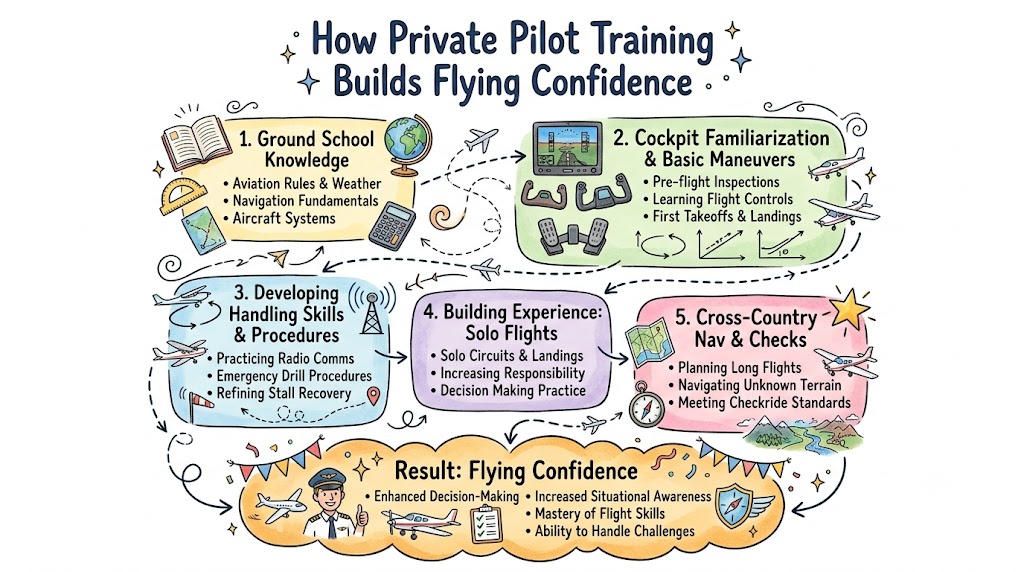
Private pilot training does not expect students to be perfect from day one. Instead, it introduces flying step by step—starting with basic understanding on the ground and gradually progressing to real flight operations. Over time, students build confidence through repetition, real-world practice, and safe learning environments. Each milestone, from the first takeoff to the first solo flight, strengthens a pilot’s belief in their abilities. This journey is not just about learning how to fly an aircraft, but about developing calm decision-making, awareness, and trust in one’s own skills.
Real-world Use Cases
A nervous beginner taking their first flight lesson may feel overwhelmed by cockpit controls but quickly gains confidence after understanding basic flight principles with an instructor.
A student preparing for their first solo flight gradually builds confidence through repeated practice of takeoffs, landings, and maneuvers under supervision.
A learner struggling with landings at the beginning improves through consistent correction and guidance, eventually landing smoothly and independently.
A career changer entering aviation builds confidence over time as structured training replaces uncertainty with skill.
A student practicing radio communication becomes more confident speaking with air traffic control after repeated exposure and correction.
A trainee learning emergency procedures develops calm decision-making skills that reduce fear during unexpected situations.
A beginner transitioning from simulator training to real aircraft gains confidence by applying familiar skills in real-world conditions.
Evaluation Criteria for Building Flying Confidence
To understand how training builds confidence, evaluate:
- Step-by-step progression in training
- Quality of instructor guidance
- Frequency of hands-on flight practice
- Exposure to real flight conditions
- Understanding of aircraft systems
- Communication training with ATC
- Error correction feedback quality
- Simulation and ground preparation
- Emergency procedure training
- Solo flight readiness milestones
- Decision-making development
- Safety awareness reinforcement
These factors directly shape how confident a student becomes as a pilot.
Step-by-Step Structured Learning Approach
Private pilot training introduces skills gradually, starting with simple concepts before moving to complex flying tasks.
For example, students first learn how an aircraft responds to control inputs before attempting full flight maneuvers. This structured approach reduces confusion and builds confidence at every stage.
Instructor-Led Guided Flight Training
Certified flight instructors play a key role in building student confidence by providing real-time feedback and corrections.
For example, a student who struggles with maintaining altitude receives immediate guidance, helping them improve during the same session instead of learning through guesswork.
Understanding Aircraft Controls and Systems
Learning how each control affects the aircraft helps students feel more in control and less intimidated.
For example, understanding how the yoke, throttle, and rudder work together makes flying feel logical rather than overwhelming.
Ground Practice and Simulator Training
Ground training and simulators help students prepare before flying a real aircraft.
For example, practicing navigation and emergency scenarios in a simulator builds familiarity before actual flight conditions.
First Takeoff and Landing Experience
The first takeoff and landing are major confidence milestones for every student pilot.
For example, after successfully completing a supervised landing, students often feel a significant boost in self-confidence.
Solo Flight Milestone Confidence Boost
The first solo flight is one of the most powerful confidence-building moments in pilot training.
For example, a student flying alone for the first time realizes they can safely operate the aircraft independently.
Mastery of Basic Flight Maneuvers
Repeated practice of turns, climbs, descents, and coordination builds muscle memory and control confidence.
For example, a student practicing coordinated turns becomes more comfortable handling the aircraft smoothly.
Learning Emergency Procedures Safely
Training includes emergency scenarios in controlled conditions, helping students stay calm under pressure.
For example, practicing simulated engine failure helps students respond confidently in real emergencies.
Weather Understanding and Decision-Making
Learning weather interpretation helps pilots make safe and confident flight decisions.
For example, a student who understands cloud formations and wind patterns feels more prepared to evaluate flight safety.
Communication with Air Traffic Control
Radio communication training builds confidence in interacting with ATC professionally.
For example, students practice standard phraseology until speaking with controllers becomes natural.
Cross-Country Flight Experience
Flying between airports builds navigation confidence and real-world flying experience.
For example, completing a solo cross-country flight helps students trust their planning and decision-making abilities.
Repetition and Skill Reinforcement
Confidence increases through repeated practice of key skills.
For example, performing multiple landings helps students eliminate hesitation and improve precision.
Pre-Flight Inspection Routine
Learning structured aircraft inspections builds responsibility and confidence before every flight.
For example, checking fuel, oil, and control surfaces becomes a habit that strengthens safety awareness.
Understanding Aircraft Performance
Knowing how aircraft behave under different conditions helps reduce fear and uncertainty.
For example, understanding how weight affects takeoff distance builds better flight planning confidence.
Progressive Responsibility in Training
Students gradually take more control as training progresses.
For example, instructors slowly reduce intervention, allowing students to build independence safely.
Error Correction in Real-Time Learning
Mistakes are corrected during training flights, helping students improve without fear.
For example, correcting a wrong approach during landing builds confidence through immediate learning.
Building Situational Awareness
Students learn to observe instruments, environment, and aircraft behavior together.
For example, monitoring altitude, airspeed, and surroundings helps build overall flight awareness.
Handling In-Flight Challenges
Training prepares students to remain calm during unexpected situations.
For example, handling turbulence during training helps students stay composed in real conditions.
Nervous Beginner vs Trained Pilot Mindset
| Factor | Nervous Beginner | Trained Pilot |
|---|---|---|
| Confidence | Low | High |
| Decision-making | Hesitant | Clear |
| Control Handling | Uncertain | Smooth |
| Stress Level | High | Managed |
| Awareness | Limited | Strong |
Simulator Confidence vs Real Flight Confidence
| Factor | Simulator Training | Real Flight Training |
| Confidence Building | Foundational | Practical |
| Stress Level | Low | Moderate at first |
| Skill Transfer | Partial | Complete |
| Experience Value | Introductory | Real-world |
Early Training vs Advanced Training
| Factor | Early Stage | Advanced Stage |
| Confidence | Developing | Strong |
| Skills | Basic | Refined |
| Independence | Low | High |
| Decision-making | Guided | Independent |
Instructor-Assisted vs Solo Flying Confidence
| Factor | Instructor-Assisted | Solo Flight |
| Confidence Level | Supported | Independent |
| Responsibility | Shared | Full |
| Stress Level | Lower | Higher initially |
| Skill Growth | Guided | Accelerated |
Benefits of Private Pilot Training for Confidence
Private pilot training helps learners:
- Overcome fear of flying
- Build real flight experience
- Improve decision-making skills
- Strengthen safety awareness
- Develop communication skills
- Gain independence in the cockpit
- Improve focus and discipline
- Build long-term aviation confidence
- Prepare for solo flight success
- Learn structured aviation thinking
Practical Tips to Build Flying Confidence
- Practice regularly with consistency
- Ask instructors questions without hesitation
- Focus on small improvements each flight
- Review mistakes constructively
- Use simulator training effectively
- Stay calm during early challenges
- Learn procedures step-by-step
- Track personal progress milestones
Common Mistakes to Avoid
- Rushing through training stages
- Ignoring instructor feedback
- Avoiding challenging maneuvers
- Inconsistent practice schedule
- Overthinking cockpit controls
- Losing confidence after small mistakes
FAQs
1. How does private pilot training build confidence?
It builds confidence through structured lessons, real flight practice, instructor guidance, and gradual skill development.
2. Is it normal to feel nervous during training?
Yes, most beginners feel nervous initially, but confidence improves with practice and experience.
3. What is the most confidence-building milestone?
The first solo flight is often the biggest confidence boost for student pilots.
4. How do instructors help build confidence?
Instructors provide feedback, corrections, and support during every stage of training.
5. Do simulators help with confidence?
Yes, simulators help students understand controls and procedures before real flight.
6. Why are landings difficult for beginners?
Landings require coordination and timing, which improve with repetition and practice.
7. How long does it take to feel confident?
Confidence builds gradually over time with consistent training and practice.
8. Can mistakes reduce confidence?
Mistakes are part of learning and actually help improve skills when corrected properly.
9. Is radio communication difficult?
It feels difficult at first, but becomes easier with practice and repetition.
10. What is the best way to stay confident?
Stay consistent, follow instructor guidance, and focus on gradual improvement.
Conclusion
Private pilot training builds flying confidence by guiding students through a structured, step-by-step learning process that transforms uncertainty into skill. With instructor support, real flight experience, simulator practice, and repeated exposure to aviation challenges, students gradually develop trust in their abilities. Each milestone—from basic maneuvers to solo flight—strengthens confidence and independence. Over time, nervous beginners evolve into capable pilots who can make calm, informed decisions in the cockpit. This confidence is not instant but built through experience, discipline, and continuous learning, making private pilot training a powerful foundation for lifelong aviation skills.

