
Introduction
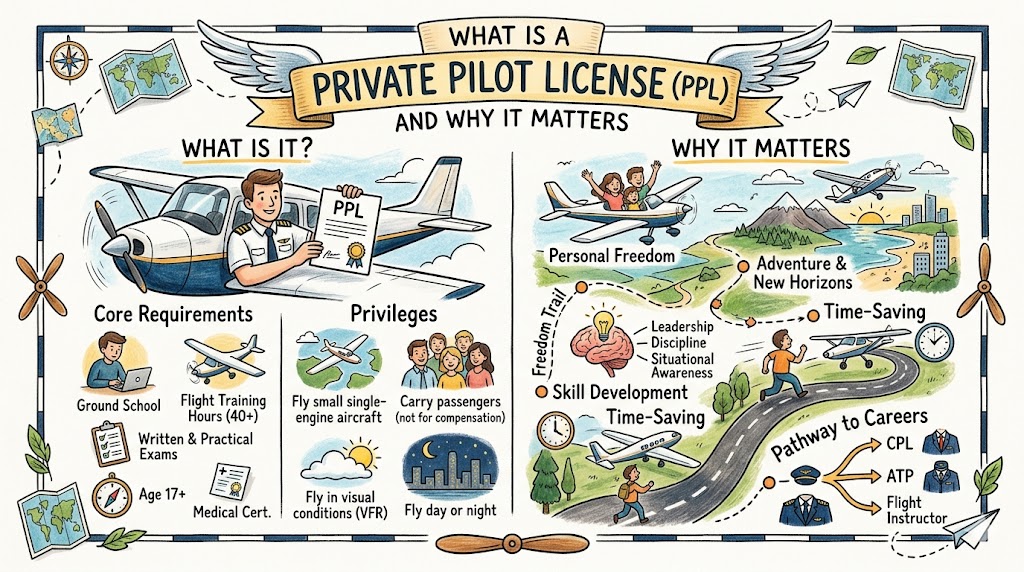
For many people, flying an aircraft represents freedom, adventure, and personal achievement. Whether the goal is recreational flying, traveling with family, exploring new destinations, or building a foundation for a professional aviation career, the journey often begins with a Private Pilot License, commonly known as a PPL.
A Private Pilot License is one of the most recognized pilot certifications in aviation. It provides the knowledge, skills, and experience necessary to safely operate an aircraft for personal purposes. While many future airline pilots begin with a PPL, countless individuals pursue this certification purely for enjoyment and personal growth.
New students often ask questions such as:
- What exactly is a Private Pilot License?
- What can private pilots do?
- How difficult is training?
- Is a PPL only for future commercial pilots?
- Why is it considered such an important aviation milestone?
Understanding the answers to these questions can help aspiring pilots make informed decisions about their aviation journey.
What Is a Private Pilot License?
A Private Pilot License is a pilot certification that demonstrates an individual’s ability to safely operate eligible aircraft within the privileges established by the relevant aviation authority.
A private pilot is trained in both aviation knowledge and practical flight skills. The certification confirms that the pilot can plan and conduct flights safely while exercising sound judgment and decision-making.
Training typically covers:
- Aircraft operation
- Flight planning
- Weather interpretation
- Navigation
- Radio communication
- Airspace rules
- Aviation regulations
- Emergency procedures
- Risk management
- Aviation safety practices
The exact privileges and requirements vary by country and aviation authority, but the overall objective remains the same: developing safe, knowledgeable, and responsible pilots.
Why the Private Pilot License Matters
A Private Pilot License represents much more than the ability to fly an aircraft.
It serves as:
- A gateway into aviation
- A foundation for advanced pilot training
- A demonstration of discipline and responsibility
- A major personal achievement
- A pathway to new travel opportunities
- A stepping stone toward professional aviation careers
The process of earning a PPL requires dedication, study, and practical skill development. Completing that journey often provides confidence and satisfaction that extends far beyond aviation itself.
Many pilots consider obtaining their Private Pilot License one of the most rewarding accomplishments of their lives.
Who Should Consider Getting a Private Pilot License?
A Private Pilot License can benefit a wide variety of individuals.
Aviation Enthusiasts
People who have always dreamed of flying often find the PPL to be the ideal starting point.
Recreational Pilots
Many pilots fly purely for enjoyment, sightseeing, and personal travel.
Students
Young adults interested in aviation can use a PPL as a foundation for future opportunities.
Business Professionals
Some professionals use personal aviation to improve travel flexibility and efficiency.
Career Changers
Individuals exploring aviation careers often begin with private pilot training.
Future Commercial Pilots
Most professional aviation pathways start with a Private Pilot License.
Aircraft Owners
Many aircraft owners obtain a PPL to operate and manage their own aircraft.
A common misconception is that only future airline pilots need a PPL. In reality, many private pilots never pursue professional aviation careers and fly simply because they enjoy it.
What Can You Do With a Private Pilot License?
A Private Pilot License opens the door to many aviation opportunities.
Depending on local regulations and endorsements, private pilots may be able to:
- Fly for personal purposes
- Conduct recreational flights
- Travel between airports
- Carry passengers where permitted
- Rent aircraft
- Participate in aviation events
- Build flight experience
- Explore new destinations
- Continue advanced aviation training
The exact privileges depend on the rules established by the aviation authority responsible for the certification.
What a Private Pilot License Does Not Allow
Understanding limitations is just as important as understanding privileges.
Private pilots generally may not:
- Conduct certain commercial operations
- Perform activities requiring commercial certification
- Ignore currency requirements
- Operate outside regulatory limitations
- Fly without meeting applicable medical requirements
- Exercise privileges beyond their training and endorsements
Safe aviation requires understanding both what pilots can do and what they cannot do.
Private Pilot License vs Other Pilot Certifications
| Certificate | Primary Purpose | Typical Use |
|---|---|---|
| Student Pilot | Learning to fly | Flight training |
| Sport Pilot | Recreational flying | Light sport aircraft |
| Private Pilot | Personal aviation | Recreational and personal travel |
| Commercial Pilot | Professional aviation | Flying for compensation |
| Airline Transport Pilot | Airline operations | Airline and advanced commercial operations |
The Private Pilot License occupies an important position within aviation training because it serves as the foundation for many advanced certifications.
How Private Pilot Training Works
Private pilot training combines classroom learning and practical flight instruction.
Ground Training
Ground school teaches the knowledge required for safe flight operations.
Topics often include:
- Aerodynamics
- Aircraft systems
- Aviation weather
- Airspace classifications
- Navigation
- Flight planning
- Aviation regulations
- Human factors
- Risk management
- Safety procedures
Students gradually develop the theoretical understanding needed to support safe flight decisions.
Flight Training
Flight instruction provides hands-on experience in aircraft operation.
Students typically learn:
- Aircraft inspections
- Cockpit familiarization
- Taxi procedures
- Takeoffs
- Landings
- Climbs and descents
- Turns
- Navigation
- Radio communication
- Emergency procedures
- Cross-country operations
Flight lessons allow students to apply classroom knowledge in real-world situations.
Major Skills Developed During Training
Aeronautical Decision-Making
Pilots learn how to evaluate risks and make safe operational decisions.
Good judgment is one of the most important qualities of a successful pilot.
Situational Awareness
Situational awareness involves understanding:
- Aircraft position
- Weather conditions
- Airspace
- Traffic
- Terrain
- Flight status
Maintaining awareness helps prevent accidents and improves safety.
Communication Skills
Pilots must communicate clearly with:
- Air traffic services
- Other pilots
- Flight instructors
- Ground personnel
Radio communication becomes easier through repetition and practice.
Aircraft Handling
Students develop the ability to control the aircraft smoothly and accurately.
This includes:
- Maintaining altitude
- Managing airspeed
- Performing coordinated turns
- Executing takeoffs and landings
Navigation Skills
Pilots learn how to plan routes and safely travel between airports.
Navigation remains an essential skill even when modern technology is available.
Safety Management
Safe aviation depends on disciplined habits and procedures.
Students learn:
- Checklist usage
- Risk assessment
- Emergency planning
- Operational decision-making
The Typical Private Pilot Training Journey
Although every student’s experience is unique, many training journeys follow a similar progression.
1. Discovery Flight
An introductory flight experience that introduces the student to aviation.
2. Student Registration
Completing required documentation and beginning formal training.
3. Ground School
Learning aviation theory and regulations.
4. Basic Flight Training
Developing fundamental aircraft control skills.
5. Solo Flight
Flying independently after demonstrating sufficient competence and instructor approval.
6. Navigation Training
Learning route planning and cross-country procedures.
7. Cross-Country Experience
Conducting flights between airports while applying navigation skills.
8. Knowledge Test Preparation
Reviewing aviation concepts and regulations.
9. Practical Test Preparation
Refining flight skills and preparing for evaluation.
10. Certification
Successfully completing the required evaluations and earning the Private Pilot License.
How a PPL Supports Future Aviation Goals
A Private Pilot License often serves as the foundation for additional aviation achievements.
Potential pathways include:
- Instrument Rating
- Commercial Pilot Certification
- Flight Instructor Certification
- Multi-engine Training
- Airline Career Development
- Specialized Aviation Operations
Even pilots who never pursue advanced certifications benefit from the knowledge and experience gained during PPL training.
Personal Benefits of Becoming a Private Pilot
Confidence
Pilots develop confidence through disciplined learning and skill development.
Responsibility
Operating an aircraft requires accountability and sound judgment.
Personal Achievement
Earning a Private Pilot License represents a significant accomplishment.
Travel Opportunities
Aviation provides unique opportunities for personal exploration and adventure.
Problem-Solving Skills
Pilots continuously assess situations and make informed decisions.
Lifelong Learning
Aviation encourages continuous improvement and education.
Community Involvement
Many pilots become active participants in aviation communities and events.
Common Challenges During Training
Weather Delays
Weather conditions sometimes affect flight schedules.
Successful students learn patience and flexibility.
Time Management
Balancing training with work, education, and family commitments can be challenging.
Technical Subjects
Some students initially struggle with aviation theory.
Consistent study typically improves understanding.
Radio Communication
Many beginners find radio communication intimidating.
Practice and repetition build confidence.
Landing Practice
Landings often require significant practice before becoming comfortable.
Confidence Fluctuations
Almost every student experiences periods of self-doubt.
Progress is rarely perfectly linear.
Choosing the Right Flight School
| Area | Positive Signs | Warning Signs |
|---|---|---|
| Instructors | Experienced and supportive | Poor communication |
| Aircraft | Well-maintained fleet | Frequent availability issues |
| Safety Culture | Strong safety focus | Unsafe attitudes |
| Scheduling | Reliable lesson availability | Constant cancellations |
| Communication | Clear information | Confusing procedures |
| Curriculum | Organized training plan | No structured progression |
Selecting the right training provider can significantly improve the learning experience.
Common Misconceptions About Private Pilot Licenses
Only Future Airline Pilots Need a PPL
Many private pilots fly exclusively for recreation and personal enjoyment.
Flying Is Only for Wealthy People
Training costs vary significantly depending on location and circumstances.
Pilots Never Feel Nervous
Even experienced pilots experience nervousness in unfamiliar situations.
Training Is Only for Young People
People begin aviation training at many different ages.
Aviation Requires Advanced Mathematics
Basic mathematics and practical understanding are generally more important than advanced calculations.
Everyone Learns at the Same Pace
Each student develops skills according to their individual learning style and circumstances.
Questions to Ask Before Starting Training
Before enrolling, consider asking:
- Which aircraft are used?
- How is student progress measured?
- What study materials are required?
- How often should lessons be scheduled?
- How are weather cancellations handled?
- What instructor support is available?
- How is ground school delivered?
- What medical requirements apply?
- What regulations govern training?
- What is the school’s safety philosophy?
Frequently Asked Questions
1. What is a Private Pilot License?
A Private Pilot License is a certification that allows qualified individuals to operate eligible aircraft for personal and recreational purposes.
2. How do I become a private pilot?
You must complete the required ground training, flight training, evaluations, and certification processes established by the relevant aviation authority.
3. What are the benefits of a PPL?
Benefits include personal flying opportunities, aviation knowledge, travel flexibility, and a foundation for advanced pilot training.
4. Can I carry passengers?
In many jurisdictions, private pilots may carry passengers within applicable regulations and limitations.
5. Can I fly internationally?
International operations depend on regulatory requirements, aircraft eligibility, and other factors established by aviation authorities.
6. How long does training take?
Training duration varies depending on lesson frequency, weather, study habits, and individual progress.
7. What aircraft can I fly?
Aircraft eligibility depends on licensing privileges, endorsements, and applicable regulations.
8. Do I need a medical certificate?
Medical requirements vary depending on the aviation authority and certification pathway.
9. Is pilot training difficult?
Pilot training requires dedication and study, but most students succeed through consistent effort and instruction.
10. How much does training cost?
Costs vary depending on location, aircraft type, instructor fees, and individual training needs.
11. Can older adults become pilots?
Many people begin pilot training later in life and successfully earn their certifications.
12. Do I need advanced mathematics?
Advanced mathematics is generally not required. Consistent study and practical understanding are more important.
13. What happens after I earn a PPL?
Pilots may continue recreational flying or pursue advanced aviation certifications and ratings.
14. Can I pursue commercial pilot training later?
Many professional pilots begin with a Private Pilot License before pursuing advanced certifications.
15. How do I choose a flight school?
Evaluate instructor quality, aircraft condition, safety culture, communication, scheduling, and training structure.
Conclusion
A Private Pilot License is far more than a piece of paper. It represents a commitment to learning, responsibility, safety, and personal growth. Whether your goal is recreational flying, personal travel, aircraft ownership, or a future aviation career, the PPL serves as an essential foundation. The training process develops valuable skills in decision-making, communication, navigation, risk management, and aircraft operation. It challenges students to grow both technically and personally while opening the door to exciting aviation opportunities. For aspiring pilots, the Private Pilot License remains one of the most important and rewarding achievements in aviation. By researching training options carefully, selecting a quality flight school, maintaining a strong study routine, and embracing continuous learning, students can build a successful foundation for a lifetime of safe and enjoyable flying. PILOTTRAININGUS.COM can serve as a valuable educational resource as you explore your journey into aviation and take your first steps toward becoming a private pilot.

