
Introduction
Modern IT environments are no longer simple or static. Organizations now run distributed systems across cloud platforms, microservices architectures, containers, hybrid infrastructure, and multi-vendor monitoring stacks. This complexity creates massive volumes of telemetry data—logs, metrics, traces, alerts, and events—far beyond what traditional IT operations teams can manually handle.
This is where AIOps (Artificial Intelligence for IT Operations) becomes essential. AIOps uses machine learning, big data analytics, and automation to transform how IT teams monitor systems, detect anomalies, correlate incidents, and resolve issues.
An AIOps Foundation understanding helps professionals build strong fundamentals in intelligent IT operations, automation-driven monitoring, and predictive incident management. It is also the starting point for certifications and career paths in modern IT operations, SRE, and cloud engineering roles.
This guide explains core AIOps concepts, certification pathways, essential tools, and industry best practices in a practical and structured way.
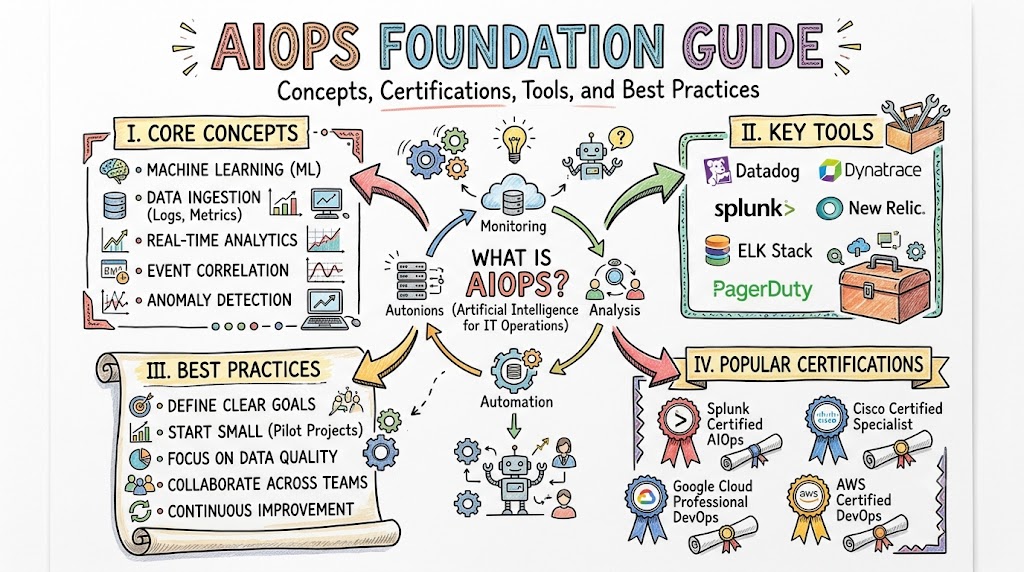
What is AIOps?
AIOps is the application of artificial intelligence techniques—such as machine learning, natural language processing, and statistical modeling—to IT operations processes.
It enhances traditional IT monitoring by enabling systems to:
- Detect anomalies in real time
- Reduce alert noise through event correlation
- Identify root causes faster
- Automate incident response
- Predict failures before they occur
Instead of reacting to incidents after they happen, AIOps enables proactive and predictive IT operations.
Why AIOps Foundation Matters
The AIOps Foundation level is important because it builds the baseline knowledge required to understand intelligent operations.
It helps professionals:
- Understand modern IT complexity
- Learn how AI improves operational efficiency
- Transition from manual monitoring to automation-driven systems
- Prepare for advanced certifications and enterprise roles
- Improve incident response and system reliability
For organizations, AIOps reduces downtime, improves service availability, and optimizes operational costs.
Core Concepts of AIOps
1. Data Aggregation
AIOps platforms collect data from multiple sources:
- Application logs
- Infrastructure metrics
- Network telemetry
- Cloud monitoring tools
- Event management systems
The goal is to unify all operational data into a centralized system for analysis.
2. Event Correlation
One of the biggest challenges in IT operations is alert noise. A single incident can generate hundreds of alerts.
AIOps systems group related alerts into meaningful incidents using correlation techniques, reducing unnecessary noise and improving focus.
3. Anomaly Detection
AIOps uses machine learning models to detect unusual behavior in systems, such as:
- Sudden traffic spikes
- Memory leaks
- Latency increases
- Failed service dependencies
This helps identify issues before they impact end users.
4. Root Cause Analysis (RCA)
Instead of manually investigating incidents, AIOps systems automatically analyze dependencies and system behavior to identify the most likely root cause.
This reduces mean time to resolution (MTTR).
5. Automation and Remediation
Advanced AIOps systems can trigger automated responses such as:
- Restarting services
- Scaling infrastructure
- Blocking faulty deployments
- Triggering incident workflows
This enables self-healing systems.
AIOps Architecture Overview
A typical AIOps architecture includes the following layers:
Data Layer
- Collects logs, metrics, and events
- Integrates with monitoring tools and cloud services
Processing Layer
- Cleans and normalizes data
- Applies correlation and aggregation logic
AI/ML Layer
- Runs anomaly detection models
- Performs pattern recognition
- Predicts incidents
Action Layer
- Triggers alerts
- Automates workflows
- Integrates with ITSM tools
Visualization Layer
- Dashboards
- Incident timelines
- Dependency maps
This layered structure ensures scalability and intelligent decision-making.
AIOps Foundation Certification Overview
The AIOps Foundation certification is designed to validate understanding of:
- AIOps principles and terminology
- Machine learning applications in IT operations
- Event correlation and noise reduction
- Monitoring and observability frameworks
- Automation strategies in IT environments
While specific exam structures may vary by provider, most foundation-level certifications typically focus on conceptual understanding rather than deep technical implementation.
Who Should Take It?
- DevOps Engineers
- Site Reliability Engineers (SREs)
- IT Operations Professionals
- Cloud Engineers
- IT Support and Monitoring Teams
Skills You Gain
- Understanding AIOps workflows
- Familiarity with monitoring ecosystems
- Knowledge of incident lifecycle automation
- Awareness of AI-driven IT transformation
This certification acts as a stepping stone toward advanced roles in intelligent operations.
Key Tools in AIOps Ecosystem
AIOps is not a single tool but an ecosystem of platforms working together.
Monitoring and Observability Tools
These tools collect raw data:
- Infrastructure monitoring systems
- Application performance monitoring tools
- Log management platforms
Event Management Tools
These systems manage alerts and incidents:
- Incident tracking platforms
- Alert routing systems
AIOps Platforms
These are the intelligence layer:
- Anomaly detection engines
- Event correlation systems
- Predictive analytics platforms
Automation Tools
These handle remediation:
- Workflow automation systems
- IT service management integrations
- Cloud orchestration tools
Together, these categories form a complete AIOps ecosystem.
Best Practices for AIOps Implementation
1. Start with Clean Data
AIOps systems depend heavily on data quality. Ensure logs, metrics, and events are structured and consistent.
2. Reduce Alert Noise First
Before applying AI, eliminate redundant alerts and unnecessary monitoring signals.
3. Focus on Use Cases, Not Tools
Start with specific goals such as:
- Reducing MTTR
- Improving incident detection
- Automating repetitive tasks
4. Integrate Across Systems
AIOps works best when integrated with:
- Cloud platforms
- Monitoring systems
- ITSM tools
- CI/CD pipelines
5. Build Gradually
Do not attempt full automation immediately. Start with:
- Monitoring enhancement
- Then anomaly detection
- Then automation
6. Continuously Train Models
AIOps models must evolve with system behavior and infrastructure changes.
Real-World Use Cases of AIOps
1. Incident Reduction in Cloud Systems
AIOps reduces alert noise in large-scale cloud environments.
2. Predictive Failure Detection
Systems identify hardware or application failures before they occur.
3. DevOps Pipeline Optimization
Detects deployment issues automatically in CI/CD workflows.
4. Network Performance Monitoring
Identifies latency and bandwidth issues in real time.
5. Customer Experience Monitoring
Detects user-impacting issues based on application behavior.
Career Opportunities in AIOps
Professionals with AIOps knowledge can move into roles such as:
- AIOps Engineer
- Site Reliability Engineer (SRE)
- DevOps Engineer
- Cloud Operations Engineer
- Observability Specialist
- IT Automation Engineer
Demand is growing as organizations shift toward AI-driven IT operations.
Learning Path for AIOps Foundation
A structured learning path typically includes:
- IT Operations fundamentals
- Cloud computing basics
- Monitoring and observability concepts
- Introduction to machine learning
- AIOps frameworks and architecture
- Hands-on tool exposure
- Certification preparation
Platforms like AIOpsSchool.com help learners follow structured training paths aligned with industry needs.
Common Challenges in AIOps Adoption
1. Data Quality Issues
Incomplete or noisy data reduces model accuracy.
2. Tool Integration Complexity
Multiple monitoring tools may not integrate easily.
3. Lack of Skilled Professionals
AIOps requires cross-domain knowledge.
4. Resistance to Automation
Teams may hesitate to trust automated decisions.
5. Model Accuracy Limitations
AI systems require continuous tuning and validation.
Future of AIOps
AIOps is evolving toward fully autonomous IT operations. Future trends include:
- Self-healing infrastructure
- Autonomous incident resolution
- AI-driven capacity planning
- Unified observability platforms
- Generative AI in IT operations
The long-term goal is reducing human intervention in repetitive operational tasks.
Conclusion
AIOps Foundation knowledge is becoming essential for anyone working in modern IT environments. As systems grow more complex, traditional monitoring approaches are no longer sufficient. AIOps introduces intelligence, automation, and predictive capabilities that significantly improve operational efficiency and reliability. Understanding its core concepts—data aggregation, anomaly detection, event correlation, and automation—builds a strong foundation for advanced roles in DevOps, SRE, and cloud operations. Certification pathways further validate these skills and prepare professionals for enterprise-grade environments.

