
Introduction
Pilot training in the USA attracts students from many backgrounds because it offers a structured pathway into aviation. Some students want to become airline pilots, some want to fly privately, and others begin training simply because they love aircraft and flying. However, many beginners delay their aviation journey because they believe common myths about cost, age, medical requirements, academic difficulty, or career opportunities.
These myths can make pilot training seem more confusing or less accessible than it really is. While learning to fly does require discipline, money, time, and consistent effort, it is not limited to one type of student. People from different educational, professional, and personal backgrounds can begin flight training if they meet the required standards and choose the right training path. Understanding the truth behind these myths helps aspiring pilots make better decisions, compare flight schools more carefully, and begin training with realistic expectations.
Real-world Use Cases
A college student may want to start private pilot training while studying and later continue toward commercial pilot training. A working professional may consider aviation as a career change but worry about age, cost, and training time. A parent may research flight school USA options to understand whether pilot training is realistic for their child.
An international student may explore FAA pilot training because the USA has many aviation schools, training environments, and structured programs. A part-time learner may want to train while working full-time but may fear they cannot complete the process. These situations show why separating myth from reality is important before enrolling in any flight training program.
Evaluation Criteria for Understanding Pilot Training Myths
Before believing or rejecting any claim about pilot training, students should evaluate:
- FAA pilot training requirements
- Flight school structure and training quality
- Realistic cost estimates
- Medical certificate requirements
- Instructor experience
- Aircraft availability
- Ground school support
- Written exam preparation
- Student scheduling flexibility
- Long-term career goals
- Flight hour-building pathway
- Personal commitment and consistency
Good information helps students avoid fear-based decisions and choose a training path that matches their goals.
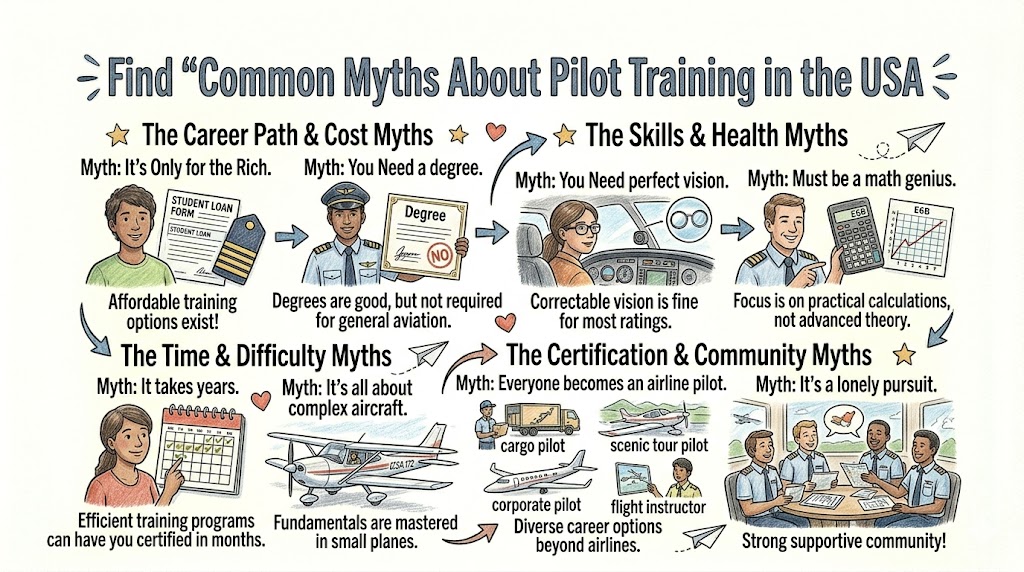
Myth 1- Pilot Training Is Only for Rich Students
One of the most common pilot training myths is that only wealthy students can afford flight training. This belief stops many serious students before they even speak with a flight school.
The reality is that pilot training is a major investment, but students can plan it in stages. Some begin with a Private Pilot License, then continue toward advanced ratings later. Others explore financing options, scholarships, part-time training, or modular programs. A parent researching pilot training cost should ask for a complete cost estimate instead of assuming it is impossible.
Myth 2- You Must Be Excellent at Math and Science
Many beginners think they must be naturally strong in advanced math or science to become a pilot. This can discourage students who are interested in aviation but not confident academically.
The reality is that pilots need practical math and clear thinking, not advanced academic brilliance. Students learn fuel planning, speed, distance, weather basics, navigation, and aircraft performance step by step. A college student who is average in math can still succeed with consistent study and instructor support.
Myth 3- You Need Perfect Eyesight
Some students believe they cannot become pilots if they wear glasses or contact lenses. This myth is especially common among beginners who have not yet learned about aviation medical standards.
The reality is that many pilots fly with corrected vision. The important factor is meeting the required medical standard, not having naturally perfect eyesight. A beginner worried about vision should complete the appropriate aviation medical exam early before making major training decisions.
Myth 4- Only Young Students Can Become Pilots
Many working professionals believe they are too late to begin pilot training. This myth can prevent motivated adults from exploring aviation as a second career or serious personal goal.
The reality is that students can begin training at different life stages. A career changer may need stronger financial planning and time management, but age alone does not automatically prevent someone from learning to fly. The key is understanding medical eligibility, training goals, and realistic timelines.
Myth 5- Pilot Training Is Too Difficult for Beginners
Some people assume pilot training is only for people with previous aviation experience. They imagine flight school as too technical, too fast, or too difficult for a complete beginner.
The reality is that pilot training is designed to build skills gradually. Students start with basic aircraft knowledge, ground school, simple maneuvers, communication practice, and instructor-led flights. A beginner does not need to know everything on day one; they need patience, preparation, and consistent practice.
Myth 6- You Must Have a Military Background
Another common myth is that pilots must come from military aviation. While military training is one respected pathway, it is not the only route.
The reality is that many pilots train through civilian flight schools, university aviation programs, independent instructors, and structured FAA pilot training programs. A student who has never been in the military can still pursue private pilot training, commercial pilot training, and advanced ratings through civilian aviation training.
Myth 7- A Pilot License Guarantees an Airline Job Immediately
Some students believe that once they earn a pilot license, they will automatically receive an airline job. This creates unrealistic expectations and confusion about the aviation career path.
The reality is that a license is one step in a longer journey. Airline careers usually require additional ratings, flight hours, experience, interview preparation, and professional development. A student pilot guide should clearly explain that the path from first lesson to airline cockpit involves multiple training stages.
Myth 8- All Flight Schools Are the Same
Many beginners think any flight school USA option will provide the same training experience. This can lead to poor school selection and unnecessary frustration.
The reality is that flight schools vary widely in aircraft availability, instructor quality, safety culture, scheduling, maintenance standards, cost transparency, and student support. A student should compare schools carefully before enrolling instead of choosing only the nearest or cheapest option.
Myth 9- Bad Weather Means Training Stops Completely
Weather can affect flight lessons, and some students assume poor weather means pilot training stops entirely. This creates concern about delays and wasted time.
The reality is that weather may delay actual flying, but training can continue through ground school, simulator sessions, flight planning, weather analysis, and exam preparation. A part-time learner can use non-flying days productively to strengthen aviation knowledge.
Myth 10- FAA Exams Are Impossible to Pass
FAA exams may sound intimidating to beginners, especially students who are new to aviation terminology and regulations. Some assume the written exam or checkride is nearly impossible.
The reality is that FAA exams are challenging but manageable with preparation. Ground school, instructor guidance, practice questions, mock oral reviews, and steady study habits help students prepare. A motivated student who studies consistently can build confidence before the written exam and practical test.
Myth 11- You Need to Buy Your Own Aircraft
Some beginners assume they must own an aircraft before starting flight training. This myth can make training seem far more expensive than necessary.
The reality is that most students train using flight school aircraft. Aircraft rental is usually part of the training cost structure. A beginner can learn to fly without purchasing a plane, which makes entry into aviation more practical for many students.
Myth 12- Part-Time Students Cannot Complete Pilot Training
Many students want to train while working, studying, or managing family responsibilities. They may worry that part-time training is not realistic.
The reality is that part-time students can complete pilot training if they stay consistent and organized. Training may take longer, but regular lessons, steady study, and clear scheduling can keep progress moving. A working professional can succeed by planning weekly training time and avoiding long gaps between lessons.
Myth 13- International Students Cannot Train in the USA
Some international students believe pilot training in the USA is only for US citizens or residents. This misunderstanding can stop them from exploring available training options.
The reality is that many international students train in the USA through approved processes and flight schools that support international learners. Requirements can include documentation, visa considerations, security procedures, and school-specific admission steps. International students should speak with flight schools early to understand the process clearly.
Myth 14- Pilot Training Takes the Same Time for Everyone
Some students expect a fixed training timeline and become discouraged if their progress differs from someone else’s. This myth creates unnecessary pressure.
The reality is that training time depends on weather, aircraft availability, instructor scheduling, student preparation, lesson frequency, learning style, and personal confidence. Two students may start at the same time but finish at different times. Progress should be measured by safety and readiness, not comparison.
Benefits of Understanding the Truth About Pilot Training
Understanding pilot training myths helps students:
- Make better enrollment decisions
- Reduce fear and confusion
- Plan finances realistically
- Choose the right flight school
- Prepare better for exams
- Stay motivated during training
- Avoid unrealistic expectations
- Build a stronger aviation career path
- Communicate better with instructors
- Stay focused on safety and progress
Accurate information gives students confidence and helps them approach aviation training with a practical mindset.
Myth-Based Decisions vs Fact-Based Decisions
| Factor | Myth-Based Decision | Fact-Based Decision |
|---|---|---|
| Training Confidence | Student feels discouraged before starting | Student understands the real pathway |
| Cost Planning | Cost is assumed to be impossible | Costs are researched and planned |
| Flight School Selection | School is chosen randomly or only by price | School is compared by quality and support |
| Exam Preparation | FAA exams feel intimidating | Exams are approached with a study plan |
| Career Expectations | Student expects instant airline placement | Student understands step-by-step progress |
| Motivation | Myths create fear and delay | Facts create confidence and action |
| Long-Term Progress | Training may be avoided or rushed | Training is planned realistically |
Practical Tips for Aspiring Pilots
Verify Facts Before Enrolling
Do not rely only on online opinions or casual advice. Speak directly with flight schools, instructors, and aviation professionals to understand the real requirements.
Compare Flight Schools Carefully
Look at instructor availability, aircraft condition, safety culture, student support, scheduling flexibility, and cost transparency. The right school can make training smoother and more efficient.
Understand FAA Training Requirements
Learn the basic requirements for your training path before starting. Understanding medical certificates, ground school, flight hours, written exams, and checkrides helps reduce confusion.
Prepare Early for Ground School
Ground school is not something to delay until the end. Studying early helps students understand flight lessons better and prepare for the FAA written exam with more confidence.
Plan Pilot Training Costs Realistically
Ask for a full cost estimate that includes aircraft rental, instructor fees, ground school, books, supplies, exams, medical checks, and possible extra practice time.
Stay Consistent During Flight Training
Consistency is one of the biggest success factors. Flying regularly helps students retain skills, reduce review time, and build confidence faster.
Avoid Unrealistic Expectations
Pilot training is rewarding, but it is not instant. Expect challenges, weather delays, exam preparation, and gradual skill development. A realistic mindset helps students stay motivated.
Ask Questions Without Hesitation
Good students ask questions. If you do not understand a maneuver, rule, weather topic, or aircraft system, ask your instructor for clarification.
How Pilot Training Really Works in Simple Terms
Pilot training usually combines three main areas: ground knowledge, flight skills, and decision-making. Ground knowledge helps students understand aviation rules, weather, navigation, aircraft systems, and safety procedures. Flight skills help students control the aircraft, communicate, navigate, take off, land, and handle emergencies.
Decision-making connects everything together. A safe pilot must know when to fly, when to wait, how to evaluate risk, and how to make calm choices in changing conditions. This is why aviation training focuses on both technical skill and responsible judgment.
Why Myths Can Hurt Student Progress
Myths create unnecessary fear. A student may delay training because they think they are too old, not rich enough, not strong enough in math, or not from the right background. These assumptions can stop capable people from exploring aviation.
Myths can also create unrealistic expectations. Some students may think training is easy, fast, or guarantees immediate employment. When reality is different, they may feel disappointed. The best approach is to begin with accurate information, practical planning, and a willingness to learn step by step.
FAQs
1- Is pilot training in the USA very expensive?
Pilot training can be a significant investment, but costs vary by school, aircraft type, location, and training pace. Students can plan training in stages, compare schools, and ask about financing or payment options.
2- Is there an age limit to start pilot training?
Students can begin aviation training at different ages depending on the license or certificate goal. Many adults and career changers successfully start training later in life with proper planning and medical eligibility.
3- Do I need perfect health to become a pilot?
You do not need to be perfect, but you must meet the medical standards required for your training path. A medical exam early in the process helps students understand their eligibility before investing heavily.
4- Do pilots need to be very good at math?
Pilots need practical math skills for fuel, distance, speed, navigation, and aircraft performance. Advanced math is not usually required for beginner flight training, and these skills are taught during training.
5- Are FAA exams hard to pass?
FAA exams require preparation, but they are manageable with good ground school, consistent study, practice tests, and instructor guidance. Students who prepare properly can approach exams with confidence.
6- How do I choose the right flight school?
Compare flight schools based on safety culture, instructor quality, aircraft availability, scheduling, cost transparency, maintenance standards, and student support. Avoid choosing only by price.
7- Can I complete pilot training part-time?
Yes, part-time students can complete pilot training if they remain consistent. Training may take longer, but regular lessons and steady study help maintain progress.
8- Can international students train in the USA?
Yes, many international students train in the USA through proper documentation and approved school processes. They should contact flight schools early to understand requirements and timelines.
9- Does a pilot license guarantee an airline job?
No, a license alone does not guarantee an airline job. Professional aviation usually requires additional ratings, flight hours, experience, and career development before airline opportunities.
10- What mistakes do beginners commonly make?
Common mistakes include choosing a school without research, underestimating costs, delaying ground school, flying inconsistently, ignoring medical requirements, and expecting instant career results.
Conclusion
Pilot training in the USA is often surrounded by myths that make the journey seem more difficult, expensive, or limited than it really is. While becoming a pilot requires commitment, discipline, planning, and steady learning, it is not reserved only for rich students, young people, military backgrounds, or academic experts. Beginners should focus on accurate information, realistic cost planning, medical readiness, school selection, and consistent training habits. The right flight school and instructor support can make the journey clearer and more manageable. By replacing myths with facts, aspiring pilots can begin aviation training with confidence and take meaningful steps toward their flying goals.

