
Introduction
Becoming an airline pilot requires much more than learning how to take off, fly, and land an aircraft. Airlines need pilots who can manage complex situations, communicate clearly, follow procedures, work with a crew, and make safe decisions under pressure.
Commercial pilot training is an important stage in this journey. It helps students move beyond basic recreational flying and begin developing the accuracy, discipline, technical knowledge, and professional attitude expected in paid aviation work.
However, earning a commercial pilot certificate does not automatically lead to an airline cockpit. Future airline pilots normally need additional ratings, multi-engine experience, flight-hour building, medical eligibility, advanced training, and successful airline selection.
What Is Commercial Pilot Training?
Commercial pilot training prepares a pilot to exercise the privileges of a commercial pilot certificate within the limits of aviation regulations.
The training develops more advanced skills than private pilot training. Students learn to control an aircraft smoothly and accurately while applying professional procedures.
Commercial pilot training commonly covers:
- Advanced aircraft control
- Cross-country planning
- Navigation
- Aircraft performance
- Weather interpretation
- Emergency procedures
- Aviation regulations
- Commercial flight maneuvers
- Aeronautical decision-making
- Passenger comfort
- Professional cockpit discipline
Under current FAA regulations, an applicant for a commercial pilot certificate must receive the required ground and flight training, meet the applicable experience requirements, pass a knowledge test, and complete a practical test. The applicant must also hold at least a private pilot certificate or meet an applicable military-pilot provision.
Commercial Pilot Certificate vs Airline Pilot Career
A commercial pilot certificate allows a qualified pilot to be compensated for certain flying activities. It does not mean the pilot is automatically qualified to work for an airline.
These stages are different:
Commercial Pilot Certificate
This certificate provides professional flying privileges, subject to applicable regulations and operating requirements.
Commercial Pilot Employment
A commercial pilot may pursue suitable work such as flight instruction, charter support, aerial survey, corporate aviation, or other approved operations. Each job may have additional experience, insurance, medical, and employer requirements.
Airline First Officer Qualification
An airline first officer generally needs significantly more experience and advanced qualifications than a newly certificated commercial pilot.
Airline Transport Pilot Certificate
The Airline Transport Pilot certificate represents a higher level of pilot certification. For the standard airplane ATP path, FAA rules generally require at least 1,500 hours of total pilot time and other specific experience. Restricted ATP pathways may permit lower total-time thresholds for certain qualified military pilots and graduates of authorized aviation degree programs.
Airline Captain
Becoming a captain requires airline experience, company seniority, aircraft qualification, training, performance, and successful completion of upgrade requirements.
Commercial pilot training is therefore an important foundation, not the final step.
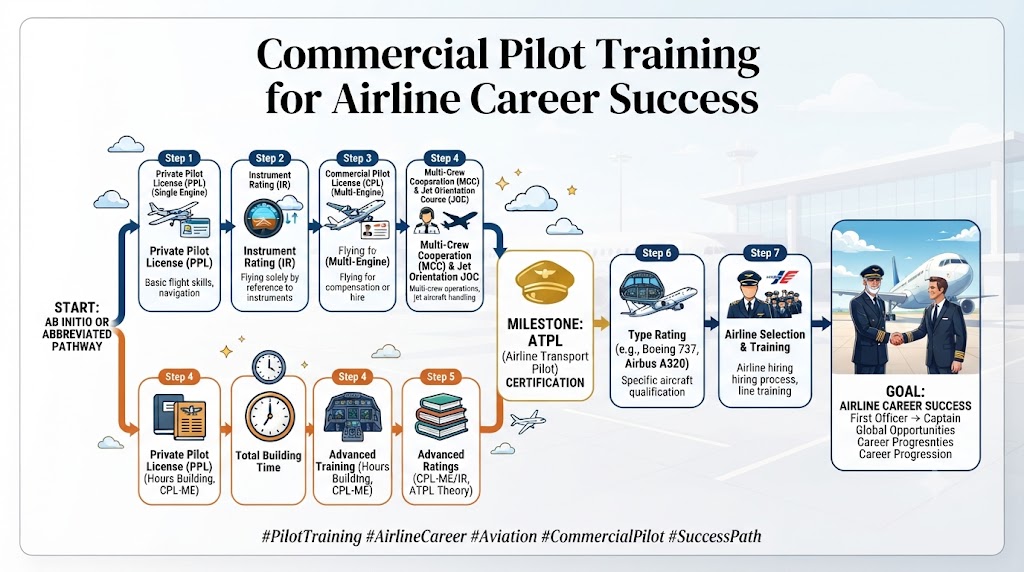
The Typical Airline Pilot Training Path
The exact journey differs between students, schools, and countries, but a common U.S. airline-career path includes the following stages.
1. Discovery Flight
A discovery flight allows a student to experience a training aircraft and understand basic cockpit activities before making a major commitment.
2. Student Pilot Preparation
The student completes the required application, medical planning, ground study, and early flight lessons.
3. Private Pilot Training
Private pilot training develops basic aircraft control, navigation, communication, weather awareness, and safe operating habits.
4. Instrument Rating
Instrument training teaches a pilot to control and navigate an aircraft by reference to flight instruments and operate within the instrument flight system.
5. Commercial Pilot Training
The pilot develops greater accuracy, advanced maneuvering skills, stronger judgment, and professional operating discipline.
6. Multi-Engine Training
Multi-engine training prepares the pilot to manage aircraft with more than one engine, including engine-out performance and asymmetric thrust.
7. Flight Instructor Training
Many pilots earn flight instructor qualifications and build experience by teaching new students.
8. Flight-Hour Building
The pilot gains practical experience while improving decision-making, communication, consistency, and operational knowledge.
9. ATP Preparation
Qualified pilots complete the required experience and advanced training needed for the Airline Transport Pilot certificate.
10. Airline Selection and Training
Successful applicants may complete interviews, technical evaluations, simulator assessments, background checks, and employer-specific aircraft training.
Each stage prepares the pilot for greater responsibility.
Why Private Pilot Training Comes First
Private pilot training creates the foundation for every later qualification.
During this stage, students learn:
- Basic aircraft control
- Takeoffs and landings
- Slow flight and stalls
- Navigation
- Radio communication
- Weather planning
- Airspace rules
- Checklist use
- Emergency procedures
- Aircraft responsibility
Commercial training cannot correct every weakness in basic flying. A student who struggles with aircraft control, preparation, or decision-making may find advanced training difficult and expensive.
Students should focus on building strong habits from the beginning rather than trying to complete each certificate as quickly as possible.
Good pilots do not simply memorize procedures. They understand why those procedures matter.
Why an Instrument Rating Matters
Airline flying depends heavily on instrument procedures.
An instrument rating teaches pilots how to operate when outside visual references are limited. It also develops the ability to follow precise routes, altitudes, clearances, and approach procedures.
Instrument training helps improve:
- Aircraft control
- Weather awareness
- Air traffic control communication
- Route planning
- Approach procedures
- Workload management
- Situational awareness
- Decision-making
- Checklist discipline
A student learns to manage several tasks while maintaining accurate control of the aircraft.
Instrument training also teaches an important lesson: a safe pilot must respect weather limits and make early decisions. Continuing into unsafe weather because of schedule pressure is not professional behavior.
Advanced Aircraft Control During Commercial Training
Commercial pilot training develops precision and smoothness.
Students may practice advanced maneuvers that require planning, coordination, and accurate energy management. The purpose is not to perform tricks. These exercises reveal how well the pilot understands the aircraft.
Commercial-level flying requires accurate control of:
- Altitude
- Heading
- Airspeed
- Bank angle
- Aircraft energy
- Power settings
- Configuration
- Flight path
The pilot also learns to consider passenger comfort. Sudden control movements, unstable approaches, and poor planning may be technically recoverable, but they do not demonstrate professional flying.
A professional pilot aims to remain ahead of the aircraft.
Multi-Engine Training
Many airline aircraft use more than one engine, so multi-engine experience is important for airline career preparation.
Multi-engine training introduces new areas of responsibility, including:
- Asymmetric thrust
- Engine failure recognition
- Engine-out control
- Aircraft performance
- Emergency procedures
- Propeller management
- Checklist discipline
- Workload control
- Decision-making
- Crew coordination
An engine failure in a multi-engine aircraft creates different handling and performance challenges from those in a single-engine aircraft.
Students must learn that having another engine does not remove risk. Aircraft weight, weather, altitude, runway length, and pilot response all affect performance.
Good multi-engine training focuses on understanding the aircraft rather than simply completing a required number of hours.
Commercial Pilot Experience Requirements
For a commercial pilot certificate with an airplane single-engine rating under the standard Part 61 route, the FAA generally requires at least 250 hours of pilot flight time, along with specific experience in powered aircraft, pilot-in-command time, cross-country flying, instrument training, night operations, and other required areas. Approved Part 141 programs may use a different structured curriculum and eligibility framework.
Students should not assume that reaching the minimum total time automatically makes them ready for the practical test.
Actual training time may increase because of:
- Weather interruptions
- Aircraft availability
- Learning pace
- Training frequency
- Instructor changes
- Skill development
- Additional practice
- Examination scheduling
The legal minimum is only one part of training readiness.
Building Flight Hours After Commercial Training
Many newly qualified commercial pilots still need significant experience before becoming eligible for airline positions.
Pilots may build experience through legally authorized work such as:
- Flight instruction
- Aerial survey
- Aerial photography
- Corporate flying
- Charter operations
- Ferry flying
- Approved sightseeing operations
- Other entry-level commercial roles
Availability depends on:
- Pilot qualifications
- Local regulations
- Aircraft experience
- Insurance requirements
- Employer standards
- Medical eligibility
- Work authorization
- Market conditions
Students should avoid accepting unsafe, illegal, or poorly managed flying simply to increase their logbook totals.
Flight-hour building should improve judgment and professionalism, not only create a larger number.
Becoming a Flight Instructor
Flight instruction is a common experience-building path for future airline pilots.
Teaching strengthens many important skills.
Communication
An instructor must explain technical ideas in clear and simple language.
Situational Awareness
The instructor must monitor the aircraft, student, traffic, weather, and environment at the same time.
Decision-Making
Instructors must know when to allow a student to continue and when to take control.
Technical Knowledge
Teaching forces pilots to understand subjects more deeply.
Leadership
An instructor becomes responsible for creating a safe and effective learning environment.
Patience
Every student learns differently. Good instructors adapt without lowering safety standards.
Flight instruction requires separate certification and is not the only way to build experience. However, it can create strong professional habits when performed responsibly.
Skills Airlines Look for in Pilot Candidates
Airlines evaluate more than flight hours.
A strong pilot candidate should demonstrate:
- Safety awareness
- Technical knowledge
- Clear communication
- Professional behavior
- Good judgment
- Teamwork
- Discipline
- Reliability
- Situational awareness
- Emotional control
- Leadership
- Respect for procedures
- Ability to accept feedback
- Honest recordkeeping
A pilot with excellent aircraft-control skills but poor communication or weak judgment may struggle in a multi-crew airline environment.
Professional behavior should begin during the first training lesson, not during the airline interview.
Crew Resource Management
Crew Resource Management, often called CRM, teaches aviation professionals how to use people, information, equipment, and procedures effectively.
Airline pilots work with:
- Other pilots
- Cabin crew
- Air traffic controllers
- Dispatchers
- Maintenance personnel
- Ground teams
- Operations staff
CRM develops skills such as:
- Clear communication
- Workload sharing
- Decision-making
- Leadership
- Followership
- Threat management
- Error management
- Conflict resolution
- Fatigue awareness
A first officer must be willing to speak when something appears unsafe. A captain must create an environment where concerns can be raised professionally.
Good teamwork protects the entire operation.
Aeronautical Decision-Making
Safe decision-making is one of the most important qualities of an airline pilot.
Pilots regularly make decisions about:
- Weather
- Fuel
- Aircraft condition
- Personal fitness
- Passenger needs
- Air traffic delays
- Route changes
- Diversions
- Maintenance concerns
- Continuing or cancelling a flight
Commercial pressure can create dangerous thinking. A pilot may feel pressure to complete a flight because passengers are waiting, money has been spent, or a schedule is important.
A professional pilot understands that safety is more important than convenience.
Delaying, diverting, or cancelling a flight may be the best decision.
Medical Fitness for a Professional Pilot
Commercial and airline pilots must meet the medical requirements that apply to their certificates and operating roles.
Medical fitness may involve:
- Vision
- Hearing
- Cardiovascular health
- Neurological health
- Medication use
- Sleep quality
- Fatigue
- Mental alertness
- Substance restrictions
- Stress management
Students should investigate medical eligibility early, preferably before making a major financial commitment.
An authorized aviation medical examiner can provide official guidance about certification requirements. Students should never hide a medical condition or provide inaccurate information on an application.
Medical eligibility is part of long-term career planning.
Choosing the Right Flight School
Choosing a flight school is one of the most important decisions in pilot training.
Students should review several factors.
Training Approval
Understand whether the school operates under Part 61, Part 141, or another applicable system.
FAA-approved Part 141 pilot schools use an approved structured curriculum and are subject to specific certification and compliance requirements. Part 61 training can provide greater flexibility, depending on the student and school.
Instructor Quality
Ask about instructor experience, availability, communication, and turnover.
Aircraft Availability
A school may advertise many aircraft, but students should ask how many are regularly available for training.
Maintenance Culture
Aircraft should be maintained properly, and safety concerns should be handled openly.
Training Continuity
Frequent instructor or aircraft changes may affect progress.
Complete Cost Estimate
Request a written estimate that explains:
- Aircraft rental
- Instructor fees
- Ground training
- Simulator sessions
- Study materials
- Examination fees
- Fuel charges
- Insurance
- Additional practice
- Housing
- Transportation
Student Feedback
Speak with current and former students rather than depending only on promotional material.
Career Claims
Be careful with promises of guaranteed completion, guaranteed airline interviews, or guaranteed employment.
No responsible school can control every part of a student’s career.
Part 61 and Part 141 Training
Both training paths can produce skilled professional pilots.
Part 61 Training
Part 61 training may offer:
- Flexible scheduling
- Individual training pace
- Easier adjustment around work or study
- Direct instructor coordination
It may require the student to take greater responsibility for scheduling and progress.
Part 141 Training
Part 141 schools follow FAA-approved training courses and structured stage requirements.
Possible advantages include:
- Organized syllabus
- Formal progress checks
- Standardized records
- Structured training sequence
- Reduced experience requirements for some certificates or ratings
The best choice depends on the student’s learning style, schedule, finances, career goals, and school quality.
Full-Time vs Part-Time Training
Full-Time Training
Full-time training may provide:
- Better continuity
- Frequent practice
- Faster progress
- Strong study habits
- Fewer long gaps between flights
Possible challenges include:
- High immediate cost
- Limited time for employment
- Intensive workload
- Greater financial pressure
Part-Time Training
Part-time training may allow students to:
- Continue working
- Spread expenses over time
- Maintain other responsibilities
- Use a more flexible schedule
Possible challenges include:
- Slower progress
- Skill loss between flights
- More review lessons
- Greater exposure to scheduling interruptions
Consistency is important in either format.
Understanding Training Costs
Commercial pilot training is a major financial commitment.
Total cost depends on:
- Previous flight experience
- Aircraft rental rates
- Fuel prices
- Instructor fees
- Training frequency
- Aircraft category
- Simulator use
- Examination fees
- Medical expenses
- Study materials
- Housing
- Transportation
- Additional practice
- Failed or repeated tests
Students should avoid comparing schools using only the lowest advertised package price.
A low estimate may exclude important costs or assume that every lesson is completed at the minimum possible time.
Create a financial plan that includes a reasonable reserve for unexpected training needs.
Interrupting training for several months because funds are unavailable can increase the final cost.
How Long Does Training Take?
There is no single completion period for every student.
Training time depends on:
- Full-time or part-time attendance
- Weather
- Aircraft availability
- Instructor availability
- Student preparation
- Learning speed
- Training consistency
- Financial continuity
- Examination availability
- Previous experience
Students who study before lessons and fly consistently often progress more efficiently.
However, speed should never become more important than skill.
Completing training quickly has little value if the student does not develop safe and reliable habits.
Common Training Challenges
Weather Delays
Poor weather can interrupt flight schedules. Students should use these days for ground study, simulator practice, and flight planning.
Training Costs
A detailed budget and realistic reserve can reduce financial interruptions.
Skill Plateaus
Progress may slow during difficult maneuvers or instrument procedures. Focused practice and honest instructor feedback can help.
Failed Tests
A failed test is serious, but it does not automatically end a career. The student should identify the cause, complete proper retraining, and improve.
Motivation Problems
Long training programs can become tiring. Breaking the journey into smaller goals may help maintain focus.
Comparison With Other Students
Every pilot develops at a different speed. Comparing progress too closely can create unnecessary pressure.
The goal is safe competence, not winning a race.
Preparing for Knowledge and Practical Tests
Good preparation begins long before the examination date.
Students should:
- Study consistently
- Review official training materials
- Understand aircraft systems
- Practice flight planning
- Use checklists correctly
- Chair-fly procedures
- Complete mock oral examinations
- Practice weak maneuvers
- Ask questions
- Review weather and regulations
- Understand practical-test standards
The FAA publishes Airman Certification Standards that explain the knowledge, risk-management, and flight-skill areas evaluated during certification tests.
Students should aim to understand the material rather than memorize answers only for the test.
Building an Airline-Ready Profile
An airline-ready profile develops over many years.
Important areas include:
Accurate Logbooks
Record flight time carefully and honestly.
Clean Training Records
Keep certificates, endorsements, medical documents, and examination records organized.
Strong Safety Habits
Avoid careless decisions and unnecessary risks.
Professional References
Build positive relationships with instructors, employers, and aviation professionals.
Interview Preparation
Review technical subjects, personal history, decision-making examples, and crew scenarios.
Simulator Preparation
Practice basic instrument scanning, procedures, communication, and crew coordination.
Honest Applications
Never hide required information about training history, violations, incidents, or employment.
Integrity is essential in aviation.
The ATP Stage
The Airline Transport Pilot certificate is a major qualification for airline careers in the United States.
For the standard airplane ATP certificate, applicants generally must be at least 23 years old and meet the applicable experience requirements. A restricted ATP may be available from age 21 for applicants who meet specific regulatory pathways. Applicants seeking an ATP with an airplane multiengine rating must also complete an authorized ATP Certification Training Program before taking the applicable knowledge test.
Restricted ATP pathways may include:
- Certain military pilots with at least 750 hours
- Qualified graduates of authorized bachelor’s aviation programs with at least 1,000 hours
- Qualified graduates of certain associate-degree or reduced-credit aviation programs with at least 1,250 hours
These pathways have detailed educational, training, documentation, and experience conditions. Students should not assume that any aviation degree automatically qualifies them for reduced ATP hours.
International Students Training in the United States
International students may complete flight training in the United States, but they must plan carefully.
Important areas include:
- Suitable immigration status
- School authorization
- Passport validity
- Security screening
- Financial planning
- Accommodation
- English proficiency
- Health insurance
- Licence conversion
- Home-country requirements
- Employment authorization
The Transportation Security Administration’s Flight Training Security Program requires security threat assessments for covered flight-training candidates. The program was updated through a final rule published in 2024.
International students must understand that permission to study does not automatically provide permission to work as a pilot in the United States.
Before paying fees, students should verify:
- Whether the school can train international students
- Which immigration documents are required
- Whether security approval is needed
- How long approvals may take
- Whether the resulting FAA certificate can be converted at home
- Whether the planned career path is legally possible
Official immigration, aviation, and security authorities should be used for current guidance.
Common Mistakes to Avoid
Future airline pilots should avoid:
- Choosing a school only because it advertises the lowest price
- Ignoring additional fees
- Starting without a complete financial plan
- Flying too infrequently
- Studying only before tests
- Ignoring instructor feedback
- Chasing hours without building skill
- Neglecting sleep and health
- Maintaining inaccurate logbooks
- Believing employment is guaranteed
- Failing to verify school approval
- Ignoring medical eligibility
- Hiding training difficulties
- Failing to research work authorization
- Comparing progress constantly with others
Good career planning requires patience, research, and honesty.
Commercial Pilot Career Path
| Training Stage | Main Purpose | Skills Developed | Possible Next Step |
|---|---|---|---|
| Private Pilot Training | Build basic flying ability | Aircraft control, navigation and safety | Instrument rating |
| Instrument Rating | Learn instrument operations | Precision, weather and ATC procedures | Commercial training |
| Commercial Pilot Training | Develop professional flying skills | Advanced control and decision-making | Multi-engine training |
| Multi-Engine Training | Learn twin-engine operations | Engine-out control and workload management | Experience building |
| Flight Instructor Training | Learn to teach pilots | Communication, leadership and awareness | Flight instruction |
| Experience Building | Develop practical flight experience | Judgment, consistency and professionalism | ATP preparation |
| ATP Preparation | Meet advanced airline standards | Airline knowledge and advanced procedures | Airline application |
| Airline Training | Learn company and aircraft procedures | Crew operations and aircraft systems | First officer duties |
The exact path depends on regulations, school programs, personal qualifications, available employment, and airline requirements.
Flight School Selection Checklist
Before choosing a school, review:
- School approval and operating rules
- Course structure
- Instructor qualifications
- Instructor availability
- Aircraft availability
- Aircraft condition
- Maintenance standards
- Safety culture
- Simulator access
- Training schedule
- Written cost estimate
- Additional fees
- Payment and refund policies
- Student support
- Housing options
- International student authorization
- Security requirements
- Examination preparation
- Graduate feedback
- Career guidance
- Medical eligibility
- Personal financial plan
How PILOTTRAININGUS.COM Supports Future Pilots
Aspiring pilots can use PILOTTRAININGUS.COM while researching commercial pilot training, understanding different stages of flight education, and preparing for professional aviation careers.
Students should use reliable resources to compare training options, identify important questions, and understand the difference between earning a commercial certificate and becoming airline-ready.
The final decision should be based on verified school information, current regulations, safety standards, personal career goals, and a realistic financial plan.
Frequently Asked Questions
1. What is commercial pilot training?
Commercial pilot training develops the knowledge, flight skills, decision-making, and professional standards required to exercise commercial pilot privileges.
2. Does a commercial pilot certificate guarantee an airline job?
No. Airline employment normally requires additional experience, ratings, medical eligibility, ATP qualifications, employer selection, and company training.
3. What training is completed before the commercial certificate?
Many future airline pilots first complete private pilot training and an instrument rating. The exact sequence may depend on the school and training program.
4. Why is an instrument rating important?
Instrument training develops precision, weather knowledge, air traffic control skills, workload management, and the ability to operate safely without normal outside visual references.
5. Is multi-engine training required for an airline career?
Multi-engine experience is important for many airline pathways because most airline aircraft have more than one engine. Exact requirements vary by certificate and employer.
6. How do pilots build flight hours?
Pilots may build experience through flight instruction and other legally authorized commercial operations. Availability depends on qualifications, insurance, employment conditions, and work authorization.
7. How long does commercial pilot training take?
The time depends on training frequency, weather, aircraft availability, student progress, finances, and previous experience. No single timeline applies to everyone.
8. How much does commercial pilot training cost?
Costs depend on aircraft rates, instructor fees, fuel, required hours, location, examinations, housing, and additional training. Students should request a complete written estimate.
9. Can international students train in the United States?
Yes, when they meet the applicable school, immigration, security, financial, and aviation requirements. Training permission does not automatically provide employment authorization.
10. What qualities do airlines look for?
Airlines commonly value safety awareness, technical knowledge, communication, teamwork, discipline, integrity, decision-making, professionalism, and the ability to learn.
Conclusion
Commercial pilot training is one of the most important foundations of an airline career. It develops accurate aircraft control, stronger technical knowledge, professional discipline, and better decision-making. However, a commercial certificate is only one stage of the journey. Future airline pilots may also need instrument qualifications, multi-engine training, flight-hour building, ATP eligibility, medical fitness, and successful airline training. Students should choose their flight school carefully, understand the complete cost, verify current requirements, and avoid programs that promise guaranteed airline success. The most successful pilots focus on more than certificates and flight hours. They build safe habits, accept feedback, maintain honest records, communicate clearly, and continue learning throughout their careers.

