
Introduction
Choosing the right airplane parts is one of the most important decisions an aircraft owner, pilot, maintenance team, or aviation buyer can make. Every component in an aircraft has a purpose, whether it is a small fastener, a fuel line, an oil filter, an avionics switch, a tire, a brake pad, or an engine-related part. When these parts are high quality, properly documented, and compatible with the aircraft, they support safer flying, smoother operation, and better long-term reliability.
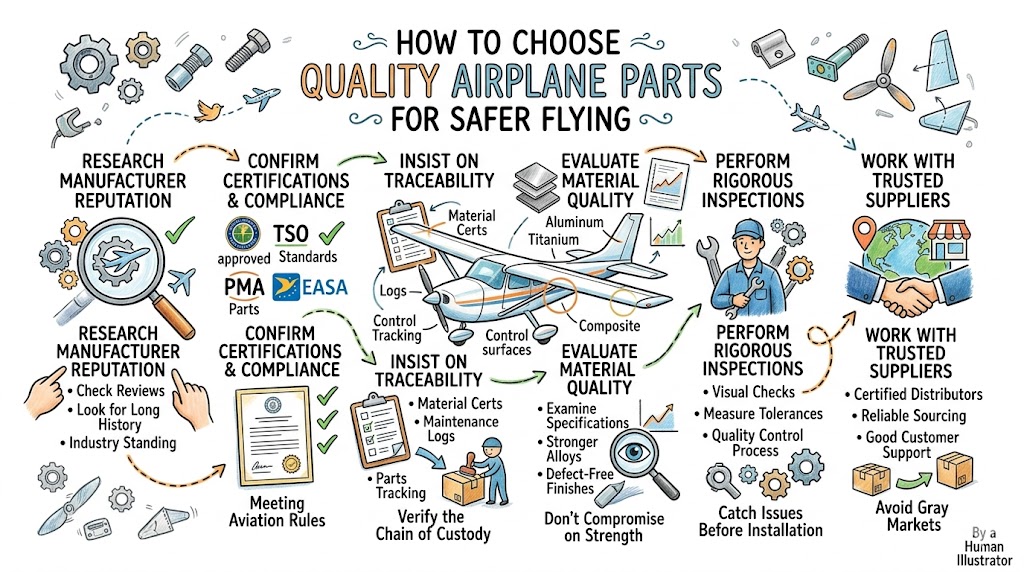
Aircraft are different from ordinary machines because even a small part can affect safety, performance, compliance, and maintenance cost. A poor-quality or incompatible component can cause unexpected downtime, repeated repairs, operational risk, or expensive damage to other systems. That is why airplane parts should never be selected only by price or appearance. Buyers must evaluate compatibility, material quality, certification requirements, supplier reputation, documentation, and installation needs before making a purchase.
This guide explains how to choose quality airplane parts for safer flying. It covers the major types of airplane parts, what buyers should check, how to compare new and used parts, common mistakes to avoid, and how to work with reliable airplane parts suppliers.
Real-World Use Cases
Quality airplane parts support safer and more dependable aviation operations in many real-world situations.
- Private aircraft owners use quality parts to improve aircraft reliability and reduce unexpected repair problems.
- Pilots depend on properly functioning parts to reduce mechanical risks before and during flight.
- Maintenance teams use trusted components to complete repairs with confidence and proper documentation.
- Aircraft operators reduce downtime by choosing parts that fit correctly and perform reliably.
- Flight schools maintain safer and more dependable training aircraft by using suitable parts during routine service.
- Aircraft sellers protect resale value by keeping maintenance records complete and using quality replacement parts.
- Aviation buyers avoid costly mistakes by checking compatibility, condition, and supplier credibility before purchasing.
Evaluation Criteria for Buyers
Before purchasing airplane parts, buyers should use a structured evaluation process. This helps prevent wrong purchases, installation problems, compliance issues, and safety risks.
Important evaluation criteria include:
- Part compatibility: Confirm the part fits the exact aircraft make, model, serial range, and system requirement.
- Material quality: Review the strength, durability, corrosion resistance, and suitability of the material.
- Certification and approval status: Check whether the part requires approval, certification, or traceability for the aircraft application.
- Manufacturer reputation: Prefer parts from recognized manufacturers or trusted aviation suppliers.
- Supplier reliability: Evaluate whether the supplier provides clear descriptions, documentation, support, and transparent policies.
- Documentation and traceability: Keep invoices, part numbers, certificates, service records, and maintenance documentation.
- Fit and finish: Inspect machining, surfaces, threads, connectors, seals, and overall workmanship.
- Condition of new or used parts: New parts should be verified, and used parts should be inspected carefully for wear or hidden damage.
- Warranty or return policy: Choose suppliers that offer clear support if the part is incorrect, damaged, or unsuitable.
- Maintenance requirements: Understand inspection intervals, installation needs, and service life expectations.
- Long-term parts availability: Consider whether replacement parts will be available later.
- Safety impact: Give extra attention to parts that affect engine operation, control systems, fuel flow, braking, electrical reliability, or structural strength.
Best for
This guide is best for private aircraft owners, aviation maintenance teams, aircraft parts buyers, flight schools, and aircraft operators who want safer and more reliable maintenance decisions.
It is useful for buyers who want to avoid poor-quality parts, wrong-fit components, and undocumented purchases.
It also helps owners protect aircraft value through better records, smarter sourcing, and safer replacement practices.
Not Ideal for
This guide is not a replacement for certified aircraft mechanics, official aircraft maintenance manuals, manufacturer instructions, or aviation authority regulations.
It should be used as a practical buying guide, not as technical repair approval or installation instruction.
Any safety-critical part should be reviewed and installed by qualified aviation professionals.
Why Quality Airplane Parts Matter
Quality airplane parts are essential because aircraft safety depends on every system working correctly. A single weak fitting, faulty wire, worn tire, poor seal, or incorrect fastener can create larger operational concerns.
Flight Safety
The primary reason to choose quality parts is safety. Airplane parts must perform under vibration, changing temperatures, pressure, load, and repeated use. Quality parts reduce the chance of system failure and support safer flight operations.
Aircraft Reliability
Reliable parts help the aircraft operate consistently. This matters for private owners, flight schools, business aircraft operators, and anyone who depends on predictable aircraft availability.
Regulatory Compliance
Aircraft maintenance often requires proper documentation, approved parts, and accurate records. Choosing parts without the right traceability can create compliance and inspection problems.
Reduced Maintenance Issues
Poor-quality parts may fail early, fit poorly, or create repeated maintenance problems. Quality parts reduce unnecessary rework and help maintenance teams complete repairs more efficiently.
Better Performance
Engine parts, fuel system components, tires, avionics, and control system hardware can all influence aircraft performance. The right parts help maintain smoother operation and better flight confidence.
Lower Long-Term Repair Costs
Cheap parts can become expensive if they fail early or damage connected systems. Quality parts may cost more upfront but often reduce long-term maintenance expenses.
Improved Aircraft Lifespan
Consistent use of compatible and high-quality parts helps protect the aircraft structure, engine systems, electrical systems, and interior components over time.
Stronger Resale Value
Aircraft buyers often review maintenance history before purchase. Properly documented, quality replacement parts can improve buyer confidence and support stronger resale value.
Pilot and Passenger Confidence
When an aircraft is maintained with the right parts and proper records, pilots and passengers can feel more confident about safety and reliability.
Types of Airplane Parts Buyers Should Evaluate
Airplanes contain many different types of parts, and each category has different buying risks. Some parts are safety-critical, while others affect comfort, serviceability, or long-term maintenance.
1- Engine Parts
Engine parts are among the most important components in any aircraft. They directly affect performance, reliability, and flight safety.
Common Engine Parts
- Oil filters
- Spark plugs
- Cylinders
- Ignition components
- Fuel system parts
- Exhaust components
- Engine mounts
- Seals
- Hoses
- Cooling parts
- Gaskets
- Carburetor or fuel injection components
What to Check
When buying engine parts, confirm the exact engine model compatibility, part number, operating limits, condition, and documentation. For hoses and seals, check material compatibility and service life. For ignition and fuel components, verify that the part is suitable for the aircraft and engine configuration.
Common Risks
Poor-quality engine parts can cause oil leaks, fuel leaks, overheating, rough running, power loss, excessive vibration, or premature wear. Engine-related buying decisions should always be handled carefully.
Best Buying Practice
Use properly documented parts from trusted aviation suppliers and consult qualified mechanics before installation. Never assume that a similar-looking engine component is interchangeable.
2- Avionics and Electrical Parts
Avionics and electrical systems support communication, navigation, monitoring, and cockpit control. These parts should be reliable, properly rated, and compatible with the aircraft’s electrical system.
Common Avionics and Electrical Parts
- Radios
- GPS systems
- Transponders
- Cockpit displays
- Sensors
- Switches
- Batteries
- Wiring
- Circuit breakers
- Connectors
- Antennas
- Lighting systems
What to Check
Check voltage rating, system compatibility, installation requirements, wiring quality, connector type, and documentation. For avionics, confirm software support, display condition, panel fit, antenna compatibility, and future service support.
Common Risks
Electrical faults can create intermittent failures, communication issues, inaccurate readings, lighting problems, or battery-related starting issues. Poor wiring or incorrect circuit protection can become a serious safety concern.
Best Buying Practice
Choose avionics and electrical parts with clear specifications and professional installation support. Keep installation records and verify that the system is tested properly after installation.
3- Airframe and Structural Parts
Airframe and structural parts affect the physical strength and integrity of the aircraft. These parts require careful inspection for material quality, fit, corrosion, and damage.
Common Airframe and Structural Parts
- Panels
- Brackets
- Spars
- Ribs
- Fairings
- Composite parts
- Aluminum parts
- Rivets
- Fasteners
- Structural fittings
- Corrosion-sensitive components
What to Check
Inspect for cracks, dents, corrosion, deformation, poor machining, surface damage, and correct dimensions. Composite parts should be reviewed for delamination, cracks, and repair history. Metal parts should be checked for corrosion protection and structural soundness.
Common Risks
Poor structural parts can affect alignment, load-bearing strength, and long-term airframe durability. Hidden damage in used structural parts can be especially risky.
Best Buying Practice
Buy structural parts only from reliable sources, verify documentation, and use professional inspection before installation. Avoid unknown or undocumented structural components.
4- Landing Gear and Brake Parts
Landing gear and brakes handle some of the highest stress during aircraft operation. They are critical for takeoff, landing, taxiing, and ground safety.
Common Landing Gear and Brake Parts
- Tires
- Wheels
- Brake pads
- Calipers
- Hydraulic lines
- Struts
- Bearings
- Axles
- Brake discs
- Landing gear hardware
What to Check
Inspect tire age, tread condition, sidewalls, brake pad wear, wheel condition, bearing quality, hydraulic leaks, and hardware compatibility. For used parts, check for impact damage, corrosion, cracks, and uneven wear.
Common Risks
Weak brakes, damaged tires, worn bearings, or compromised landing gear parts can affect ground handling, landing safety, and stopping distance.
Best Buying Practice
Prioritize quality and compatibility for landing gear and brake components. Replace worn parts promptly and avoid questionable used parts in high-stress applications.
5- Fuel and Hydraulic System Parts
Fuel and hydraulic systems must be leak-free, properly rated, and compatible with the fluids used in the aircraft. These parts directly affect engine operation, braking, landing gear, and other critical functions.
Common Fuel and Hydraulic Parts
- Fuel pumps
- Fuel filters
- Fuel lines
- Fuel tanks
- Valves
- Fittings
- Hydraulic pumps
- Hoses
- Seals
- Fluid-compatible components
What to Check
Check fluid compatibility, pressure ratings, temperature ratings, hose condition, seal material, fitting quality, and installation requirements. Fuel system parts must be clean, properly sized, and suitable for aviation use.
Common Risks
Poor fuel or hydraulic parts can cause leaks, pressure loss, contamination, engine performance problems, braking issues, or landing gear concerns.
Best Buying Practice
Choose parts with clear specifications and aviation suitability. Never install fuel or hydraulic parts without verifying compatibility and condition.
6- Control System Parts
Control system parts connect pilot inputs to aircraft movement. These components must be precise, smooth, strong, and correctly installed.
Common Control System Parts
- Control cables
- Pulleys
- Rods
- Hinges
- Bearings
- Bellcranks
- Linkages
- Control surface hardware
- Bushings
- Turnbuckles
What to Check
Inspect cables for fraying, pulleys for smooth movement, bearings for play, hinges for wear, and rods or linkages for straightness and proper fit. Confirm correct size, material, and application.
Common Risks
Control system problems can cause stiffness, looseness, poor response, binding, or unsafe handling characteristics.
Best Buying Practice
Use high-quality, properly documented control system parts and have installation inspected by qualified aviation professionals.
7- Cabin and Safety Equipment
Cabin and safety equipment supports passenger protection, comfort, and emergency readiness. These parts are important for both safety and aircraft usability.
Common Cabin and Safety Parts
- Seat belts
- Harnesses
- Oxygen systems
- Fire extinguishers
- Emergency locator transmitters
- Cabin lighting
- Interior panels
- Seats
- Passenger safety items
- Emergency equipment
What to Check
Check expiration status, condition, compatibility, mounting points, inspection requirements, and accessibility. Seat belts and harnesses should be checked for wear, fraying, and secure attachment.
Common Risks
Old or poor-quality safety equipment may fail when needed. Loose interior panels or poorly installed cabin parts can also create safety and comfort issues.
Best Buying Practice
Use properly rated safety equipment, inspect regularly, and document replacements or service actions.
8- Hardware and Fasteners
Hardware and fasteners may be small, but they are essential to aircraft safety. They hold systems, structures, panels, and components together.
Common Hardware and Fasteners
- Bolts
- Nuts
- Washers
- Screws
- Rivets
- Clamps
- Cotter pins
- Safety wire
- Hinges
- Aviation-grade hardware
What to Check
Check grade, size, thread type, corrosion protection, material, and intended application. Avoid general-purpose hardware unless it is clearly suitable and approved for the aircraft application.
Common Risks
Wrong fasteners can loosen, corrode, fail under vibration, or create structural weakness. Small hardware mistakes can lead to serious consequences.
Best Buying Practice
Use aviation-grade hardware that matches the aircraft maintenance requirements. Keep hardware organized, labeled, and documented.
How to Identify Quality Airplane Parts
Choosing quality airplane parts requires careful review before purchase and before installation. The following steps help buyers reduce risk.
Verify Part Number and Compatibility
Always match the part number with the aircraft make, model, engine type, and maintenance requirement. Similar-looking parts may not be interchangeable.
Check Aircraft Model Fitment
A part may fit one aircraft variation but not another. Confirm model, serial range, system type, and installation location.
Review Certification or Approval Status
Some parts require specific approval or documentation. Buyers should understand whether a part is approved, eligible, or suitable for the aircraft application.
Inspect Material and Build Quality
Look for clean machining, proper finish, correct threading, smooth surfaces, strong seals, and durable materials. Avoid parts with visible defects or unclear quality.
Confirm Documentation and Traceability
Documentation helps prove the identity, origin, and suitability of a part. Keep invoices, certificates, labels, and maintenance records organized.
Avoid Unknown or Unverified Parts
If a part has no clear source, no part number, no documentation, or vague description, avoid using it in safety-critical systems.
Review Supplier Reputation
Reliable suppliers provide accurate descriptions, clear communication, fair return policies, and proper documentation. Poor suppliers increase the risk of wrong or low-quality parts.
Check Warranty or Return Options
A good return policy protects you if the part does not fit, arrives damaged, or does not meet the advertised condition.
Inspect Used Parts Carefully
Used parts can be useful, but they require close inspection. Check wear, corrosion, service history, hidden damage, and remaining service life.
Confirm Installation Requirements
Some parts need special tools, procedures, calibration, or professional installation. Confirm requirements before buying.
Ask Certified Mechanics When Unsure
If there is any uncertainty about compatibility, safety, or installation, consult a qualified aircraft mechanic before purchase or installation.
Keep All Purchase and Maintenance Records
Good records help with inspections, future repairs, troubleshooting, and resale value.
New vs Used Airplane Parts
Both new and used airplane parts can be useful depending on the situation. New parts often provide better confidence and support, while used parts may reduce cost when properly inspected.
| Factor | New Airplane Parts | Used Airplane Parts | Buyer Recommendation |
|---|---|---|---|
| Safety | Generally more predictable when sourced properly | Depends on condition, history, and inspection | Use new parts for safety-critical systems when possible |
| Cost | Higher upfront cost | Lower upfront cost | Compare savings against risk and inspection needs |
| Documentation | Usually stronger documentation | May have limited or missing records | Avoid undocumented critical parts |
| Warranty | Often includes supplier or manufacturer support | Usually limited or unavailable | Prefer warranty-backed parts for expensive items |
| Condition | Unused and easier to evaluate | May have wear, corrosion, or hidden damage | Inspect used parts carefully |
| Availability | May require lead time | May be available immediately | Confirm fit before buying either option |
| Inspection Needs | Still requires verification | Requires detailed condition review | Have used parts inspected professionally |
| Best Use Cases | Engine, avionics, fuel, control, and safety-critical parts | Non-critical parts or well-documented components | Match choice to risk level |
Airplane Parts Buying Checklist
Use this checklist before purchasing airplane parts.
- Confirm aircraft make and model compatibility
- Match the correct part number
- Verify certification or approval requirements
- Check supplier reputation
- Review part documentation
- Inspect material and finish
- Confirm installation requirements
- Check warranty or return policy
- Compare safety impact
- Avoid suspiciously cheap parts
- Inspect used parts carefully
- Confirm long-term availability
- Keep invoices and maintenance records
- Ask about lead times before ordering
- Consult a qualified aircraft mechanic before installation
Airplane Parts Comparison Table
| Part Category | What to Check | Common Risk | Best Buying Practice |
| Engine Parts | Part number, engine fit, seals, hoses, documentation | Engine performance issues, leaks, overheating | Use documented parts from trusted suppliers |
| Avionics and Electrical | Voltage, connectors, wiring, software support, installation needs | Communication or electrical failure | Confirm compatibility and use professional installation |
| Airframe Parts | Material, corrosion, cracks, dimensions, structural condition | Structural weakness or poor fit | Avoid undocumented structural parts |
| Landing Gear and Brakes | Tires, wheels, pads, bearings, hydraulic lines | Poor braking or landing performance | Inspect wear and replace questionable parts |
| Fuel Systems | Pumps, lines, filters, fittings, fluid compatibility | Fuel leaks or engine supply issues | Verify pressure rating and material compatibility |
| Hydraulic Systems | Hoses, seals, pumps, valves, fittings | Pressure loss or system failure | Use properly rated components |
| Control Systems | Cables, pulleys, hinges, linkages, bearings | Binding, looseness, poor control response | Prioritize precision and professional inspection |
| Cabin Safety | Harnesses, oxygen, fire extinguisher, ELT, lighting | Emergency equipment failure | Check condition, expiry, and mounting |
| Fasteners | Grade, size, thread, corrosion protection | Loosening or structural failure | Use aviation-grade hardware only |
Common Mistakes Buyers Should Avoid
Airplane parts buying mistakes can lead to wasted money, maintenance delays, and safety concerns. Buyers should avoid these common errors.
Buying Only Based on Lowest Price
A low price may look attractive, but cheap parts can become expensive if they fail early, do not fit, or lack documentation. Safety should always come before short-term savings.
Ignoring Aircraft Compatibility
Even small differences in aircraft model, serial number, engine type, or system configuration can affect compatibility. Always verify fit before buying.
Using Non-Aviation-Grade Parts
General-purpose hardware or non-aviation components may not be designed for aircraft vibration, load, pressure, or temperature requirements.
Skipping Documentation Review
A part without documentation can create problems during installation, inspection, maintenance, or resale. Documentation matters as much as the part itself.
Buying From Unknown Suppliers
Unreliable suppliers may provide vague listings, incorrect parts, poor communication, or limited return support. Choose suppliers carefully.
Not Inspecting Used Parts Properly
Used parts may have hidden damage, corrosion, wear, or unknown service history. Always inspect before installation.
Ignoring Certification Requirements
Some aircraft parts require specific approvals or traceability. Ignoring these requirements can create compliance and safety problems.
Overlooking Return Policies
If a part does not fit or arrives damaged, a clear return policy is important. Avoid sellers that provide no support after purchase.
Failing to Check Long-Term Availability
Some parts may become hard to find later. Consider future replacement needs before choosing uncommon parts.
Installing Parts Without Professional Guidance
Installation errors can make even quality parts unsafe. Safety-critical parts should be installed or reviewed by qualified professionals.
Tips for Choosing a Reliable Airplane Parts Supplier
A good supplier helps buyers reduce risk, save time, and make better maintenance decisions. Supplier quality is an important part of aircraft safety.
Choose Aviation-Focused Suppliers
Aviation suppliers understand aircraft requirements better than general hardware or industrial sellers. They are more likely to provide suitable parts and useful support.
Look for Clear Product Descriptions
Product listings should include part numbers, compatibility information, condition, specifications, and relevant documentation details.
Ask About Documentation and Traceability
Before buying, ask what documentation comes with the part. This is especially important for safety-critical or regulated components.
Confirm Stock Availability and Lead Times
Aircraft downtime can become expensive. Confirm whether the part is in stock and how long delivery will take.
Review Return and Warranty Support
A supplier with a clear return policy is usually more reliable than one that provides no post-sale support.
Prefer Transparent Pricing
Avoid vague pricing, unclear fees, or incomplete product information. Transparent suppliers make planning easier.
Check Communication Quality
A reliable supplier should respond clearly and professionally to compatibility, documentation, and shipping questions.
Ask About Aircraft Model Compatibility
Before ordering, confirm that the part matches your exact aircraft make, model, and system requirement.
Avoid Vague or Incomplete Listings
If a listing does not clearly explain the part condition, specifications, or origin, ask questions or choose another supplier.
Build Long-Term Supplier Relationships
Working with trusted suppliers over time can improve service, support, and parts sourcing reliability.
Practical Safety Tips Before Installing Any Airplane Part
Buying the right part is only the first step. Proper inspection and installation are equally important.
- Compare the part against the aircraft manual or maintenance requirement.
- Confirm the correct part number before installation.
- Inspect for visible damage, corrosion, cracks, or poor finish.
- Verify that all required hardware is included.
- Check whether special tools or calibration are needed.
- Keep photos and documentation for maintenance records.
- Do not force parts into place if fitment is poor.
- Replace questionable seals, hoses, or fasteners.
- Test the system after installation where applicable.
- Have safety-critical installations reviewed by a qualified aircraft mechanic.
Frequently Asked Questions
1. Why is part quality important for airplane safety?
Part quality is important because every aircraft component affects performance, reliability, or safety in some way. Poor-quality parts may fail early, fit incorrectly, or create system problems. Quality parts reduce risk and support safer flying.
2. How do I know if an airplane part is compatible?
Check the aircraft make, model, serial information, system requirement, and part number. Compare the part against maintenance manuals or manufacturer guidance. When uncertain, ask a qualified aircraft mechanic or trusted supplier.
3. Should I buy new or used airplane parts?
New parts usually provide better documentation, warranty support, and condition confidence. Used parts may reduce cost but require careful inspection and service history review. For safety-critical systems, new or fully documented parts are usually the better choice.
4. What documents should come with airplane parts?
Useful documents may include invoices, part numbers, certificates, traceability records, inspection records, or manufacturer information. Documentation helps prove the part’s identity and supports future maintenance. Keep all records organized with aircraft files.
5. Can I use non-aviation-grade parts on an aircraft?
Non-aviation-grade parts should not be used unless they are clearly suitable and acceptable for the specific application. Aircraft parts must handle vibration, load, temperature, and safety requirements. Always consult proper guidance before using non-aviation components.
6. How can poor-quality parts affect flying safety?
Poor-quality parts can cause leaks, electrical failures, braking issues, engine problems, structural weakness, or control system concerns. Even small components can create serious risks if they fail. That is why quality and compatibility should always come first.
7. What should I check before installing a part?
Check the part number, condition, documentation, material, fit, and installation requirements. Inspect for cracks, corrosion, wear, or visible defects. Safety-critical parts should be installed or reviewed by a qualified aircraft mechanic.
8. Why is supplier reputation important?
A reliable supplier provides accurate descriptions, proper documentation, clear communication, and better support. Unknown suppliers may sell incorrect, poorly described, or undocumented parts. Supplier reputation helps reduce buying risk.
9. How do airplane parts affect resale value?
Aircraft with properly documented maintenance and quality replacement parts are more attractive to buyers. Poor records or questionable parts can reduce confidence and lower resale value. Good parts and good records protect long-term aircraft value.
10. How can I avoid buying the wrong airplane parts?
Start by confirming the exact aircraft model, required part number, and system compatibility. Buy from trusted suppliers, review documentation, and avoid vague listings. For important parts, consult a qualified mechanic before purchasing.
Conclusion
Choosing quality airplane parts is essential for safer flying, better aircraft reliability, stronger performance, compliance readiness, and long-term ownership value. Buyers should never select aircraft parts only by price or appearance; instead, they should verify compatibility, review documentation, inspect material quality, evaluate supplier reputation, and understand installation requirements before purchasing. Whether buying engine parts, avionics, structural components, landing gear, fuel system parts, control hardware, cabin safety equipment, or fasteners, every decision should support safety and reliability. By working with trusted suppliers and qualified aviation professionals, aircraft owners and maintenance teams can reduce risk, avoid costly mistakes, and keep airplanes ready for safer and more dependable flight.

