
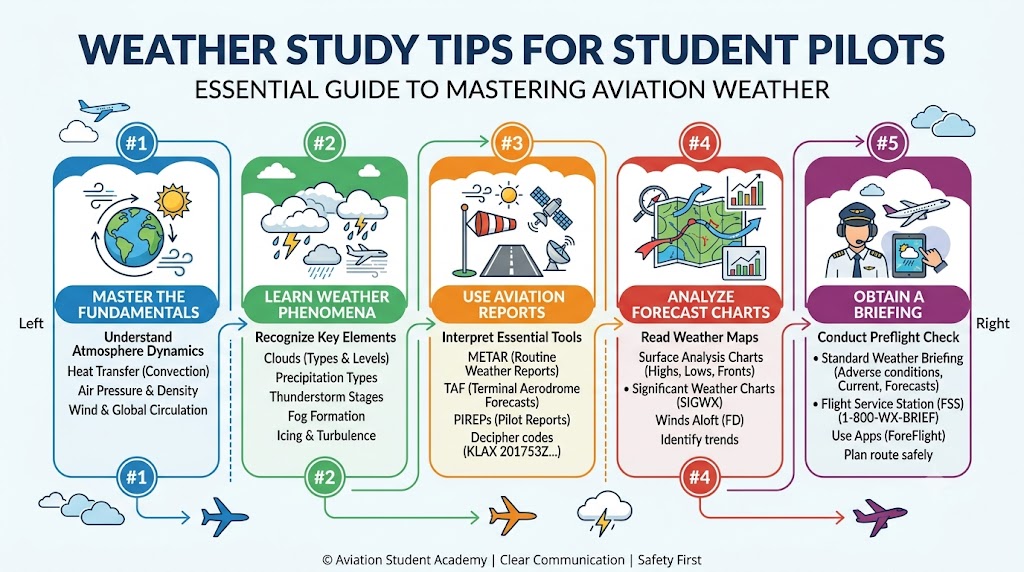
Learning aviation weather is one of the most important parts of becoming a safe and confident pilot. Student pilots need more than the ability to check whether a day looks sunny. They need to understand weather reports, forecasts, winds, visibility, clouds, pressure, temperature, and developing weather systems.
A strong weather study routine helps students connect classroom concepts with real flight planning. It also teaches them to recognize changing conditions, ask better questions during training, and understand why instructors make particular weather-related decisions.
This guide explains practical ways to study aviation weather and build useful habits throughout pilot training.
Why Weather Knowledge Matters for Student Pilots
Weather affects nearly every stage of a flight.
Wind can influence takeoff and landing performance. Visibility and ceiling can affect flight conditions and airport operations. Temperature can influence aircraft performance. Thunderstorms, turbulence, icing, fog, and other hazards can create additional operational concerns.
For student pilots, weather knowledge serves two purposes:
- Academic preparation: Understanding concepts needed for pilot training and examinations.
- Practical preparation: Learning how weather information contributes to flight planning and decision-making.
The goal is not simply to memorize definitions. Students should learn how different weather elements interact and how pilots interpret available information.
Start With the Fundamentals
Before studying complicated weather systems, build a strong understanding of basic atmospheric concepts.
Temperature
Temperature describes how warm or cold the air is. Student pilots should understand how temperature relates to aircraft performance and atmospheric conditions.
Pay particular attention to:
- Surface temperature
- Temperature changes with altitude
- Temperature and dew point
- Effects of temperature on density
Dew Point
Dew point indicates the temperature at which air becomes saturated under the relevant conditions.
Understanding the relationship between temperature and dew point can help students better understand the potential development of:
- Fog
- Low clouds
- Mist
- Other moisture-related conditions
Atmospheric Pressure
Pressure changes with altitude and weather systems. Students should understand basic pressure patterns and how pressure information appears in aviation weather products.
Rather than memorizing isolated facts, try connecting pressure with broader weather patterns.
Learn How to Read METARs
A METAR provides an aviation weather observation for an airport or reporting location.
At first, METARs can look like a collection of confusing abbreviations. The easiest approach is to break the report into individual sections.
Study the information in a consistent order:
- Reporting station
- Observation time
- Wind
- Visibility
- Present weather
- Clouds
- Temperature and dew point
- Pressure
- Additional information
Instead of attempting to memorize the entire format at once, learn what each group represents.
Practice Makes METAR Reading Easier
Choose an airport and read its current observation regularly during your study sessions.
Ask yourself:
- What is the wind doing?
- What is the reported visibility?
- What cloud information appears?
- What is the temperature?
- How close are the temperature and dew point?
- What pressure information is provided?
- Is any significant weather reported?
This approach turns METAR reading into a repeatable process.
Understand TAFs
A TAF provides a forecast for an airport over a specified period.
Student pilots should learn how TAF information differs from an observation.
A useful study method involves comparing:
What the METAR reported → What the TAF predicted → What actually happened later
This comparison helps students understand that forecasts describe expected conditions rather than guaranteed conditions.
What to Study in a TAF
Pay attention to:
- Expected wind
- Visibility
- Weather phenomena
- Cloud conditions
- Significant changes
- Temporary conditions
- Timing of forecast changes
The objective is to understand how conditions may evolve rather than simply looking for a single favorable number.
Study Wind Carefully
Wind affects aircraft operations in many ways, making it an important subject for student pilots.
Study:
- Wind direction
- Wind speed
- Gusts
- Crosswind components
- Headwinds
- Tailwinds
- Wind changes with altitude
- Wind shifts
Practice With Real Examples
When reading a weather report, imagine the runway orientation and consider how the reported wind relates to it.
For training purposes, students can practice calculating or interpreting wind components using instructor-approved examples.
This makes wind information more meaningful than memorizing terminology alone.
Understand Visibility and Ceiling
Visibility and ceiling are important parts of aviation weather interpretation.
Visibility
Visibility describes how far objects can be seen under the reported conditions.
Reduced visibility can occur because of conditions such as:
- Fog
- Mist
- Rain
- Snow
- Dust
- Smoke
- Other atmospheric conditions
Ceiling
Ceiling refers to specific reported cloud conditions relevant to aviation operations.
Students should learn the terminology associated with cloud coverage and understand how cloud information appears in weather reports.
Do not study visibility and ceiling as isolated definitions. Connect them to the type of flight environment they describe.
Learn Clouds Instead of Just Memorizing Names
Cloud identification becomes easier when students understand how clouds form.
Start by learning:
- Basic cloud types
- Cloud development
- Moisture
- Atmospheric stability
- Rising and sinking air
- Vertical development
Then connect those concepts with flight planning and weather hazards.
Focus on the Bigger Picture
Instead of asking only:
“What type of cloud is this?”
Ask:
- Why did this cloud form?
- What atmospheric conditions support it?
- Is it developing or dissipating?
- What other weather might occur with it?
This approach builds stronger weather reasoning skills.
Understand Atmospheric Stability
Atmospheric stability helps explain how air behaves when it moves vertically.
Students should understand the basic differences between:
- Stable air
- Unstable air
Then connect stability with weather characteristics such as:
- Cloud development
- Turbulence
- Vertical motion
- Precipitation
- Thunderstorm development
Understanding the relationship between these concepts can make later weather topics much easier.
Study Fronts and Air Masses
Fronts describe boundaries between different air masses.
Student pilots should become familiar with the general characteristics of:
- Cold fronts
- Warm fronts
- Stationary fronts
- Occluded fronts
Rather than memorizing lists, study how changes in air masses can influence:
- Clouds
- Precipitation
- Wind
- Visibility
- Temperature
- Weather development
Use diagrams and real weather maps when studying these concepts.
Learn About Thunderstorms
Thunderstorms deserve particular attention during aviation weather training.
Study the conditions that support thunderstorm development and learn the associated hazards, including:
- Strong winds
- Turbulence
- Lightning
- Heavy precipitation
- Reduced visibility
- Rapid weather changes
- Other hazardous conditions
Students should understand that thunderstorms represent a significant aviation weather concern and require careful interpretation of current information and appropriate instructor guidance.
Understand Turbulence
Turbulence can result from different atmospheric conditions.
Study the basic causes and categories discussed in your training materials, including turbulence associated with:
- Convective activity
- Terrain
- Wind changes
- Atmospheric conditions
- Aircraft wake
The objective is to understand why turbulence develops and how pilots obtain information about it.
Study Fog and Low-Visibility Conditions
Fog provides a useful example of how temperature, moisture, wind, and atmospheric conditions interact.
Learn the basic conditions associated with different types of fog and understand how reduced visibility can develop.
Useful topics include:
- Radiation fog
- Advection fog
- Upslope fog
- Steam fog
Do not simply memorize the names. Focus on the atmospheric conditions that produce each type.
Understand Icing Concepts
Aircraft icing is another important subject in aviation weather training.
Students should understand:
- How atmospheric moisture contributes to icing
- Why certain cloud conditions can create icing concerns
- Why temperature matters
- How icing can affect aircraft performance
- Why pilots must take applicable aircraft limitations and operational guidance seriously
Use approved training materials and instructor guidance when studying icing because actual operational decisions require current and aircraft-specific information.
Build a Daily Weather Study Routine
Consistent short study sessions often work better than trying to learn everything in one long session.
A simple routine can look like this:
Step 1: Review One Weather Concept
Choose one topic such as dew point, pressure, stability, or fronts.
Step 2: Read a Current Weather Observation
Study a METAR and identify each major section.
Step 3: Review the Forecast
Read the relevant TAF and identify expected changes.
Step 4: Compare Conditions
Later, compare the forecast with subsequent observations.
Step 5: Record One Lesson
Write down one thing you learned or misunderstood.
Step 6: Discuss Questions With Your Instructor
Bring confusing weather concepts into your next training discussion.
This routine gradually turns weather study into a practical skill.
Weather Study Checklist for Student Pilots
Use this checklist as a study aid alongside your approved training materials:
| Topic | Study Focus |
|---|---|
| Temperature | Temperature changes and aircraft performance concepts |
| Dew Point | Moisture and saturation |
| Pressure | Pressure patterns and aviation reporting |
| Wind | Direction, speed, gusts, and changes |
| Visibility | Factors that reduce visibility |
| Ceiling | Cloud coverage and aviation terminology |
| METAR | Understanding current observations |
| TAF | Understanding forecasts and changes |
| Clouds | Formation and identification |
| Stability | Stable and unstable air |
| Fronts | Weather changes around air-mass boundaries |
| Thunderstorms | Development and hazards |
| Turbulence | Causes and aviation implications |
| Fog | Formation and reduced visibility |
| Icing | Conditions and operational concerns |
How to Practice Weather Interpretation
Use the Same Airport for Several Days
Following one airport helps students observe how conditions change.
For example, track:
- Morning weather
- Afternoon weather
- Evening weather
- Wind changes
- Cloud changes
- Temperature changes
- Forecast accuracy
This creates a real-world weather learning experience.
Compare Multiple Sources
When appropriate, compare observations, forecasts, weather charts, and other authorized aviation weather products.
The purpose is to understand how different products contribute different pieces of information.
Create Weather Scenarios
Ask yourself questions such as:
- What weather changes might occur as a front approaches?
- How could increasing moisture affect visibility?
- What does a large temperature-dew point spread suggest compared with a small spread?
- How might stronger winds affect a training flight?
- What additional information would you want before discussing a flight with your instructor?
These exercises develop analytical thinking.
Common Weather Study Mistakes Student Pilots Should Avoid
1. Memorizing Without Understanding
Memorization has a role in pilot training, but students should also understand the relationships between weather elements.
2. Studying Only METARs and TAFs
Airport reports are important, but aviation weather includes much more than those two products.
3. Ignoring the Forecast Timeline
Weather changes over time. Students should learn to interpret when forecast conditions are expected to change.
4. Treating Forecasts as Guarantees
Forecasts describe expected conditions. Actual weather can differ.
5. Focusing Only on Temperature
Temperature represents only one part of the atmospheric picture. Wind, moisture, visibility, clouds, pressure, and other factors also matter.
6. Ignoring Local Weather Patterns
Terrain and regional conditions can influence weather behavior. Students should discuss relevant local patterns with instructors.
7. Using Outdated Information for Real Flight Decisions
Weather information can change. Actual flight planning should rely on current, appropriate aviation weather information.
8. Studying Without Asking Questions
Weather can involve complex interactions. Student pilots should ask instructors about concepts they do not understand rather than simply memorizing an uncertain answer.
How Weather Knowledge Supports Flight Planning
Weather study becomes more valuable when students understand how it connects to flight planning.
Weather information can contribute to discussions about:
- Route selection
- Airport selection
- Wind considerations
- Visibility
- Ceiling
- Expected weather changes
- Aircraft performance
- Alternate planning
- Potential hazards
Students should learn how these factors interact rather than treating each weather element as an independent item.
Actual operational decisions should always follow applicable procedures, current weather information, aircraft limitations, and instructor guidance during training.
A Better Way to Remember Aviation Weather
Create Visual Connections
Use diagrams for:
- Fronts
- Cloud formation
- Pressure systems
- Atmospheric stability
- Wind patterns
Use Flashcards Carefully
Flashcards work well for:
- Abbreviations
- Definitions
- Symbols
- Terminology
However, use practical examples alongside them.
Explain Concepts in Your Own Words
After studying a weather topic, explain it without looking at your notes.
If you cannot explain it simply, review the concept again.
Connect Theory With Real Weather
Look at an actual weather report and ask how the conditions relate to what you learned.
This connection between theory and observation can make information easier to remember.
Daily Aviation Weather Study Routine
A student pilot can divide a short study session into manageable sections:
5 minutes: Review one weather concept.
10 minutes: Decode a METAR.
10 minutes: Review a TAF and expected changes.
10 minutes: Study one weather chart or educational example.
5 minutes: Write down questions or important observations.
The exact study time can vary. The important part is maintaining a consistent learning habit.
How Instructors Can Help Students Improve Weather Knowledge
Student pilots should use their instructors as an important source of clarification.
Ask instructors to explain:
- Why certain weather conditions matter.
- How local weather behaves.
- How to interpret unfamiliar weather information.
- How weather factors influence training flights.
- Which weather products students should study.
- How to recognize important changes in conditions.
Instructor explanations can help students connect textbook concepts with actual flight training.
Frequently Asked Questions
Q1. Why should student pilots study aviation weather?
Weather affects flight planning, aircraft performance, visibility, winds, clouds, and potential hazards. Understanding weather helps students develop stronger aviation decision-making skills.
Q2. What should a student pilot learn first?
Start with basic concepts such as temperature, dew point, pressure, wind, visibility, clouds, and atmospheric stability before moving into more complex weather systems.
Q3. Are METARs difficult for student pilots to learn?
METARs may seem complicated initially because they use standardized abbreviations. Breaking them into sections and practicing regularly can make them easier to interpret.
Q4. What is the best way to learn TAFs?
Practice reading TAFs alongside METARs and compare forecast conditions with later observations. This helps students understand both forecasts and actual weather changes.
Q5. Should student pilots study thunderstorms?
Yes. Thunderstorms are an important aviation weather topic because they can involve several significant hazards. Students should understand their development, characteristics, and associated risks.
Q6. How can I improve my aviation weather knowledge?
Study consistently, read current weather observations, practice interpreting forecasts, review weather charts, and discuss difficult concepts with your instructor.
Q7. Should I rely on one weather report when planning a flight?
A single report rarely provides the complete weather picture. Student pilots should learn how different authorized aviation weather products provide complementary information.
Q8. Can weather forecasts change?
Yes. Forecasts represent expected conditions and can differ from subsequent observations. Students should learn to consider current information and changing conditions.
Q9. Why is the temperature-dew point relationship important?
The relationship provides useful information about atmospheric moisture and can help students understand conditions associated with cloud and fog development.
Q10. Can weather study replace an official flight weather briefing?
No. Educational study helps build knowledge, but actual flight preparation requires current and appropriate aviation weather information and compliance with applicable procedures.
Conclusion
Weather knowledge forms an important part of effective pilot training.
Student pilots should learn to connect METARs, TAFs, winds, clouds, visibility, pressure, and atmospheric conditions.
Regular practice makes weather information easier to interpret and remember.
Comparing forecasts with actual observations can strengthen practical understanding.
Most importantly, students should use current aviation weather information and instructor guidance when preparing for real flights.
Consistent weather study builds knowledge that supports safer and more informed flight planning.

