
Introduction
Starting flight training is exciting, but successful aviation training requires more than scheduling a first lesson and learning how to control an aircraft. A new aviation student needs to understand certification requirements, medical eligibility, ground-school expectations, flight-school procedures, aircraft documents, airspace, weather, risk management, and the standards used to evaluate pilot performance.
The Federal Aviation Administration (FAA) integrates aeronautical knowledge, flight proficiency, and risk management through its Airman Certification Standards (ACS). For private-pilot training, the ACS is not simply an examination checklist; it provides a framework for what a pilot applicant is expected to know, perform, and manage safely.
A good training checklist therefore starts before the first solo flight. It should help a student establish the right administrative foundation, choose appropriate training resources, build sound habits, prepare for knowledge testing, develop practical flight skills, and understand how every lesson contributes toward the eventual certificate.
1. Start With the Correct Training Objective
Before enrolling, determine exactly what you are training toward.
Possible objectives include:
- Recreational flying
- Private pilot certification
- Sport pilot certification
- Commercial aviation
- Airline-oriented career training
- Flight instruction
- Instrument training
- Multi-engine training
- Helicopter or another aircraft category
The requirements, training pathway, medical considerations, and practical-test standards can differ depending on the certificate and aircraft category.
For a student pursuing a private pilot certificate in an airplane, for example, training must eventually address three connected areas:
- Aeronautical knowledge
- Flight skills
- Risk management
That integrated approach is central to the FAA’s ACS framework.
Student objective checklist
- Identify the certificate or rating you want.
- Identify the aircraft category and class involved.
- Determine whether the training is recreational or career-oriented.
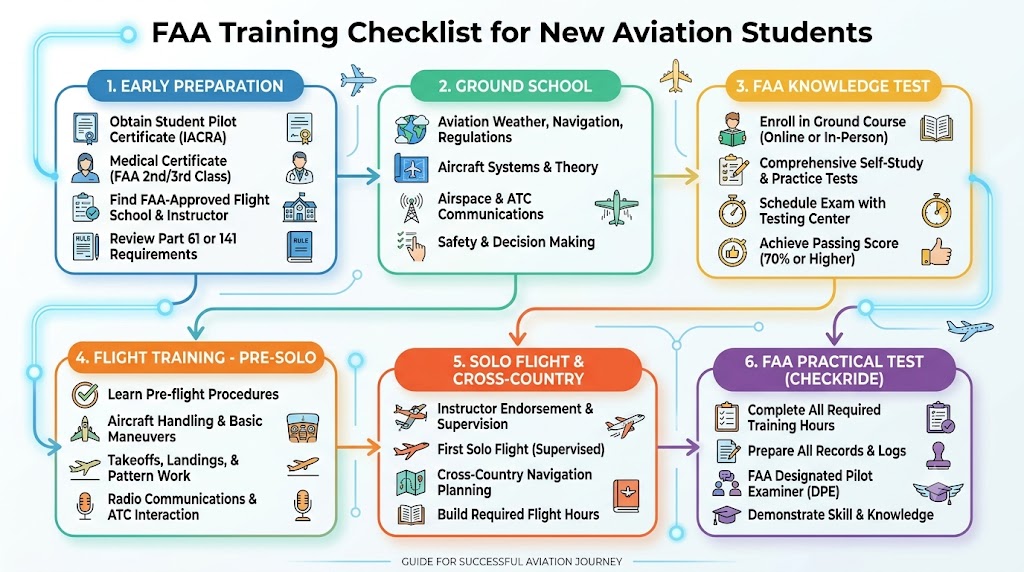
- Understand the applicable FAA certification standards.
- Discuss your long-term goals with a qualified flight instructor.
- Establish a realistic training schedule.
- Estimate the financial resources required.
- Understand what happens after the initial certificate if aviation is a career goal.
A common mistake is choosing a training program without considering where it leads. A student planning to pursue professional aviation may need a different training strategy from someone whose objective is simply to earn a private pilot certificate.
2. Confirm Student Pilot Eligibility
One of the first administrative checkpoints is determining whether you meet the FAA requirements for a student pilot certificate.
The FAA states that an applicant for a student pilot certificate must be at least 16 years old, except that applicants intending to pilot a glider or balloon can qualify at a younger age. The applicant must also be able to read, speak, and understand English.
Importantly, you do not need a student pilot certificate merely to begin taking flight lessons. It is required before exercising solo-flight privileges.
Student pilot documentation checklist
- Confirm age eligibility.
- Confirm English-language eligibility.
- Understand when the student pilot certificate is required.
- Create the appropriate FAA/IACRA application when applicable.
- Provide required identity information accurately.
- Work with an authorized person to process the application.
- Keep copies of relevant application records.
The FAA’s IACRA system provides a student-pilot application process, and the FAA identifies IACRA as one route for submitting the application.
Do not treat administrative paperwork as an afterthought. Errors in names, identification information, or application details can create avoidable delays.
3. Address Medical Certification Early
Medical eligibility should be considered before investing heavily in flight training, particularly if aviation is intended as a career.
The FAA states that pilots exercising private-pilot privileges generally require an appropriate medical qualification unless an applicable alternative such as BasicMed applies. The FAA also identifies the third-class medical certificate as the usual class associated with student, recreational, and private pilots when a medical certificate is required.
The practical lesson is simple:
Do not wait until you have spent substantial time and money on training to discover that a medical issue needs additional review.
Medical preparation checklist
- Determine what medical qualification your intended certificate requires.
- Review the FAA medical-certification process.
- Complete the required MedXPress process when applicable.
- Locate an FAA Aviation Medical Examiner.
- Prepare accurate medical information.
- Bring required documentation to the examination.
- Keep copies of submitted information.
- Ask qualified aviation-medical professionals about unresolved concerns.
The FAA’s medical-certification guidance says applicants begin the process through MedXPress and then undergo the appropriate examination with an Aviation Medical Examiner.
A critical distinction
A medical examination is not the same thing as a student pilot certificate.
The FAA specifically states that an Aviation Medical Examiner does not issue a combined airman medical and student pilot certificate. The student pilot certificate follows its own application process.
4. Choose Your Flight School Carefully
The quality of the training environment can have a major effect on how effectively a student learns.
Do not select a flight school solely because it advertises the lowest hourly rate.
Evaluate:
- Aircraft availability
- Aircraft condition
- Instructor availability
- Instructor turnover
- Maintenance support
- Scheduling reliability
- Weather policies
- Ground-school structure
- Training records
- Dispatch procedures
- Cancellation policies
- Aircraft equipment
- Simulator availability
- Student progress tracking
- Safety culture
- Communication quality
Questions to ask a flight school
| Area | Questions to Ask |
|---|---|
| Training | What syllabus is used? |
| Instructors | How are instructors assigned? |
| Scheduling | How far ahead can students reserve aircraft? |
| Maintenance | How are maintenance issues communicated? |
| Aircraft | Which aircraft are normally used for training? |
| Ground school | What structured ground instruction is provided? |
| Progress | How is student progress evaluated? |
| Records | How are training records maintained? |
| Safety | How are safety concerns reported and discussed? |
| Costs | Which charges are included and which are additional? |
| Continuity | What happens if my instructor becomes unavailable? |
What to look for during a visit
Observe how instructors communicate with students.
A professional training environment should not make students feel pressured to continue a flight when weather, aircraft condition, fatigue, or other risk factors make cancellation or postponement appropriate.
Safety culture is often easier to observe than to advertise.
5. Understand the FAA Certification Framework
New students sometimes approach flight training as a sequence of maneuvers they must memorize.
That is incomplete.
The FAA ACS integrates knowledge, skills, and risk management. The student is therefore expected not only to perform a maneuver but also to understand the underlying principles and recognize the risks associated with the operation.
For example, learning about takeoffs is not merely learning how to rotate an aircraft.
A competent student should also understand:
- runway considerations
- wind
- density altitude
- aircraft performance
- obstacle clearance
- weight and balance
- rejected-takeoff considerations
- engine or system abnormalities
- runway length
- surrounding terrain
- decision-making
This is the difference between performing a maneuver and understanding an aviation operation.
6. Build a Ground-School Foundation
Flight lessons become much more productive when students understand the theory behind what they are doing.
A strong ground-training foundation should progressively cover subjects such as:
Aircraft fundamentals
- Flight controls
- Basic aerodynamics
- Aircraft systems
- Engine operation
- Electrical systems
- Fuel systems
- Instruments
- Performance limitations
Regulations
- Pilot responsibilities
- Operating limitations
- Required documents
- Student pilot limitations
- Currency concepts
- Airspace requirements
- Operational rules
Weather
- Weather reports
- Forecasts
- Winds
- Visibility
- Ceiling
- Thunderstorms
- Turbulence
- Icing
- Fronts
- Weather decision-making
Navigation
- Charts
- Airports
- Airspace
- Pilotage
- Dead reckoning
- Navigation equipment
- Diversion planning
Human factors
- Fatigue
- Stress
- Distraction
- Illness
- Medication considerations
- Workload
- Decision-making
- Situational awareness
Emergency procedures
Students should understand the principles behind responding to abnormal situations rather than attempting to memorize isolated reactions.
7. Use the FAA ACS as a Training Roadmap
One of the most useful habits a new student can develop is becoming familiar with the applicable ACS.
The FAA maintains ACS publications for different pilot certificates and ratings. The current private-pilot airplane ACS is among the FAA’s published certification standards.
The ACS can help students understand what will ultimately be evaluated.
Use the ACS to ask:
- What knowledge do I need?
- What skills must I demonstrate?
- What risks must I recognize?
- What references should I study?
- Which tasks have I already practiced?
- Which areas remain weak?
- Can I explain the reasoning behind the procedure?
This changes studying from “What questions might be on the test?” to:
“What does a competent pilot need to understand?”
That is a much stronger learning model.
8. Prepare for the FAA Knowledge Test
Knowledge-test preparation should begin well before the student considers scheduling the examination.
The FAA provides airman testing resources, including testing standards, handbooks, sample tests, and information about knowledge-test procedures.
Knowledge-test checklist
- Obtain appropriate FAA study material.
- Review the applicable ACS.
- Study regulations rather than only memorizing questions.
- Learn aviation weather interpretation.
- Practice navigation problems.
- Understand aircraft performance calculations.
- Review weight-and-balance principles.
- Learn airspace classifications.
- Practice using aviation charts.
- Review human factors and risk management.
- Take practice tests.
- Investigate every incorrect answer.
- Schedule the knowledge test when adequately prepared.
Do not rely exclusively on memorization
A student who memorizes answer patterns without understanding the underlying concept may perform adequately on practice questions but struggle during oral questioning or real-world decision-making.
The objective is knowledge that transfers into the cockpit.
9. Learn the Aircraft Before Flying It
A new student should become comfortable with the aircraft’s basic documentation and limitations.
Before operating an aircraft, understand:
- Aircraft flight manual or approved operating information
- Pilot operating handbook where applicable
- Weight and balance information
- Performance charts
- Operating limitations
- Required equipment
- Fuel requirements
- Emergency procedures
- Checklists
- Aircraft inspection status
- Maintenance discrepancies
- Applicable placards and limitations
The FAA’s private-pilot ACS specifically addresses airworthiness requirements, required certificates, inspections, inoperative equipment, and the pilot’s ability to locate and evaluate relevant airworthiness information.
Aircraft familiarization checklist
- Know where required aircraft documents are located.
- Know the aircraft’s operating limitations.
- Understand fuel-system basics.
- Understand engine-start procedures.
- Know normal checklist flows.
- Know emergency checklist locations.
- Understand electrical-system basics.
- Know how to identify abnormal indications.
- Review aircraft-specific performance information.
- Never assume another aircraft of the same model is configured identically.
That final point matters more than beginners often realize. Training aircraft can differ in avionics, equipment, instruments, modifications, limitations, and operating procedures.
10. Develop a Preflight Habit
A checklist is not merely a formality.
Students should learn to approach every flight systematically.
A useful preflight mindset includes:
Pilot
- Am I rested?
- Am I physically fit for the flight?
- Am I adequately prepared?
- Do I understand today’s objectives?
- Am I experiencing pressure to complete the lesson?
Aircraft
- Is the aircraft appropriate and available?
- Are required inspections current?
- Are discrepancies understood?
- Is the aircraft adequately fueled?
- Is the aircraft within weight and balance limits?
Environment
- What are the weather conditions?
- What are the wind conditions?
- What are the runway conditions?
- What airspace applies?
- Are there NOTAMs or operational restrictions?
- Are there terrain or obstacle considerations?
Mission
- What is the purpose of the flight?
- What route will be used?
- What alternatives exist?
- What would cause the flight to be delayed, modified, or canceled?
This approach gradually builds professional aeronautical decision-making.
11. Treat Weather as a Decision-Making Exercise
Beginners sometimes treat weather as something to check immediately before departure.
A better approach is to treat weather as an evolving operational variable.
Learn to consider:
- Current conditions
- Forecast conditions
- Wind direction and speed
- Visibility
- Ceiling
- Temperature
- Thunderstorm activity
- Turbulence
- Icing potential where applicable
- Weather along the entire route
- Conditions at the destination
- Conditions at potential alternates
- Trend rather than one isolated observation
The important skill is not simply identifying whether weather is “good” or “bad.”
The student should learn to ask:
What does this weather mean for this aircraft, this route, this pilot, and this particular flight?
12. Learn Airspace Before You Need It
Airspace knowledge is fundamental to safe navigation.
Students should learn to identify:
- Controlled airspace
- Uncontrolled airspace
- Special-use airspace
- Restricted areas
- Prohibited areas
- Temporary restrictions when applicable
- Airport traffic patterns
- Communication requirements
- Entry requirements
- Applicable equipment requirements
Do not study airspace only as a written-test subject.
Practice identifying it on actual charts and connecting it to flight-planning decisions.
13. Build Navigation Skills Systematically
Modern avionics can make navigation easier, but technology should not replace understanding.
A new student should develop competence in:
- Reading sectional charts
- Identifying airports
- Identifying terrain
- Measuring distances
- Estimating groundspeed
- Calculating headings
- Estimating fuel requirements
- Recognizing airspace boundaries
- Planning checkpoints
- Understanding diversion procedures
- Using onboard navigation equipment
- Cross-checking electronic information
The key principle
Use technology as an aid, not as a substitute for situational awareness.
A student who understands the route should be able to recognize when an electronic navigation display does not make sense.
14. Learn Weight and Balance Early
Weight and balance should become part of normal flight planning rather than something studied only for an examination.
Students should understand:
- Maximum allowable weight
- Center-of-gravity limits
- Useful load
- Fuel weight
- Passenger and baggage considerations
- Effects of loading changes
- Performance implications
An aircraft can be within its maximum weight and still have a center-of-gravity issue.
Therefore, students should understand both sides of the problem:
How much does the aircraft weigh?
and
Where is that weight located?
15. Develop Risk-Management Habits
The FAA’s certification philosophy explicitly integrates risk management with knowledge and skills.
Students should gradually learn to identify hazards before they become emergencies.
Common risk factors include:
- Fatigue
- Weather deterioration
- Time pressure
- Passenger pressure
- Inadequate preparation
- Unfamiliar airports
- Equipment problems
- Poor visibility
- Strong winds
- High workload
- Inadequate fuel planning
- Distraction
- Overconfidence
Use a simple decision sequence
Identify → Assess → Mitigate → Reassess
For example:
Hazard: Strong crosswind.
Assessment: Student has limited crosswind experience.
Mitigation: Discuss limits with the instructor, select an appropriate runway, and modify or cancel the lesson if conditions exceed the student’s training objectives or safe operating limits.
Reassessment: Monitor changing wind conditions before and during the operation.
The exact decision should always reflect the applicable aircraft limitations, instructor guidance, regulations, and operating environment.
16. Learn to Communicate With Air Traffic Control
Radio communication can feel intimidating at first.
Students should gradually learn:
- Standard aviation terminology
- Airport traffic-pattern communications
- ATC instructions
- Readbacks
- Frequency changes
- Position reporting
- Requests for assistance
- What to do when communication becomes confusing
A useful habit is to prepare mentally before transmitting.
Know:
- Who you are calling.
- Who you are.
- Where you are.
- What you need.
Students should also understand that asking ATC for clarification is preferable to acting on an instruction they do not understand.
17. Build Emergency-Procedure Familiarity
Emergency training should not be approached as a collection of frightening scenarios.
The objective is to build calm, structured responses to abnormal situations.
Students should become familiar with applicable procedures involving situations such as:
- Engine abnormalities
- Electrical problems
- Communication failures
- Navigation problems
- Flight-control abnormalities
- Unexpected weather
- Airport or runway changes
- Other aircraft emergencies
The specific response depends on the aircraft, situation, operating environment, and applicable procedures.
A student should know where the relevant checklist is located and how to use it rather than assuming every abnormal situation can be handled from memory.
18. Track Training Progress
Students should maintain an organized record of their training.
Track:
- Lesson date
- Aircraft
- Instructor
- Lesson objective
- Skills practiced
- Knowledge topics covered
- Areas requiring additional work
- Instructor feedback
- Homework
- Next training objective
Why this matters
Without progress tracking, students can repeatedly practice familiar tasks while neglecting weak areas.
A simple progress matrix can help:
| Training Area | Introduced | Practiced | Consistent | Needs Review |
|---|---|---|---|---|
| Preflight inspection | ✓ | ✓ | ||
| Aircraft controls | ✓ | ✓ | ✓ | |
| Radio communication | ✓ | ✓ | ✓ | |
| Navigation | ✓ | |||
| Weather interpretation | ✓ | ✓ | ✓ | |
| Emergency procedures | ✓ | |||
| Risk management | ✓ | ✓ |
The objective is not to chase checkmarks. The objective is to identify where competence is developing and where additional training is justified.
19. Understand the Difference Between Proficiency and Familiarity
A student may perform a maneuver correctly once without being consistently proficient.
Training should progressively move through:
Introduction → Understanding → Guided Practice → Repetition → Consistency → Independent Performance
This distinction is particularly important before solo operations.
A student should not interpret one successful attempt as evidence that the skill is permanently mastered.
Aviation proficiency depends on repeatability, situational awareness, judgment, and the ability to manage changing conditions.
20. Prepare for Solo Flight Responsibly
Solo flight is an important milestone, but it should not become a psychological finish line.
Before solo, the instructor determines whether the student has demonstrated the required readiness under applicable rules and training procedures.
Students should focus on:
- Aircraft control
- Checklist discipline
- Airport operations
- Radio communication
- Emergency procedures
- Weather awareness
- Personal limitations
- Traffic awareness
- Decision-making
- Understanding local operating procedures
Avoid the wrong mindset
Do not think:
“I need to solo as quickly as possible.”
Think:
“I need to become consistently capable of operating safely within the privileges and limitations my instructor has authorized.”
The second mindset produces better long-term habits.
21. Understand Maintenance and Airworthiness Basics
Students do not need to become aircraft mechanics, but pilots must understand enough about airworthiness to make appropriate operational decisions.
The FAA’s private-pilot ACS expects applicants to understand general airworthiness requirements, required aircraft certificates, inspection requirements, maintenance responsibilities, and considerations surrounding inoperative equipment.
Students should learn to:
- Identify required aircraft documents.
- Understand inspection concepts.
- Recognize maintenance discrepancies.
- Know when a problem needs maintenance attention.
- Understand that pilots should not casually dismiss aircraft defects.
- Record or communicate discrepancies through the appropriate process.
- Know where approved operating information can be found.
A pilot’s responsibility does not end when the engine starts.
22. Develop Good Checklist Discipline
Checklists should become a habit from the beginning.
Use the aircraft’s approved or appropriate checklist rather than creating improvised procedures from memory.
Good checklist discipline means:
- Use the checklist at the appropriate stage.
- Avoid rushing.
- Do not skip items because the flight is routine.
- Understand critical checklist actions.
- Confirm configuration changes.
- Use challenge-and-response procedures when appropriate.
- Return to the checklist when interrupted.
One of the worst habits for a new pilot is gradually replacing a formal checklist with memory because “I’ve done this many times.”
Routine operations are precisely where complacency can develop.
23. Learn From Every Flight
A productive student does not measure a lesson only by whether the aircraft flew.
After each lesson, ask:
Knowledge
What did I understand better today?
Skills
Which skills improved?
Weaknesses
What still requires practice?
Decision-making
What decisions did we make, and why?
Risk management
What hazards were identified?
Next lesson
What should I prepare before returning?
A short post-flight review can significantly improve learning efficiency.
24. Common Mistakes New Aviation Students Should Avoid
Mistake 1: Choosing a school based only on price
A low hourly rate does not necessarily mean a lower total training cost.
Aircraft availability, scheduling reliability, instructor continuity, maintenance, and training efficiency can affect the overall experience.
Mistake 2: Treating the written test as the goal
Passing a knowledge test does not by itself create cockpit competence.
Mistake 3: Memorizing procedures without understanding them
Understanding why a procedure exists makes knowledge more transferable.
Mistake 4: Ignoring medical considerations
Resolve significant medical-certification questions early.
Mistake 5: Relying entirely on electronic navigation
Technology can fail, become unavailable, or display information that a distracted pilot misinterprets.
Mistake 6: Allowing schedule pressure to influence safety decisions
A missed lesson is generally easier to recover from than a poor operational decision.
Mistake 7: Being afraid to ask questions
A professional training environment should encourage questions.
Mistake 8: Comparing progress with other students
Training progress varies with experience, availability, learning style, weather, aircraft availability, and individual skill development.
Mistake 9: Ignoring instructor feedback
Feedback is most valuable when it identifies a recurring weakness before it becomes a habit.
Mistake 10: Assuming certification means learning is finished
The certificate marks a new level of responsibility, not the end of learning.
25. Practical FAA Training Checklist
Use the following as a working preparation list.
Administrative
- Identify the intended certificate or rating.
- Confirm eligibility requirements.
- Understand student pilot certificate requirements.
- Establish the appropriate IACRA process.
- Organize identification documents.
- Keep application information accurate.
Medical
- Determine applicable medical requirements.
- Understand the FAA medical process.
- Complete required MedXPress steps when applicable.
- Schedule the appropriate aviation medical examination.
- Resolve questions through qualified aviation-medical channels.
Flight School
- Compare training structures.
- Review aircraft availability.
- Ask about instructor continuity.
- Review maintenance procedures.
- Understand cancellation policies.
- Review total training costs.
- Ask how student progress is tracked.
Ground Training
- Study aircraft systems.
- Study regulations.
- Learn weather.
- Learn airspace.
- Learn navigation.
- Study performance.
- Learn weight and balance.
- Study human factors.
- Understand risk management.
- Review emergency procedures.
Flight Training
- Learn aircraft checklist procedures.
- Develop consistent preflight habits.
- Practice normal operations.
- Practice abnormal and emergency procedures.
- Develop radio communication skills.
- Practice navigation.
- Develop traffic-awareness skills.
- Practice decision-making.
- Track instructor feedback.
- Review every lesson.
Certification Preparation
- Study the applicable ACS.
- Prepare for the knowledge test.
- Complete required training.
- Maintain accurate training records.
- Review weak areas with the instructor.
- Prepare for oral questioning.
- Prepare for the practical test.
- Understand certification limitations and responsibilities.
26. A Simple Training Workflow for New Students
A practical training progression can look like this:
1. Define the goal
Determine what certificate or rating you are pursuing.
↓
2. Verify eligibility
Review age, language, student-certificate, and medical considerations.
↓
3. Select the training environment
Evaluate the school, aircraft, instructors, scheduling, maintenance, and safety culture.
↓
4. Establish ground knowledge
Build foundational understanding of aircraft, regulations, weather, airspace, navigation, and risk management.
↓
5. Begin flight training
Connect classroom knowledge with practical aircraft operations.
↓
6. Track progress
Record strengths, weaknesses, instructor feedback, and upcoming objectives.
↓
7. Develop consistency
Move from instructor-supported practice toward reliable independent performance.
↓
8. Prepare for testing
Use the applicable FAA standards to identify knowledge, skill, and risk-management requirements.
↓
9. Complete certification requirements
Work with the instructor and appropriate FAA-authorized personnel through the required process.
↓
10. Continue learning
Use the first certificate as a foundation for continued proficiency and sound aeronautical decision-making.
27. How Students Can Make Training More Efficient
Efficiency does not mean flying as quickly as possible.
It means getting more useful learning from every training opportunity.
Before the lesson
- Review the previous lesson.
- Study the next objective.
- Review relevant aircraft procedures.
- Check weather.
- Prepare questions.
- Arrive rested and prepared.
During the lesson
- Listen actively.
- Ask when something is unclear.
- Focus on the instructor’s feedback.
- Avoid rushing.
- Connect procedures to underlying concepts.
After the lesson
- Record what was learned.
- Identify weak areas.
- Review mistakes.
- Prepare for the next lesson.
This cycle creates a feedback loop:
Prepare → Practice → Receive feedback → Review → Improve
That process is more valuable than simply accumulating flight hours.
28. When to Revisit the Training Plan
A training plan should not be treated as permanent.
Reassess it when:
- The student’s career goal changes.
- Training becomes inconsistent.
- Instructor availability changes.
- Aircraft availability becomes unreliable.
- Costs differ substantially from expectations.
- A major skill gap develops.
- The student changes aircraft.
- The student begins instrument or advanced training.
- Academic or work commitments change.
The right training plan is the one that remains aligned with the student’s actual objective and circumstances.
29. What “Ready” Should Mean
Readiness should not mean:
- “I have completed enough lessons.”
- “My friend already soloed.”
- “I passed the practice test.”
- “I can perform the maneuver once.”
- “The weather looks okay.”
- “The airplane has always worked before.”
A more useful definition of readiness is:
The student can consistently demonstrate the required knowledge and skills, recognize relevant risks, use appropriate procedures, and make sound decisions within the limits of the training and authorization provided.
That concept aligns closely with the FAA’s integrated approach to certification through knowledge, skills, and risk management.
30. Final Recommendation
New aviation students should treat FAA training as a structured process of building knowledge, skill, judgment, and risk-management habits, rather than simply collecting flight hours.
Start by confirming eligibility, understanding medical requirements, selecting a suitable training environment, and learning the certification standards that will eventually govern your evaluation. Use the aircraft checklist, FAA guidance, instructor feedback, and ACS as recurring references throughout training.
The strongest students are not necessarily those who progress fastest. They are the ones who develop disciplined preparation, understand why procedures exist, recognize their limitations, communicate clearly, and remain willing to stop and reassess when circumstances change.
Aviation rewards consistency. Build good habits from the first lesson, and those habits can become the foundation for every certificate, rating, aircraft, and operational environment that follows.
FAQ
Q1. Do I need a student pilot certificate before my first flight lesson?
No. The FAA states that a student pilot certificate is not required simply to take flying lessons. It is required before you fly solo under student-pilot privileges.
Q2. What is the minimum age for a student pilot certificate?
For the general student pilot certificate, the FAA states that the minimum age is 16. There are different age provisions for glider and balloon operations.
Q3. Do I need a medical certificate?
It depends on the certificate and operating privileges involved. For private-pilot operations, applicable medical requirements should be determined before training progresses too far. The FAA also provides specific alternatives and exceptions, including BasicMed in applicable circumstances.
Q4. What is the FAA ACS?
The Airman Certification Standards define the knowledge, skills, and risk-management elements evaluated for applicable pilot certificates and ratings. They provide an important framework for both training and certification preparation.
Q5. Should I study for the knowledge test before starting flight training?
Starting ground study early can be beneficial. However, the objective should be genuine understanding rather than memorizing test questions.
Q6. How should I choose a flight school?
Consider training quality, instructor availability, aircraft availability, maintenance practices, scheduling, safety culture, training records, curriculum, and total cost rather than looking only at the advertised aircraft rate.
Q7. Should I buy aviation equipment immediately?
Not necessarily. Some equipment decisions depend on the aircraft, flight school, training stage, and instructor preferences. Discuss required equipment before making significant purchases.
Q8. What should I do if I do not understand an instructor’s explanation?
Ask for clarification. Aviation training depends on understanding procedures and concepts, not merely following instructions without comprehension.
Q9. Is passing the FAA knowledge test enough to demonstrate readiness?
No. FAA certification standards integrate aeronautical knowledge, flight proficiency, and risk management. A knowledge-test pass is only one component of the broader certification process.
Q10. What is the most important habit for a new aviation student?
Develop disciplined preparation and decision-making from the beginning. Know the aircraft, understand the environment, follow appropriate procedures, recognize risks, and be willing to reassess a decision when conditions change.
Conclusion
FAA flight training is best approached as a progressive development of knowledge, practical skill, judgment, and risk management.
New students should establish their certification path, medical and administrative requirements before committing significant resources.
They should choose a training environment based on quality, safety culture, aircraft availability, instructors, and operational reliability.
The FAA ACS should remain a reference throughout training rather than something reviewed only before the practical test.
Most importantly, students should develop disciplined habits that remain useful long after the first certificate is earned.

