
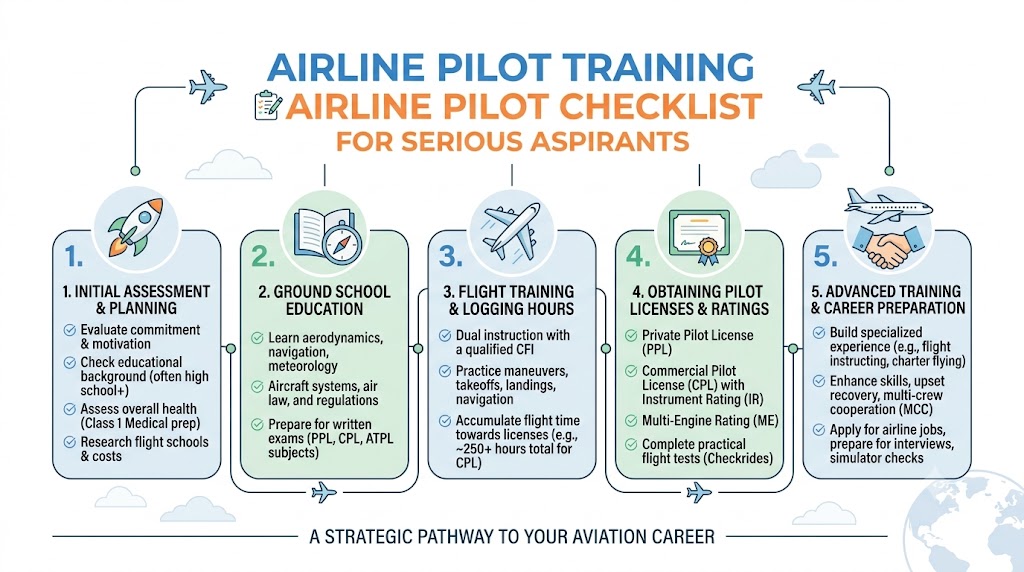
Becoming an airline pilot is not simply a matter of completing flying hours and passing examinations. A serious aspirant needs to manage regulatory eligibility, medical fitness, academic preparation, flight training, communication skills, financial planning, and professional development as one connected process. This checklist provides a practical framework for preparing for airline pilot training while avoiding common mistakes that can create delays or unnecessary expense.
Executive Summary
Airline pilot training demands much more than enthusiasm for aviation. Successful candidates typically combine strong theoretical knowledge, disciplined study habits, consistent flying performance, sound decision-making, professional communication, and careful career planning.
The most important principle is simple:
Do not treat pilot training as a sequence of exams and flying hours. Treat it as preparation for a safety-critical profession.
Requirements vary by country, licensing authority, training organization, and airline. Before committing significant money, confirm the current requirements with the applicable aviation authority and an approved flight-training organization.
1. Understand the Airline Pilot Career Path
Before enrolling in training, understand what the complete pathway looks like.
A typical professional pathway may involve:
- Initial aviation medical assessment
- Educational eligibility
- Ground-school preparation
- Student pilot authorization or equivalent
- Private pilot training, where applicable
- Commercial pilot training
- Instrument training
- Multi-engine training
- Required theory examinations
- Commercial licensing requirements
- Instrument and other applicable ratings
- Additional airline-oriented training
- Multi-crew preparation
- Airline selection and assessment
- Type-specific training, where applicable
- Initial operating experience and supervised line operations
The exact sequence differs between jurisdictions.
Why this matters
A common mistake is choosing a flight school first and researching licensing requirements afterward.
The better approach is to establish:
- Which license you need
- Which authority regulates it
- What medical certificate is required
- What educational qualifications are required
- What examinations are involved
- What flight experience is required
- Which training organizations are approved
- What additional requirements airlines commonly expect
Only then should you compare training options.
2. Eligibility Checklist
Before spending substantial money on training, verify your eligibility.
Basic eligibility
- Confirm the minimum age requirements applicable to your license.
- Confirm educational requirements.
- Check whether mathematics and physics are required.
- Verify English-language requirements.
- Confirm nationality, residency, or documentation requirements where applicable.
- Understand identification and passport requirements.
- Check whether criminal, immigration, or background documentation may be required.
- Confirm any conversion requirements if training or licensing will occur in another country.
Educational preparation
Strong academic preparation is particularly useful in areas such as:
- Mathematics
- Physics
- Basic aerodynamics
- Meteorology
- Navigation
- Aviation regulations
- Aircraft systems
- Human factors
You do not need to be a theoretical physicist to become a pilot, but you should be comfortable learning technical subjects and applying them accurately.
3. Complete the Medical Assessment Early
The aviation medical examination should be one of the first major checkpoints, not something postponed until after significant training expenditure.
Aviation medical standards are specific to the licensing authority and certificate category.
Medical checklist
- Identify the appropriate aviation medical examiner.
- Determine which medical certificate your intended career requires.
- Complete the required examination before committing to a large training investment.
- Understand any limitations placed on your certificate.
- Keep copies of relevant medical documentation.
- Understand the renewal requirements.
- Report relevant changes in health through the appropriate regulatory process.
Why early medical assessment matters
Flight training can represent a substantial financial commitment.
Discovering a medical eligibility issue after paying for extensive training can create significant financial and career disruption.
Practical rule: establish medical eligibility before making irreversible commitments.
4. Choose the Right Training Route
There is no single training route that is automatically best for every student.
Possible pathways may include:
- Integrated professional pilot programs
- Modular training
- University-based aviation programs
- Independent flight-school training
- Military-to-civilian pathways
- Airline-linked or airline-sponsored programs where available
Each has different implications for:
- Cost
- Training pace
- Flexibility
- Scheduling
- Financing
- Instructor continuity
- Aircraft availability
- Progress monitoring
- Career preparation
Integrated vs. Modular Training
| Factor | Integrated | Modular |
|---|---|---|
| Structure | Highly structured | More flexible |
| Training pace | Usually continuous | Can be self-paced |
| Flexibility | Lower | Higher |
| Financing | Program-dependent | Usually staged |
| Personal control | Lower | Higher |
| Suitable for | Students wanting a defined pathway | Students needing flexibility |
Neither option guarantees employment.
The quality of the training organization, instructional standards, aircraft availability, student support, and your own performance matter considerably.
5. Evaluate the Flight School Before Enrolling
Do not select a school solely because its advertised price is low.
A flight school should be evaluated like a serious professional training provider.
Training organization checklist
- Confirm regulatory approval.
- Review the school’s training programs.
- Check aircraft availability.
- Understand aircraft maintenance arrangements.
- Ask about instructor availability.
- Understand typical scheduling delays.
- Review the training syllabus.
- Ask how student progress is monitored.
- Understand examination preparation.
- Review additional or hidden charges.
- Understand refund and withdrawal policies.
- Ask how weather cancellations are handled.
- Ask how aircraft unserviceability affects students.
- Determine whether the school has adequate simulator access.
- Understand the process for addressing training difficulties.
Ask about training continuity
A cheap program that repeatedly loses flying days can become more expensive than a well-managed program.
Look beyond the advertised hourly rate.
Consider:
Aircraft availability + instructor availability + maintenance downtime + weather + scheduling efficiency + administrative delays.
6. Build a Realistic Financial Plan
Pilot training requires financial discipline.
The advertised training price should never be treated as the complete career cost.
Potential expenses can include:
- Tuition
- Flight hours
- Instructor fees
- Simulator sessions
- Examination fees
- Medical examinations
- Licensing fees
- Accommodation
- Transportation
- Food and living expenses
- Training materials
- Headsets and equipment
- Uniforms
- Documentation
- Additional flight training
- Re-tests
- Skill tests
- Travel
- Interview preparation
- Airline assessment expenses
- Type-specific training, depending on the career pathway
Create a training contingency fund
Do not build your financial plan around the assumption that everything will happen exactly according to the school’s minimum schedule.
Training can take longer because of:
- Weather
- Aircraft maintenance
- Instructor availability
- Student performance
- Examination failures
- Scheduling constraints
- Regulatory requirements
- Training interruptions
A responsible financial plan should include a contingency reserve.
7. Build a Strong Ground-School Foundation
Flying skills are only one part of professional pilot preparation.
A serious aspirant should develop strong theoretical knowledge in:
Core subjects
- Air law and regulations
- Aircraft systems
- Aerodynamics
- Meteorology
- Navigation
- Radio communication
- Human performance
- Flight planning
- Performance
- Mass and balance
- Operational procedures
- Principles of flight
- Instrumentation
The exact subjects depend on the license and regulatory authority.
Study checklist
- Establish a regular study schedule.
- Understand concepts instead of memorizing answers.
- Maintain organized notes.
- Review weak subjects systematically.
- Practice calculations.
- Use approved or reputable training material.
- Practice aviation terminology in English.
- Regularly review previously learned material.
8. Treat Aviation English as a Core Skill
Communication errors can become operational problems.
Airline pilots must communicate effectively with:
- Air traffic control
- Other pilots
- Cabin crew
- Dispatch or operations personnel
- Maintenance personnel
- Ground staff
- Company management
Good aviation communication requires more than conversational English.
You should develop:
- Clear pronunciation
- Concise phraseology
- Active listening
- Accurate readbacks
- Confidence without unnecessary talking
- Ability to communicate under pressure
- Ability to clarify ambiguous instructions
- Ability to explain abnormal situations clearly
Practical habit
When studying aviation material, become comfortable thinking about technical concepts in English rather than translating every sentence mentally.
9. Develop Core Flight Skills
The objective of training is not merely to accumulate flight hours.
Focus on developing reliable skills.
Essential areas
- Pre-flight preparation
- Aircraft inspection
- Checklist discipline
- Aircraft control
- Takeoff procedures
- Climb management
- Cruise procedures
- Navigation
- Descents
- Approach procedures
- Landing technique
- Radio communication
- Weather interpretation
- Emergency procedures
- Instrument flying
- Situational awareness
- Decision-making
The important distinction
A student should aim to become consistently competent, not occasionally impressive.
A technically brilliant flight followed by poor checklist discipline is not professional performance.
Airline operations reward consistency.
10. Develop Checklist Discipline Early
One of the most transferable habits from training to airline operations is disciplined checklist use.
Do not rely on memory when a procedure requires a checklist.
Develop the habit of:
- Knowing why the checklist exists.
- Understanding the sequence.
- Using the correct checklist.
- Reading accurately.
- Confirming the required action.
- Avoiding distractions.
- Completing the checklist deliberately.
Checklist discipline should become automatic long before airline training.
11. Learn to Think in Terms of Risk Management
Professional pilots do not simply ask:
“Can I do this?”
They also ask:
“Should I do this under these conditions?”
Consider:
- Weather
- Aircraft condition
- Fuel
- Terrain
- Navigation
- Pilot workload
- Experience level
- Time pressure
- Passenger considerations
- Alternate options
- Airport conditions
- Personal fitness
A useful decision framework
Before a significant decision, consider:
Threat → Risk → Mitigation → Decision → Review
For example:
| Threat | Potential Risk | Mitigation |
|---|---|---|
| Deteriorating weather | Reduced visibility or increased workload | Reassess route and alternatives |
| Aircraft technical issue | Reduced system reliability | Follow approved procedures |
| Fatigue | Reduced attention | Stop or reassess suitability |
| Time pressure | Poor decision-making | Remove the pressure from the decision |
| High workload | Missed information | Prioritize and simplify |
The goal is not to eliminate every risk.
The goal is to recognize, assess, and manage risk professionally.
12. Learn Crew Resource Management Principles
Airline flying is fundamentally a team activity.
Develop the ability to:
- Communicate clearly
- Listen actively
- Challenge unsafe decisions respectfully
- Accept constructive feedback
- Share workload
- Maintain situational awareness
- Manage authority gradients
- Resolve disagreements professionally
- Ask for help when necessary
A strong pilot is not someone who always appears confident.
A strong pilot knows when to question, when to verify, and when to ask for assistance.
13. Build Professional Habits
Professionalism begins during training.
Personal standards checklist
- Arrive prepared.
- Review the flight before reporting.
- Maintain required documentation.
- Keep training records organized.
- Maintain equipment properly.
- Follow procedures consistently.
- Accept instructor feedback.
- Correct recurring weaknesses.
- Communicate respectfully.
- Avoid unnecessary risk-taking.
- Take responsibility for mistakes.
- Maintain punctuality.
These behaviors are often more revealing than simply knowing technical answers.
14. Track Your Training Progress
Do not leave your development entirely in the hands of memory.
Maintain a structured training record.
Track:
| Area | What to Record |
|---|---|
| Flight training | Completed exercises |
| Ground school | Subjects completed |
| Weak areas | Recurring difficulties |
| Instructor feedback | Specific improvement points |
| Examinations | Results and weak topics |
| Simulator training | Scenarios practiced |
| Operational knowledge | Areas requiring review |
| Personal development | Communication and workload skills |
After every flight
Ask yourself:
- What went well?
- What did not go well?
- What did the instructor identify?
- What caused the problem?
- What will I do differently next time?
- Can I explain the lesson without looking at my notes?
This turns each flight into a learning cycle rather than simply another logbook entry.
15. Do Not Hide Weaknesses
One of the most damaging habits a trainee can develop is pretending to understand something that they do not understand.
If you do not understand:
- A procedure
- An aircraft system
- A navigation concept
- A weather situation
- A calculation
- An instructor’s feedback
ask for clarification.
In aviation, uncertainty that is acknowledged can be managed.
Uncertainty that is hidden can become a safety problem.
16. Prepare for Instrument Flying
Instrument flying requires a different mental approach from visual flying.
Develop competence in:
- Instrument interpretation
- Aircraft attitude control
- Navigation systems
- Radio navigation
- Instrument approaches
- Departure procedures
- Holding procedures
- Approach briefings
- Weather interpretation
- Workload management
The key challenge is not simply controlling the aircraft.
It is managing information, automation, navigation, communication, and aircraft control simultaneously.
17. Develop Basic Aircraft Systems Knowledge
You do not need to become an aircraft maintenance engineer, but you should understand the systems relevant to safe operation.
Depending on the aircraft, this may include:
- Engines
- Fuel systems
- Electrical systems
- Hydraulic systems
- Flight controls
- Landing gear
- Pressurization
- Environmental systems
- Ice protection
- Flight instruments
- Communication systems
- Navigation systems
The professional objective is to understand:
What does the system do?
How does it normally operate?
What happens when it fails?
How would the pilot recognize the failure?
What procedure applies?
18. Develop Weather Knowledge
Weather should never be treated as an examination subject only.
A serious pilot should learn how weather affects:
- Visibility
- Cloud
- Wind
- Turbulence
- Thunderstorms
- Icing
- Takeoff and landing performance
- Navigation
- Fuel planning
- Diversion decisions
Learn to interpret weather information in terms of operational consequences, not simply symbols and definitions.
19. Learn Performance and Weight-and-Balance Fundamentals
Aircraft performance is directly connected to safety.
Understand how factors such as:
- Aircraft weight
- Density altitude
- Temperature
- Wind
- Runway length
- Runway surface
- Obstacles
- Aircraft configuration
can affect aircraft performance.
Do not rely on rough mental estimates when approved performance data is required.
Professional flying means knowing when an approximation is inappropriate.
20. Build Strong Decision-Making Skills
Airline selection processes and professional flying both place significant emphasis on judgment.
Develop the ability to:
- Identify the problem.
- Gather relevant information.
- Separate facts from assumptions.
- Consider available options.
- Evaluate risks.
- Select a suitable action.
- Communicate the decision.
- Reassess when conditions change.
Good decision-making does not mean always choosing the most conservative option.
It means choosing an option that is defensible, informed, timely, and consistent with operational requirements.
21. Prepare for Airline Assessments
Once basic training is progressing, begin learning about airline recruitment processes.
Potential assessment areas can include:
- Technical knowledge
- Aviation English
- Aptitude
- Numerical reasoning
- Logical reasoning
- Spatial awareness
- Multi-tasking
- Psychometric assessment
- Group exercises
- Simulator assessment
- Behavioral interviews
- HR interviews
- Competency-based questions
Requirements vary significantly between airlines.
Preparation checklist
- Research the airline carefully.
- Understand the role.
- Review relevant technical subjects.
- Practice structured interview responses.
- Improve mental arithmetic.
- Practice workload-management exercises.
- Practice communication.
- Review your own training history.
- Be prepared to discuss mistakes and lessons learned.
- Understand the airline’s operational environment.
Do not prepare only for the interview.
Prepare for the professional behaviors the interview is trying to identify.
22. Learn From Mistakes Professionally
Interviewers and instructors do not necessarily expect perfection.
They do expect maturity.
A useful structure for discussing a mistake is:
Situation → Action → Result → Lesson → Change
For example, explain:
- What happened
- What you were responsible for
- What you did
- What the consequence was
- What you learned
- What you changed afterward
Avoid blaming:
- instructors
- weather
- aircraft
- classmates
- training organizations
unless those factors genuinely contributed and can be explained objectively.
Accountability is a professional competency.
23. Manage Fatigue and Personal Readiness
Flight training is mentally demanding.
You should develop sustainable habits around:
- Sleep
- Nutrition
- Hydration
- Exercise
- Study
- Recovery
- Stress management
- Time management
Avoid treating exhaustion as evidence of commitment.
Aviation rewards fitness for duty and sound judgment, not unnecessary exhaustion.
If you are not fit to fly, the appropriate response is to follow the applicable aviation requirements and notify the responsible personnel.
24. Build a Personal Training Dashboard
A simple dashboard can make training progress much easier to manage.
Track:
| Category | Status |
|---|---|
| Medical | Complete / Pending |
| Academic eligibility | Complete / Pending |
| Ground school | In progress |
| Examinations | Planned / Passed / Revisit |
| Flight training | In progress |
| Instrument training | Planned / In progress |
| Multi-engine training | Planned / In progress |
| Communication | Needs improvement / Strong |
| Technical knowledge | Needs improvement / Strong |
| Decision-making | Needs improvement / Strong |
| Financial plan | Funded / Review required |
| Airline preparation | Not started / In progress |
Review the dashboard regularly rather than waiting until a problem becomes serious.
25. Common Mistakes Serious Aspirants Should Avoid
Mistake 1: Choosing a school based only on price
The cheapest advertised package may not be the cheapest complete training pathway.
Better approach: evaluate total cost, training reliability, aircraft availability, instructor availability, and additional fees.
Mistake 2: Delaying the medical assessment
This can expose you to unnecessary financial risk.
Better approach: establish medical eligibility early.
Mistake 3: Treating examinations as memorization exercises
Memorized answers do not automatically translate into operational understanding.
Better approach: understand the principle behind the answer.
Mistake 4: Chasing flight hours
More hours do not automatically mean better pilot skills.
Better approach: focus on competency, consistency, and instructor feedback.
Mistake 5: Ignoring communication skills
Technical knowledge without effective communication is insufficient for airline operations.
Better approach: practice clear, concise aviation communication throughout training.
Mistake 6: Hiding mistakes
Trying to appear perfect prevents meaningful learning.
Better approach: acknowledge errors, understand their causes, and demonstrate corrective action.
Mistake 7: Ignoring financial contingencies
Training rarely proceeds exactly according to the optimistic scenario.
Better approach: maintain a realistic reserve for delays and additional training.
Mistake 8: Preparing for the airline assessment too late
Waiting until training is nearly finished can create unnecessary pressure.
Better approach: develop professional knowledge and communication habits from the beginning.
Mistake 9: Confusing confidence with competence
Being comfortable in the cockpit is not the same as being operationally reliable.
Better approach: let competence create confidence.
Mistake 10: Assuming a license guarantees an airline job
Licensing and employment are separate milestones.
Better approach: develop a broader professional profile that includes technical knowledge, communication, teamwork, judgment, and interview readiness.
26. Serious Aspirant Decision Matrix
Before committing to a training program, evaluate it against several dimensions.
| Criterion | Low-Quality Signal | Strong Signal |
|---|---|---|
| Regulatory status | Unclear | Clearly documented |
| Training structure | Informal | Defined syllabus |
| Aircraft availability | Frequent uncertainty | Predictable scheduling |
| Instructor availability | Limited | Adequate staffing |
| Maintenance | Poorly explained | Transparent process |
| Cost | Unclear | Detailed breakdown |
| Progress tracking | Minimal | Regular reviews |
| Student support | Reactive | Structured |
| Simulator access | Limited or unclear | Appropriate for training |
| Career guidance | Marketing-focused | Practical and transparent |
| Safety culture | Hard to assess | Clearly demonstrated |
No single criterion should determine the decision.
Look for the overall operating quality of the organization.
27. Airline Pilot Training Readiness Checklist
Before beginning professional training, you should be able to answer yes to most of the following:
Eligibility
- I understand the applicable licensing pathway.
- I have verified the educational requirements.
- I understand the English-language requirements.
- I have checked the relevant documentation requirements.
Medical
- I understand the medical certificate required for my career objective.
- I have completed or planned the appropriate medical assessment.
- I understand that medical certification must be maintained.
Financial
- I know the estimated total training cost.
- I understand additional expenses.
- I have planned for potential training delays.
- I have a contingency reserve.
- I understand the financial consequences of changing schools or training pathways.
Training
- I have evaluated the training organization.
- I understand the syllabus.
- I have reviewed aircraft availability.
- I understand instructor availability.
- I know how progress is assessed.
- I understand the examination process.
Personal preparation
- I can maintain a disciplined study routine.
- I am comfortable receiving corrective feedback.
- I can communicate clearly.
- I understand the importance of checklist discipline.
- I am prepared for a safety-critical profession.
- I understand that training may be demanding and unpredictable.
28. First 90 Days: A Practical Preparation Plan
Phase 1: Establish Eligibility
Focus on:
- Medical assessment
- Educational requirements
- Licensing authority
- Training pathway
- Documentation
Output: a confirmed eligibility picture.
Phase 2: Compare Training Organizations
Evaluate:
- Regulatory approval
- Fleet
- Maintenance
- Instructor availability
- Training schedule
- Cost
- Student progression
- Additional charges
Output: a shortlist based on evidence rather than advertising.
Phase 3: Strengthen Academic Foundations
Review:
- Mathematics
- Physics
- Aerodynamics
- Navigation fundamentals
- Meteorology
- Aviation terminology
Output: improved readiness for ground school.
Phase 4: Build Professional Habits
Start practicing:
- Punctuality
- Structured study
- Technical reading
- Clear communication
- Personal organization
- Feedback management
- Risk awareness
Output: habits that transfer directly into flight training.
Phase 5: Establish Career Direction
Research:
- Target airlines
- Licensing pathways
- Typical selection processes
- Competency expectations
- Additional training requirements
- Geographic and financial considerations
Output: a realistic career roadmap rather than a vague goal of “becoming a pilot.”
29. How to Know You Are Progressing Properly
Progress should not be measured only by completed hours or passed examinations.
Look for evidence that you are becoming more capable of:
- Preparing independently
- Anticipating problems
- Understanding aircraft behavior
- Managing workload
- Communicating clearly
- Applying procedures correctly
- Recognizing limitations
- Making timely decisions
- Learning from mistakes
- Maintaining situational awareness
A particularly useful question is:
“Could I explain why I made this decision, not just what I did?”
If the answer is consistently yes, your professional thinking is developing.
30. Final Airline Pilot Training Checklist
Use this as a final pre-training review.
Career Planning
- Defined airline pilot career objective
- Identified applicable licensing authority
- Researched the complete training pathway
- Reviewed potential employment pathways
Eligibility
- Educational requirements verified
- Age requirements verified
- Documentation requirements understood
- English requirements understood
Medical
- Appropriate aviation medical assessment completed or planned
- Medical certificate requirements understood
- Ongoing medical responsibilities understood
Training Organization
- Regulatory approval verified
- Aircraft fleet evaluated
- Maintenance standards reviewed
- Instructor availability evaluated
- Training syllabus reviewed
- Student progression process understood
Financial Planning
- Full estimated cost calculated
- Additional fees identified
- Accommodation and living expenses considered
- Examination and licensing costs considered
- Contingency reserve established
Academic Preparation
- Mathematics reviewed
- Physics reviewed
- Aerodynamics understood
- Meteorology fundamentals studied
- Navigation fundamentals studied
- Aviation terminology practiced
Flight Preparation
- Checklist discipline developed
- Pre-flight preparation understood
- Basic aircraft systems studied
- Weather interpretation practiced
- Risk management understood
- Decision-making skills developed
Professional Development
- Communication skills improving
- Feedback accepted constructively
- Mistakes analyzed honestly
- Teamwork skills developed
- CRM principles understood
- Fatigue management taken seriously
Airline Preparation
- Target airlines researched
- Selection processes understood
- Technical interview preparation started
- Aptitude preparation started where relevant
- Simulator assessment expectations understood
- Behavioral interview preparation started
FAQs
Q1. What should I do before paying for airline pilot training?
First verify your eligibility, complete the appropriate aviation medical assessment, understand the licensing pathway, compare approved training organizations, and calculate the realistic total cost including contingency expenses.
Q2. Is choosing the cheapest flight school a good strategy?
Not necessarily. Training reliability, aircraft availability, instructor capacity, maintenance, scheduling, and additional fees can have a greater effect on the final cost and completion time than the advertised hourly rate.
Q3. How important are mathematics and physics for pilot training?
They are useful because aviation involves performance calculations, navigation, aerodynamics, aircraft systems, and other technical subjects. You do not need advanced academic mathematics, but you should be comfortable with the mathematical and physical concepts required by your training program.
Q4. Should I complete the aviation medical examination before starting training?
For someone seriously considering professional aviation, establishing medical eligibility early is a prudent step because it reduces the risk of making a major financial commitment before discovering a certification issue.
Q5. Are flight hours the most important measure of pilot progress?
No. Hours are one measure of experience, but competence also involves aircraft control, procedural discipline, communication, decision-making, situational awareness, technical knowledge, and the ability to manage workload safely.
Q6. When should I start preparing for airline interviews?
It is better to develop relevant professional habits throughout training rather than treating airline preparation as a last-minute activity. Technical knowledge, communication, teamwork, judgment, and accountability take time to develop.
Q7. What qualities do serious airline pilot aspirants need?
Discipline, consistency, technical curiosity, communication skills, sound judgment, humility, situational awareness, resilience, teamwork, and a strong commitment to safety are among the most valuable qualities.
Q8. What is the biggest financial mistake aspiring pilots make?
One common mistake is planning around the minimum advertised training cost without considering additional flight hours, examinations, accommodation, equipment, delays, repeat training, and other career-related expenses.
Q9. Do I need to be naturally confident to become an airline pilot?
Confidence can develop through competence and experience. More important than appearing confident is being able to recognize limitations, follow procedures, communicate clearly, and make sound decisions.
Q10. What should I look for in a good flight school?
Look for regulatory compliance, a strong safety culture, reliable aircraft availability, qualified instructors, effective maintenance, structured training, transparent costs, meaningful progress reviews, and a clear process for addressing struggling students.
Conclusion
Airline pilot training should be approached as professional development, not simply as a path to collecting licenses and flight hours.
The strongest preparation begins with medical and regulatory eligibility, realistic financial planning, and careful selection of the training organization.
During training, prioritize technical understanding, checklist discipline, communication, decision-making, teamwork, and consistent performance.
Treat mistakes as opportunities to identify weaknesses and build better habits.
Most importantly, develop the judgment and professionalism expected from someone responsible for the safe operation of an aircraft and the people aboard it.
A serious aspirant does not merely aim to complete training; the aim is to become consistently safe, competent, disciplined, and employable as a professional pilot.

