
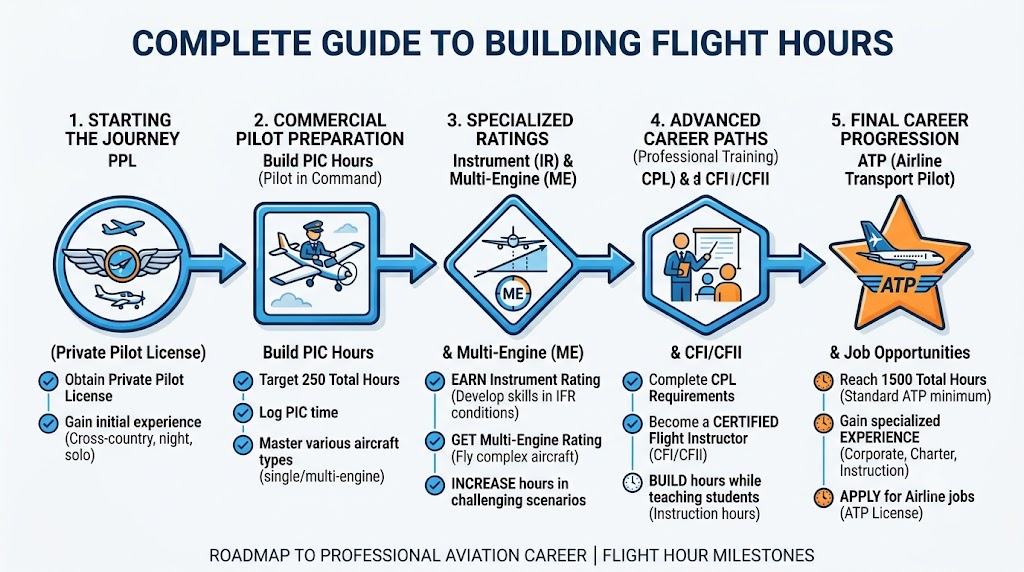
Building flight hours is an important part of becoming a more experienced and capable pilot. Whether a student is working toward an initial certificate, an advanced rating, or a professional aviation career, flight experience develops through structured training, authorized flying, and consistent practice.
However, building hours is not simply about reaching a large number on a logbook. The type, quality, and purpose of flight experience also matter. Different certificates and ratings may have different experience requirements, and not every flight hour automatically satisfies every requirement.
What Does Building Flight Hours Mean?
Building flight hours means accumulating and properly recording qualifying flight experience over time.
A pilot’s logbook can contain different categories of experience depending on the nature of the flight, the pilot’s role, the aircraft, the training being conducted, and applicable regulations.
Flight experience may come from:
- Flight instruction
- Authorized solo flying
- Cross-country flights
- Night flying
- Instrument training
- Additional ratings
- Other legitimate aviation activities
The important point is that total flight time is only one part of a pilot’s experience profile.
For example, a pilot may need particular types of experience for a certificate or rating rather than simply a large total number of hours.
Always verify applicable requirements with the relevant aviation authority, instructor, or approved training organization. Requirements vary by certificate, rating, jurisdiction, and individual circumstances.
Why Do Pilots Need to Build Flight Hours?
Flight experience helps pilots develop skills that cannot be fully developed through classroom study alone.
Regular flying can help pilots improve:
- Aircraft handling
- Navigation
- Communication
- Situational awareness
- Decision-making
- Workload management
- Flight planning
- Weather awareness
- Radio communication
- Operational discipline
- Familiarity with aircraft systems
Experience also gives pilots opportunities to apply concepts learned during ground training.
However, more hours do not automatically make someone a better pilot. The quality of training, consistency, feedback, preparation, and variety of appropriate experience all contribute to meaningful development.
Different Types of Flight Experience
Understanding the different categories of flight experience is essential when planning pilot training.
1. Dual Flight Instruction
Dual instruction is flight training conducted with a qualified flight instructor.
This is normally a major part of a student’s development because the instructor can:
- Demonstrate techniques
- Observe the student’s performance
- Correct mistakes
- Introduce new skills
- Evaluate progress
- Provide structured feedback
- Help the student prepare for future stages of training
Instructor-led flights should have a clear learning purpose rather than being treated simply as a way to increase the number of hours in a logbook.
2. Solo Flight
Authorized solo flying provides an opportunity for eligible student pilots to develop independence.
Depending on the applicable training program and authorization, solo experience can help students develop:
- Aircraft-handling confidence
- Planning skills
- Decision-making
- Personal responsibility
- Familiarity with the aircraft
- Consistency in basic procedures
Solo operations must always remain within the pilot’s authorization, training, aircraft limitations, and applicable regulations.
3. Cross-Country Experience
Cross-country flying introduces additional planning and operational considerations.
It can help pilots develop experience with:
- Route planning
- Navigation
- Airport selection
- Weather assessment
- Fuel planning
- Communication
- Diversion considerations
- Changing environmental conditions
Cross-country experience can be particularly valuable because it exposes pilots to situations beyond the immediate training environment.
The exact definition and qualifying requirements for cross-country experience depend on the applicable rules and certificate or rating.
4. Night Flight Experience
Night flying introduces a different operating environment from daytime flying.
Training and experience may help pilots understand:
- Changes in visual references
- Airport lighting
- Reduced visibility cues
- Increased importance of instrument awareness
- Different workload considerations
- Night-specific planning requirements
Pilots should receive appropriate training before conducting night operations and should follow approved procedures and applicable regulations.
5. Instrument Experience
Instrument training develops skills associated with operating by reference to flight instruments and following instrument procedures.
It can help pilots develop:
- Instrument interpretation
- Aircraft control using instruments
- Procedure awareness
- Navigation skills
- Workload management
- Communication discipline
Instrument experience can become an important part of a pilot’s development, particularly for those pursuing advanced certificates and professional aviation pathways.
6. Pilot-in-Command Experience
Pilot-in-command experience is another important concept in flight-hour planning.
Whether a particular flight can be logged in a particular capacity depends on the circumstances and applicable regulations.
Pilots should therefore avoid assuming that every flight automatically qualifies as PIC experience.
Accurate logbook entries and a clear understanding of applicable logging rules are essential.
How Students Typically Build Flight Hours
Flight-hour accumulation usually develops progressively rather than through one single activity.
A general training pathway may include:
- Initial flight lessons
- Basic aircraft control
- Structured instructor-led training
- Authorized solo experience
- Cross-country development
- Additional training areas
- Instrument training
- Additional certificates or ratings
- Continued legitimate flight experience
- Preparation for professional aviation opportunities
The exact progression can differ considerably between students.
A pilot should therefore build a plan around their specific training objective, rather than copying another pilot’s hour-building strategy.
Ways to Build Flight Experience
There are several legitimate ways pilots may accumulate experience throughout their training journey.
Structured Flight-School Training
Flight schools provide organized training with instructors, aircraft, scheduling systems, and established training programs.
This approach can be useful for pilots who need:
- Structured instruction
- Regular progress reviews
- Access to instructors
- Organized aircraft scheduling
- A defined training pathway
Continued Training
Even after completing an initial certificate, pilots may continue flying with instructors to improve their skills.
Additional training can support:
- New ratings
- Advanced aircraft skills
- Instrument development
- Cross-country experience
- Proficiency
- Preparation for future aviation goals
Additional Ratings
Additional ratings can provide structured opportunities to gain new types of experience while developing additional capabilities.
Examples may include training associated with:
- Instrument flying
- Multi-engine aircraft
- Other applicable ratings
The exact requirements vary according to the certificate, rating, jurisdiction, and training pathway.
Legitimate Experience-Building Opportunities
Pilots may encounter different opportunities to gain flight experience as they progress.
Before participating in any opportunity, pilots should confirm:
- Whether the activity is legitimate
- Whether the pilot is properly qualified
- Whether the activity complies with applicable regulations
- What experience can actually be logged
- What responsibilities are involved
A low-cost opportunity is not automatically a good opportunity if the activity is poorly structured or does not provide the experience the pilot actually needs.
Flight School vs. Independent Experience Building
Different approaches can serve different purposes.
| Factor | Structured Flight School | Independent or Other Experience |
|---|---|---|
| Training structure | Usually organized | May be more flexible |
| Instructor access | Generally available | May vary |
| Aircraft availability | Depends on school fleet | Depends on aircraft access |
| Scheduling | School-based | Potentially more flexible |
| Training objectives | Usually clearly defined | Must be carefully planned |
| Cost considerations | Varies by school and program | Varies significantly |
| Record keeping | Often supported by training records | Greater personal responsibility |
| Skill development | Structured progression | Depends on how experience is used |
| Flexibility | Depends on school policies | May offer greater flexibility |
| Best suited for | Students needing structured training | Pilots with appropriate experience and planning |
Neither approach should be considered universally appropriate. The right choice depends on the pilot’s training objective, experience level, budget, schedule, and applicable requirements.
How Much Does Building Flight Hours Cost?
Flight-hour building can represent a significant part of a pilot’s overall training budget.
The total cost can be affected by:
- Aircraft rental rates
- Instructor fees
- Aircraft type
- Fuel and operating expenses
- Airport charges
- Training location
- Aircraft availability
- Weather cancellations
- Maintenance downtime
- Additional training
- Examination or evaluation requirements
- Repeated lessons
- Scheduling efficiency
One of the most common budgeting mistakes is focusing only on the advertised aircraft hourly rate.
A lower aircraft rate does not necessarily mean a lower overall training cost.
For example, differences in aircraft availability, instructor scheduling, travel requirements, or training efficiency can affect the final amount spent.
What Affects the Time Needed to Build Flight Hours?
There is no single timeline that applies to every pilot.
Several factors can affect the pace of flight-hour accumulation.
Student Learning Pace
Students progress at different rates. Some may need additional practice before moving to a new training stage.
Training Frequency
Consistent training can help maintain continuity. Long gaps between flights may require additional review or practice.
Weather
Weather can affect the availability of suitable training conditions and may result in cancellations or schedule changes.
Aircraft Availability
A training organization may have limited aircraft availability, particularly during busy periods.
Instructor Availability
Instructor schedules can also affect how frequently a student can fly.
Maintenance
Aircraft may periodically become unavailable for maintenance or inspections.
Personal Schedule
School, work, family commitments, and other responsibilities can affect training frequency.
Financial Resources
A student’s budget can determine how frequently they can schedule flights and how quickly they can progress.
How to Plan a Flight-Hour Building Strategy
A good hour-building plan begins with the pilot’s long-term objective.
Step 1: Identify Your Aviation Goal
Ask yourself what you are working toward.
Your objective might involve:
- Recreational flying
- A private pilot certificate
- An instrument rating
- Commercial pilot training
- Additional aircraft ratings
- A professional pilot career
Your objective determines which types of experience deserve attention.
Step 2: Understand the Applicable Requirements
Do not assume that another pilot’s experience requirements apply to you.
Review the requirements associated with your:
- Certificate
- Rating
- Training program
- Jurisdiction
- Intended aviation pathway
Discuss uncertain requirements with a qualified instructor or training organization.
Step 3: Create a Training Schedule
A realistic schedule is usually more useful than an unrealistic plan based solely on maximizing hours.
Consider:
- Weekly availability
- Instructor availability
- Aircraft availability
- Weather
- Budget
- Academic or work commitments
Consistency can help maintain training continuity.
Step 4: Track Different Experience Categories
Do not focus exclusively on total flight time.
Track relevant categories accurately so you can understand your progress toward specific goals.
Your instructor or training organization can help you understand which categories matter for your pathway.
Step 5: Review Progress Regularly
Regular progress reviews can help identify:
- Areas needing more practice
- Upcoming training milestones
- Budget changes
- Scheduling problems
- Additional experience requirements
This can prevent students from accumulating hours without a clear development objective.
Step 6: Control the Budget
Create a realistic aviation budget that accounts for more than aircraft rental.
Consider:
- Aircraft
- Instructor
- Fuel-related charges where applicable
- Airport expenses
- Training materials
- Exams and evaluations
- Additional practice
- Unexpected cancellations or delays
Step 7: Think Beyond the Next Flight
Every flight should fit into a broader training plan.
Instead of asking only:
“How can I get more hours?”
also ask:
“What useful experience should I develop next?”
That shift can make hour building more purposeful.
Maintaining an Accurate Pilot Logbook
The logbook is an important record of a pilot’s experience.
Good record keeping includes:
- Recording flights promptly
- Entering required information accurately
- Separating applicable experience categories
- Reviewing entries for mistakes
- Maintaining supporting documentation where appropriate
- Following applicable logging requirements
- Keeping important records secure
A small logging error can become more significant when a pilot later needs to demonstrate experience for training, certification, or another aviation purpose.
When uncertain about whether a flight qualifies for a particular category, pilots should seek clarification rather than guessing.
Common Flight-Hour Building Mistakes
1. Focusing Only on the Total Number of Hours
A large total does not automatically represent well-rounded experience.
Better approach: Track the types and quality of experience that support your specific training goals.
2. Ignoring Training Quality
Some pilots may become overly focused on accumulating hours instead of improving skills.
Better approach: Make each stage of training purposeful and use instructor feedback to identify areas for improvement.
3. Flying Too Infrequently
Long gaps can make it harder to maintain continuity.
Better approach: Create a realistic schedule that fits your finances and availability.
4. Choosing an Aircraft Only Because It Appears Cheap
The lowest hourly rate may not produce the lowest overall training cost.
Better approach: Compare the complete training cost, availability, instructor access, and suitability of the aircraft.
5. Failing to Understand What Experience Is Needed
Not every hour serves the same purpose.
Better approach: Identify the specific experience categories relevant to your training pathway.
6. Poor Logbook Management
Incomplete or inaccurate records can create problems later.
Better approach: Maintain your logbook carefully and review entries regularly.
7. Ignoring Instructor Feedback
An instructor may identify areas requiring additional practice.
Better approach: Treat feedback as part of the training process rather than as an obstacle to hour accumulation.
8. Treating Every Flight as an Hour-Building Exercise
Flight time should contribute to meaningful skill development whenever possible.
Better approach: Establish a clear purpose for each training or experience-building flight.
9. Failing to Budget for Additional Training
Students sometimes underestimate the possibility of needing additional practice.
Better approach: Keep some financial flexibility in your training budget.
10. Choosing Experience Opportunities Without Verification
Not every advertised opportunity is appropriate for every pilot.
Better approach: Confirm qualifications, responsibilities, legitimacy, and logging eligibility before participating.
How to Make Flight-Hour Building More Efficient
Efficient hour building does not mean rushing through training.
Instead, focus on:
Consistency
Regular training can help maintain familiarity and reduce unnecessary repetition.
Preparation
Reviewing relevant training material before a flight can make instructional time more productive.
Clear Objectives
Know what skill or experience the flight is intended to develop.
Instructor Feedback
Use instructor observations to identify areas that need attention.
Smart Scheduling
Coordinate aircraft, instructor, weather, and personal availability as effectively as possible.
Accurate Records
Maintain your logbook and training records carefully.
Budget Awareness
Monitor actual spending instead of relying only on initial estimates.
Long-Term Planning
Make sure hour building supports your broader certificate, rating, or career objective.
Flight-Hour Building and Career Planning
For aspiring professional pilots, flight-hour building can become part of a much larger development pathway.
A pilot may progress through various stages involving:
- Initial pilot training
- Additional ratings
- Instrument development
- Commercial training
- Instructor qualifications
- Other legitimate professional experience
- Advanced aviation opportunities
The exact pathway varies.
Professional aviation employers may also consider factors beyond total flight hours, depending on the role and organization.
These can include:
- Certificates and ratings
- Aircraft experience
- Recency
- Training records
- Professional qualifications
- Communication skills
- Interview performance
- Organizational requirements
Therefore, aspiring professional pilots should avoid treating one flight-hour number as the complete definition of career readiness.
Choosing a Flight School for Hour Building
Before selecting a flight school or training organization, consider more than the advertised hourly aircraft rate.
Aircraft Availability
Ask how frequently students can realistically access the aircraft.
Instructor Availability
An aircraft may be available while instructor availability remains limited.
Training Structure
Understand how the school organizes training and progress reviews.
Aircraft Fleet
Consider whether the available aircraft fit your training objectives.
Pricing Transparency
Ask for a clear explanation of charges and potential additional expenses.
Safety Culture
Pay attention to how the organization approaches training, maintenance, procedures, and student concerns.
Documentation
Understand how training records and flight experience are documented.
Scheduling
Consider whether the school’s scheduling practices fit your availability.
Training Continuity
Ask how the organization handles aircraft downtime, instructor changes, and other interruptions.
Questions to Ask Before Paying for Flight Hours
Before committing to a flight school or experience-building arrangement, consider asking:
- What aircraft will I be flying?
- What is included in the published hourly rate?
- Are instructor fees separate?
- How is flight experience documented?
- What categories of experience can I expect to build?
- What happens when weather cancels a flight?
- How often is the aircraft normally available?
- What happens if the aircraft is unavailable for maintenance?
- What training pathway is recommended for my goal?
- What additional costs should I expect?
- How are student progress and training records reviewed?
- Who can clarify regulatory or logging questions?
Clear answers can make it easier to compare training options realistically.
Flight-Hour Building Checklist
Training
- Define your aviation objective
- Select an appropriate training program
- Establish a realistic schedule
- Work with qualified instructors
- Review progress regularly
- Identify areas requiring additional practice
Flight Experience
- Understand the relevant experience categories
- Track applicable experience accurately
- Build experience appropriate to your training pathway
- Avoid accumulating hours without a clear purpose
Logbook
- Record flights accurately
- Keep records current
- Review entries for errors
- Maintain supporting documents where appropriate
- Confirm uncertain logging questions with a qualified source
Financial Planning
- Understand aircraft costs
- Understand instructor charges
- Consider additional training costs
- Account for weather-related delays
- Account for aircraft maintenance downtime
- Maintain a contingency budget
Safety
- Follow approved training procedures
- Stay within your authorization
- Respect aircraft limitations
- Follow applicable regulations
- Seek qualified guidance when uncertain
Flight-Hour Building Comparison
| Approach | Main Purpose | Training Value | Flexibility | Cost Considerations | Important Consideration |
|---|---|---|---|---|---|
| Instructor-led training | Skill development | High when properly structured | Moderate | Instructor and aircraft costs | Best aligned with specific learning objectives |
| Authorized solo flying | Independent experience | Develops independence | Varies | Primarily aircraft-related costs | Must remain within authorization |
| Cross-country training | Navigation and planning experience | Develops broader operational skills | Moderate | Depends on route and aircraft | Requirements vary |
| Instrument training | Instrument skills and procedures | Develops advanced capabilities | Structured | Instructor and aircraft costs | Requires appropriate training |
| Additional ratings | Broader qualifications | Expands experience | Depends on program | Additional training investment | Requirements vary |
| Other legitimate experience | Continued development | Depends on activity | Varies | Highly variable | Verify legality and logging eligibility |
Decision Guide: Choosing Your Hour-Building Approach
If You Are Still Learning Basic Aircraft Control
Prioritize structured instruction and skill development rather than simply accumulating hours.
If You Are Authorized for Solo Flying
Use authorized solo experience to develop independence while remaining within your training authorization and applicable rules.
If You Are Preparing for Advanced Training
Identify the specific experience categories your next training objective requires.
If You Are Working Toward a Professional Career
Build a long-term plan connecting certificates, ratings, experience, training quality, and future career requirements.
If Budget Is a Major Concern
Compare the total training cost, not simply the advertised hourly aircraft rate.
If You Are Unsure What Hours You Need
Speak with your instructor or training provider and verify the applicable requirements before paying for additional flying.
Myths About Building Flight Hours
Myth 1: More Hours Automatically Mean a Better Pilot
Experience is valuable, but quality training, sound decision-making, recency, and continued learning also matter.
Myth 2: Every Flight Hour Counts Toward Every Requirement
Different certificates and ratings may require specific categories of experience.
Myth 3: The Cheapest Aircraft Is Always the Cheapest Training Option
Hourly aircraft cost is only one part of the total training expense.
Myth 4: Flying Occasionally Is Just as Effective as Consistent Training
Long gaps can affect continuity and may result in additional review or practice.
Myth 5: Once You Have Enough Hours, Instructor Feedback Is No Longer Important
Continued learning and proficiency development remain important throughout a pilot’s career.
Myth 6: Only Total Flight Time Matters
The type and nature of experience can also be important depending on the pilot’s objective.
Myth 7: Every Flight School Builds Hours the Same Way
Training structure, aircraft, instructors, scheduling, pricing, and available opportunities can vary considerably.
Frequently Asked Questions
Q1. What does building flight hours mean?
Building flight hours means accumulating and properly recording qualifying flight experience through appropriate training and flying activities.
Q2. Why do pilots need to build flight hours?
Flight experience helps pilots develop practical skills and may also be required for specific certificates, ratings, or aviation career pathways.
Q3. What types of flight experience can pilots accumulate?
Experience can include instructor-led training, authorized solo flying, cross-country experience, night experience, instrument training, and other qualifying activities.
Q4. Does every flight hour count toward every pilot requirement?
No. The applicable requirements may specify particular types or categories of experience.
Q5. How can a student pilot build experience safely?
Students should follow their approved training program, remain within their authorization, follow applicable regulations, and work with qualified instructors.
Q6. How long does it take to build flight hours?
The timeline varies according to training frequency, weather, aircraft and instructor availability, student progress, finances, and the specific training objective.
Q7. How much does flight-hour building cost?
Costs vary by aircraft, location, training organization, instructor, scheduling, and additional training requirements.
Q8. Should I focus on hours or training quality?
Both matter, but simply maximizing the number of hours should not replace meaningful training and skill development.
Q9. How important is maintaining an accurate logbook?
Accurate record keeping is essential because pilots may need to demonstrate their experience for training, certification, ratings, or other aviation purposes.
Q10. Can additional ratings help build useful experience?
Additional ratings can provide structured training and experience, but the value depends on the pilot’s specific goals and applicable requirements.
Q11. What should I ask a flight school before paying for hour building?
Ask about aircraft availability, instructor fees, total costs, training structure, documentation, scheduling, maintenance downtime, and the experience you can legitimately expect to gain.
Q12. How should I plan flight-hour building for a professional pilot career?
Start with the desired career pathway, identify applicable certificates and ratings, understand the relevant experience requirements, establish a realistic budget, and build experience through structured and legitimate training opportunities.
Conclusion
Building flight hours is about more than increasing the number recorded in a logbook.
The most useful experience combines consistent training, meaningful practice, accurate records, and appropriate flight activities.
Pilots should understand which types of experience support their particular goals before spending money on additional flying.
A realistic schedule and budget can make the training process more manageable.
Most importantly, hour building should always remain within applicable rules, training authorizations, and safe operating practices.
With a clear plan, pilots can turn accumulated flight experience into meaningful progress toward their aviation goals.

