
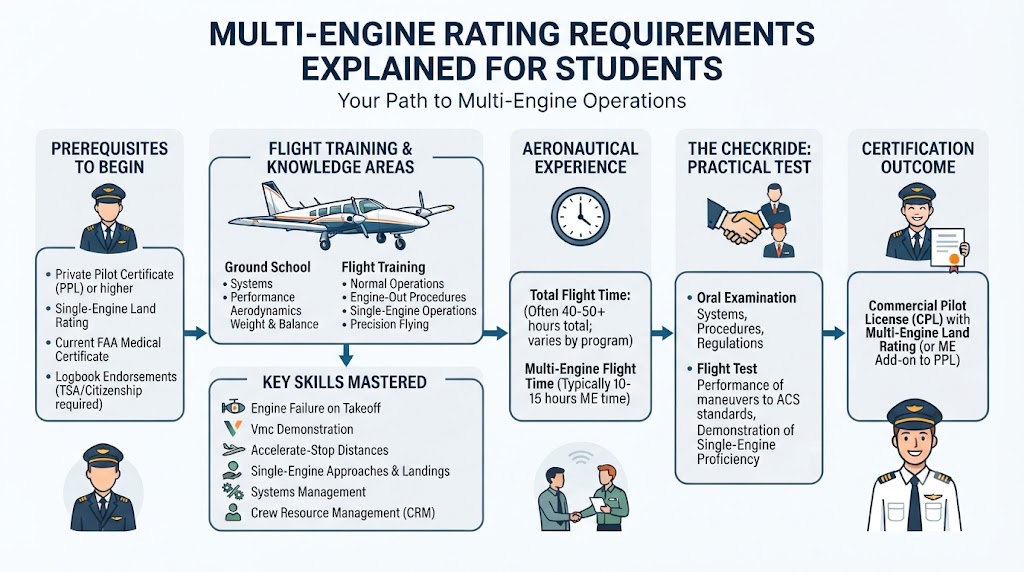
Adding a multi-engine rating can be an important step for student pilots who want to expand their flying capabilities and gain experience operating aircraft with more than one engine. However, multi-engine training involves more than simply learning how to control an aircraft with two engines.
Students need to understand eligibility, aircraft systems, performance, weight and balance, emergency concepts, flight training, instructor requirements, and practical-test preparation. A clear understanding of these areas can make the training process more organized and productive.
The exact requirements can vary depending on the student’s existing pilot certificate, aircraft category, jurisdiction, and applicable aviation regulations. Students should always confirm the requirements that apply to their specific situation with the appropriate aviation authority and a qualified flight instructor.
What Is a Multi-Engine Rating?
A multi-engine rating is an additional pilot qualification that allows a pilot to exercise applicable privileges in aircraft with multiple engines, subject to the relevant certificate, category, class, and operating requirements.
Multi-engine aircraft introduce additional systems and performance considerations compared with many single-engine aircraft.
Students may need to develop knowledge and skills related to:
- Multiple engine systems
- Propeller operation
- Fuel management
- Electrical systems
- Aircraft performance
- Weight and balance
- Asymmetric thrust
- Engine-out considerations
- Emergency procedures
- Multi-engine aerodynamics
- Aircraft limitations
The training is designed to help pilots understand how the aircraft behaves during normal operations and how performance can change when an engine is not producing power.
Who Should Consider Multi-Engine Training?
Multi-engine training can be useful for pilots with different aviation goals.
Students may consider it if they want to:
- Expand their pilot qualifications
- Gain experience with multi-engine aircraft
- Prepare for certain professional aviation pathways
- Develop broader aircraft-handling skills
- Become familiar with more complex aircraft systems
- Build experience beyond single-engine flying
However, students should first determine whether multi-engine training fits their current experience and future goals.
A conversation with a flight instructor can help identify the appropriate training path.
Understanding Multi-Engine Rating Requirements
One of the first steps is determining which requirements apply to you.
The applicable requirements can depend on factors such as:
- Your existing pilot certificate
- Existing ratings
- Aircraft category
- Aircraft class
- Training pathway
- Applicable aviation regulations
- Medical or fitness requirements where applicable
- Knowledge and practical-test requirements
Because these requirements can differ between situations, students should not assume that another pilot’s pathway will be identical to theirs.
Before beginning training, confirm your specific eligibility with a qualified instructor or the relevant aviation authority.
1. Review Your Existing Pilot Qualifications
Before enrolling in multi-engine training, review your current pilot credentials.
Consider:
- What pilot certificate do you currently hold?
- Which aircraft category and class privileges do you have?
- Do you already have relevant flight experience?
- Are any additional prerequisites applicable to your training pathway?
- Are your required documents current?
A flight school can help determine how your existing qualifications fit into its training program.
Having this information organized before enrollment can also prevent confusion later.
2. Understand the Training Aircraft
The aircraft used for multi-engine training can have a major influence on the learning experience.
Students should become familiar with:
- Cockpit layout
- Engine controls
- Engine instruments
- Propeller systems
- Fuel system
- Electrical system
- Landing gear
- Flight controls
- Emergency equipment
- Aircraft limitations
The aircraft handbook and other applicable manufacturer documentation should be the primary references for aircraft-specific information.
Do not assume that all multi-engine aircraft operate in exactly the same way.
3. Complete Ground Training
Multi-engine training involves a substantial knowledge component.
Ground instruction may cover topics such as:
Aircraft Systems
Students may study:
- Engines
- Propellers
- Fuel systems
- Electrical systems
- Landing gear
- Flight controls
- Instruments
Performance
Students may learn about:
- Takeoff performance
- Climb performance
- Landing performance
- Weight and balance
- Density altitude
- Fuel planning
- Aircraft limitations
Aerodynamics
Important concepts can include:
- Asymmetric thrust
- Yaw
- Drag
- Propeller effects
- Engine-out performance
- Aircraft control
Emergency Concepts
Students may also learn how to recognize abnormal engine indications and understand the appropriate response framework based on aircraft-specific procedures and instructor guidance.
4. Learn Multi-Engine Aerodynamics
One of the major differences between single-engine and multi-engine training is understanding what happens when the thrust produced by the engines is not balanced.
Students may encounter concepts involving:
- Asymmetric thrust
- Yaw
- Drag
- Roll tendencies
- Propeller effects
- Aircraft controllability
- Performance changes
These concepts are important because losing power from one engine can change the aircraft’s handling characteristics.
Rather than trying to memorize isolated concepts, students should aim to understand why the aircraft responds differently.
5. Understand Engine-Out Concepts
Engine-out training is an important part of multi-engine education.
Students learn about situations in which one engine is not producing expected power and how that affects aircraft performance and control.
Training may involve:
- Recognizing abnormal indications
- Maintaining aircraft control
- Understanding performance changes
- Following the aircraft checklist
- Communicating appropriately
- Making sound decisions
- Working with the instructor through simulated scenarios
The exact procedures depend on the aircraft.
Students should never substitute general internet guidance for the aircraft’s checklist or instructor-led training.
6. Study Aircraft Performance
Multi-engine pilots need a strong understanding of aircraft performance.
Performance can be influenced by:
- Aircraft weight
- Center of gravity
- Temperature
- Density altitude
- Runway conditions
- Fuel quantity
- Aircraft configuration
- Engine performance
Students should learn how to use the performance information provided for the aircraft they are training in.
Avoid relying on generic performance assumptions because aircraft characteristics can differ considerably.
7. Understand Weight and Balance
Weight and balance become particularly important as pilots learn to manage aircraft performance.
Students should understand the relationship between:
- Aircraft weight
- Center of gravity
- Fuel
- Passengers
- Baggage
- Aircraft loading
Training should teach students how to interpret the applicable aircraft documentation and determine whether a planned operation falls within the aircraft’s published limitations.
Good weight-and-balance habits should become part of the pilot’s normal planning routine.
8. Become Familiar With Engine Systems
A multi-engine pilot should have a strong understanding of the aircraft’s engine systems.
Study areas may include:
- Engine operation
- Propeller operation
- Engine instruments
- Fuel supply
- Lubrication
- Cooling
- Electrical generation
- Engine controls
Understanding the systems helps students recognize abnormal indications and communicate more effectively with instructors and maintenance professionals.
9. Study the Fuel System
Fuel management is another important area of multi-engine training.
Depending on the aircraft, students may need to understand:
- Fuel tanks
- Fuel selectors
- Fuel pumps
- Fuel lines
- Fuel monitoring
- Fuel quantity indications
- Fuel planning
Students should study the specific aircraft’s documentation because fuel-system configurations can vary significantly between aircraft.
10. Understand Electrical Systems
Many multi-engine aircraft have electrical systems that require additional understanding.
Students may learn about:
- Batteries
- Alternators or generators
- Electrical buses
- Instruments
- Electrical loads
- Circuit protection
- Electrical indications
The goal is not simply to memorize component names. Students should understand how the aircraft’s electrical system works and how relevant indications may change during abnormal situations.
11. Learn the Aircraft’s Limitations
Every training aircraft has specific limitations.
Students should become familiar with the applicable information concerning:
- Weight
- Loading
- Airspeed
- Engine operation
- Temperature
- Altitude
- Aircraft configuration
- Performance
- Operating restrictions
These limitations should always come from the aircraft’s official documentation.
A limitation from one aircraft should never automatically be applied to another aircraft.
12. Choose the Right Flight Training School
Selecting a suitable training provider can make a significant difference in the learning experience.
When evaluating a flight school, consider:
- Instructor qualifications
- Aircraft availability
- Aircraft condition
- Maintenance support
- Training syllabus
- Scheduling
- Ground-training resources
- Practical-test preparation
- Safety culture
Ask how the school organizes its multi-engine training and what students can expect throughout the program.
13. Work With a Qualified Flight Instructor
A qualified instructor provides more than flight-hour instruction.
An instructor can help students:
- Understand aircraft systems
- Practice aircraft handling
- Develop checklist discipline
- Understand performance
- Work through abnormal scenarios
- Identify weak areas
- Prepare for evaluations
- Develop sound decision-making habits
Students should be comfortable asking questions whenever a procedure or concept is unclear.
14. Prepare for Flight Lessons
Students can make their flight lessons more productive by preparing before arriving at the airport.
Before a lesson, consider:
- Reviewing the aircraft handbook
- Studying assigned ground material
- Reviewing previous lesson notes
- Preparing questions
- Reviewing relevant performance information
- Studying applicable limitations
- Getting adequate rest
Good preparation allows students to spend more training time developing practical skills rather than learning basic concepts for the first time in the cockpit.
15. Develop Strong Checklist Habits
Checklist discipline is an important part of professional flight training.
Students should learn to:
- Use the aircraft’s applicable checklist
- Understand why checklist items matter
- Avoid relying entirely on memory
- Complete procedures systematically
- Communicate clearly with the instructor
The objective is not simply to read a checklist. Students should understand the procedures they are performing and know when to seek clarification.
16. Prepare for Practical Testing
Students working toward a multi-engine rating should understand the knowledge and practical expectations applicable to their training pathway.
Preparation may include:
- Reviewing aircraft systems
- Studying multi-engine aerodynamics
- Reviewing performance concepts
- Practicing weight-and-balance calculations
- Understanding limitations
- Reviewing emergency concepts
- Practicing checklist discipline
- Reviewing instructor feedback
Students should work with their instructor to identify areas that need additional practice before testing.
17. Common Multi-Engine Training Mistakes
Focusing Only on Flight Hours
Completing lessons is not the same as fully understanding the aircraft.
Better approach: Combine flight practice with meaningful ground study.
Ignoring Aircraft Systems
A student who focuses only on handling may struggle with system-related questions.
Better approach: Study the aircraft’s systems alongside flight training.
Weak Weight-and-Balance Knowledge
Poor understanding of aircraft loading can affect planning and performance decisions.
Better approach: Practice using the aircraft’s actual documentation and training materials.
Treating Engine-Out Training as Memorization
Students may try to memorize isolated actions without understanding the underlying concepts.
Better approach: Learn the reasons behind the aircraft’s behavior and follow instructor-led procedures.
Poor Checklist Discipline
Relying entirely on memory can lead to missed items.
Better approach: Develop consistent checklist habits during training.
Long Gaps Between Lessons
Infrequent training can make it harder to retain procedures and concepts.
Better approach: Maintain a training schedule that supports consistent progress when practical.
Assuming All Multi-Engine Aircraft Are the Same
Different aircraft can have significantly different systems and handling characteristics.
Better approach: Learn the specific aircraft you are training in.
Multi-Engine Rating Training Checklist
Before Training
- Confirm applicable eligibility requirements
- Review your existing pilot qualifications
- Select a suitable training provider
- Meet with a qualified instructor
- Review the training syllabus
- Understand the aircraft being used
- Organize required documents
Ground Training
- Study aircraft systems
- Review multi-engine aerodynamics
- Study performance
- Review weight and balance
- Study fuel systems
- Review electrical systems
- Study aircraft limitations
- Understand engine-out concepts
Flight Training
- Become familiar with the cockpit
- Practice aircraft handling
- Practice normal procedures
- Develop checklist discipline
- Practice performance management
- Receive instructor-led engine-out training
- Review applicable instrument procedures
- Practice appropriate takeoff and landing techniques
Test Preparation
- Review knowledge areas
- Study aircraft systems
- Review performance information
- Practice weight-and-balance problems
- Review aircraft limitations
- Practice checklist usage
- Discuss weak areas with your instructor
- Complete instructor-recommended preparation
Questions to Ask a Multi-Engine Flight School
Before enrolling, students can ask:
- What prerequisites apply to my current pilot certificate?
- Which multi-engine aircraft will I use?
- How is the training syllabus organized?
- What ground training is included?
- How is engine-out training conducted?
- How frequently is the training aircraft available?
- What instructor qualifications should I look for?
- How does the school handle aircraft maintenance?
- How do you prepare students for the practical test?
- What additional training expenses should I plan for?
- What happens if an aircraft becomes unavailable?
- How can I prepare before my first lesson?
These questions can help students compare training providers based on more than price or advertised availability.
How Students Can Make Multi-Engine Training More Effective
Successful training depends on consistent preparation and active participation.
Study Between Lessons
Reviewing systems, terminology, and previous lessons can improve retention.
Ask Questions
If a concept does not make sense, ask the instructor to explain it from another perspective.
Understand Instead of Memorizing
Understanding aircraft behavior makes it easier to apply knowledge in different situations.
Review Instructor Feedback
Keep notes about areas that require additional attention.
Practice Decision-Making
Multi-engine flying involves more than manipulating controls. Students should develop the ability to assess aircraft condition, performance, workload, and available options.
Maintain Consistency
Regular training can help students retain procedures and build confidence.
Frequently Asked Questions
Q1. What is a multi-engine rating?
A multi-engine rating is an additional pilot qualification associated with operating applicable multi-engine aircraft. The exact privileges depend on the pilot’s certificate, category, class, and applicable regulations.
Q2. What are the basic requirements for multi-engine training?
Requirements depend on the student’s existing qualifications, aircraft category, jurisdiction, and applicable aviation rules. Students should confirm their individual requirements with a qualified instructor and the relevant aviation authority.
Q3. Is multi-engine training difficult?
It can be challenging because students must learn additional aircraft systems, performance concepts, aerodynamics, and engine-out considerations. Consistent study and instructor-led practice can make the learning process more manageable.
Q4. Why is engine-out training important?
Engine-out training helps students understand how aircraft control and performance can change when one engine is not producing expected power. Training should always be conducted according to aircraft-specific procedures and qualified instructor guidance.
Q5. What should students study before multi-engine flight lessons?
Useful preparation can include aircraft systems, aerodynamics, performance, weight and balance, fuel systems, electrical systems, limitations, and applicable emergency concepts.
Q6. Do students need ground training?
Ground knowledge is an important part of understanding a multi-engine aircraft. The exact training requirements depend on the student’s circumstances and applicable regulations.
Q7. How should students choose a multi-engine flight school?
Compare instructor qualifications, aircraft availability, aircraft condition, maintenance support, training structure, scheduling, safety practices, and practical-test preparation.
Q8. Should students study the aircraft handbook?
Yes. The aircraft handbook and applicable manufacturer documentation are important references for learning the aircraft’s systems, limitations, performance information, and procedures.
Q9. Can a student use experience from a single-engine aircraft?
Single-engine experience can provide a useful foundation, but multi-engine aircraft introduce additional systems and handling considerations. Students still need aircraft-specific training.
Q10. How can students prepare for the practical test?
Work closely with the instructor, review the applicable knowledge areas, study aircraft systems and limitations, practice relevant performance concepts, and address weak areas before the evaluation.
Final Thoughts
Earning a multi-engine rating requires students to develop more than basic familiarity with an aircraft containing two or more engines. The training combines aircraft systems knowledge, aerodynamics, performance planning, weight and balance, checklist discipline, and instructor-led flight practice. Students can make the process more effective by preparing before lessons, studying the specific training aircraft, asking questions, reviewing instructor feedback, and maintaining consistent training habits. Most importantly, multi-engine students should remember that aircraft-specific documentation, qualified instructor guidance, and applicable aviation regulations should always take priority over generalized information. A strong foundation in both knowledge and practical skills can help students approach multi-engine training in a structured and responsible way.

