
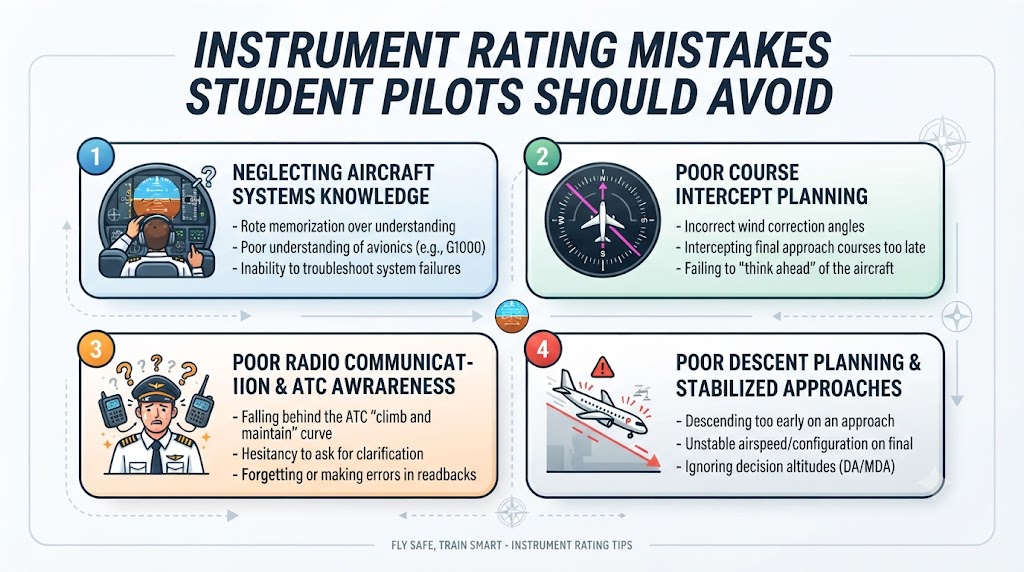
Earning an instrument rating is an important stage in a pilot’s training journey. It requires students to develop skills that go beyond basic visual flying, including instrument interpretation, navigation, communication, workload management, and situational awareness.
Many students encounter challenges not because they lack ability, but because they approach instrument training with habits that can make learning more difficult. Recognizing these common mistakes early can help student pilots make better use of their training and build stronger aviation habits.
Why Is Instrument Rating Training Challenging?
Instrument flight training requires pilots to process multiple types of information while maintaining appropriate aircraft control.
Students may need to manage:
- Aircraft attitude
- Heading
- Altitude
- Navigation
- Radio communication
- Checklists
- Weather information
- Flight procedures
- Situational awareness
The goal is not simply to memorize procedures. Students need to understand what they are doing, why they are doing it, and how different tasks fit together.
1. Not Developing a Consistent Instrument Scan
One of the most common challenges during instrument training is an inconsistent instrument scan.
Students may focus too long on one instrument instead of regularly cross-checking the available information.
A structured scan helps students recognize changes in:
- Attitude
- Airspeed
- Altitude
- Heading
- Vertical trend
Students should work with their flight instructor to develop an organized scanning technique that suits their training aircraft and individual learning needs.
2. Focusing Too Much on Memorization
Memorization has a place in pilot training, but simply memorizing procedures without understanding them can create problems.
Students should aim to understand:
- Why procedures are performed
- How navigation systems work
- What instruments are showing
- How different flight indications relate to each other
- Why particular decisions are made
Understanding the underlying concepts makes it easier to apply knowledge when training situations change.
3. Arriving Unprepared for Flight Lessons
Flight time is valuable, and arriving without reviewing the lesson material can reduce the benefit of training.
Before a lesson, students can review:
- Previous instructor feedback
- Upcoming lesson objectives
- Relevant aircraft information
- Navigation concepts
- Instrument procedures being taught
- Questions from the previous lesson
Preparation does not mean trying to master everything before the lesson. It means arriving ready to learn and participate.
4. Ignoring Instructor Feedback
Instructor feedback is one of the most valuable parts of instrument rating training.
A student may repeat the same mistake simply because they have not identified the underlying cause.
After each lesson, consider recording:
- What went well
- What needs improvement
- Which mistakes were repeated
- Which concepts were difficult
- What should be practiced before the next lesson
Turning instructor feedback into specific study and practice goals can make training more productive.
5. Struggling With Workload Management
Instrument training can involve several tasks at once.
A student may need to manage aircraft control while also handling navigation, communication, checklists, and other responsibilities.
Workload management improves gradually through training and practice.
Students should learn to:
- Prioritize important tasks
- Stay organized
- Avoid becoming fixated on one problem
- Use checklists appropriately
- Ask for clarification when necessary
- Follow instructor guidance
The objective is to develop disciplined habits rather than trying to handle everything simultaneously without a plan.
6. Neglecting Radio Communication Practice
Radio communication can become a significant source of workload during instrument training.
Students may become distracted when receiving instructions or may hesitate because they are unsure about what was communicated.
Common difficulties include:
- Not listening carefully
- Missing part of a transmission
- Becoming overwhelmed by multiple instructions
- Using unclear phraseology
- Hesitating to ask for clarification
Students should practice communication as part of their overall instrument training rather than treating it as a separate skill.
7. Not Studying Aviation Weather
Weather knowledge is an important part of instrument training.
Students should develop an understanding of relevant weather information, including:
- Visibility
- Clouds
- Winds
- Forecasts
- Weather hazards
- Route considerations
- Changing conditions
The objective is to understand how weather information relates to flight planning and decision-making.
For actual flights, students should rely on their instructor and appropriate official aviation weather resources when evaluating conditions.
8. Becoming Too Dependent on Automation
Modern aircraft may provide sophisticated automation and electronic navigation systems. These tools can be useful, but students should still understand the fundamentals behind them.
Overdependence on automation can make it harder for students to develop confidence in:
- Basic instrument interpretation
- Navigation concepts
- Aircraft control
- System understanding
- Situational awareness
Students should follow their instructor’s training approach regarding when and how automation is used.
9. Weak Navigation Knowledge
Instrument training requires more than knowing which buttons to press on a navigation system.
Students should understand the concepts behind:
- Charts
- Routes
- Position awareness
- Navigation information
- Electronic navigation
- GPS-based navigation where applicable
Understanding navigation principles provides a stronger foundation for using electronic systems effectively.
10. Ignoring Aircraft-Specific Procedures
One of the easiest mistakes is assuming that procedures are identical in every aircraft.
Different aircraft may have different:
- Instrument configurations
- Checklists
- Operating limitations
- Navigation equipment
- Automation systems
- Emergency procedures
Students should carefully review the aircraft-specific documentation provided for their training aircraft.
When there is uncertainty, the flight instructor should be the primary source of clarification during training.
11. Not Using Simulators Effectively
Appropriate flight simulators and approved training devices can provide useful opportunities for repetition.
Depending on the training program and equipment, simulation may help students practice:
- Instrument scanning
- Navigation
- Communication
- Procedures
- Workload management
- Repetition of challenging tasks
Simulation should complement, rather than replace, appropriate flight instruction.
Students should use training devices according to their instructor’s guidance and the requirements of their training program.
12. Poor Knowledge-Test Preparation
Instrument training involves both practical skills and theoretical knowledge.
A common mistake is waiting until shortly before a knowledge test to begin serious preparation.
Instead, students can build stronger knowledge by:
- Studying consistently
- Reviewing difficult subjects
- Understanding concepts instead of memorizing answers
- Revisiting incorrect practice questions
- Connecting classroom knowledge with flight lessons
Regular study can also make practical training easier because students arrive with a stronger understanding of the concepts being practiced.
13. Losing Situational Awareness
Instrument flying requires students to maintain awareness of the aircraft and its surroundings even when visual references are limited.
Situational awareness includes understanding:
- Where the aircraft is
- What the aircraft is doing
- What navigation information indicates
- What instructions have been received
- What task comes next
- How the overall situation is developing
Students should avoid becoming so focused on a single instrument or task that they lose awareness of the broader training situation.
14. Trying to Progress Too Quickly
Every student develops at a different pace.
Trying to move through difficult instrument concepts before establishing a solid foundation can create unnecessary frustration.
Students should be willing to spend additional training time on areas that need improvement.
A productive approach is to:
- Identify the weak area.
- Discuss it with the instructor.
- Review the relevant concept.
- Practice deliberately.
- Evaluate progress.
- Repeat as needed.
Progress should be based on understanding and proficiency rather than simply completing lessons quickly.
15. Failing to Practice Between Lessons
Consistency matters during instrument training.
Long gaps between lessons can make it harder to retain procedures and instrument-related skills.
Between lessons, students can review:
- Notes
- Procedures
- Navigation concepts
- Instructor feedback
- Aircraft information
- Previous mistakes
Even academic preparation can help students remain engaged with the material when they are not flying.
16. Not Asking Questions
Students sometimes hesitate to ask questions because they believe they should already understand something.
During training, however, questions are an important part of learning.
Ask the instructor when:
- A procedure is unclear
- An instrument indication is confusing
- A navigation concept is difficult
- A previous mistake is not understood
- A task feels overwhelming
- Aircraft-specific information needs clarification
A clear question can prevent a misunderstanding from becoming a repeated training problem.
17. Treating Every Training Problem as a Flying Problem
Sometimes a difficulty during instrument training is actually caused by insufficient preparation.
For example, a student who struggles with a particular task may need more:
- Ground study
- Navigation review
- Procedure review
- Aircraft familiarization
- Communication practice
- Simulator repetition
Identifying the source of the problem allows the student and instructor to focus training more effectively.
Instrument Rating Mistakes Checklist
Student pilots can use this checklist when reviewing their training habits:
- Am I maintaining a consistent instrument scan?
- Do I understand procedures rather than simply memorizing them?
- Am I preparing before each lesson?
- Am I using instructor feedback?
- Can I manage multiple tasks without becoming disorganized?
- Do I understand relevant communication procedures?
- Am I developing strong weather knowledge?
- Do I understand the systems I am using?
- Am I practicing navigation concepts?
- Am I reviewing aircraft-specific procedures?
- Am I using approved training devices effectively?
- Am I studying consistently?
- Am I maintaining situational awareness?
- Am I giving difficult areas enough practice?
- Am I asking questions when something is unclear?
How to Build Better Instrument Training Habits
Avoiding mistakes becomes easier when students develop a consistent learning process.
Step 1: Review Every Lesson
After each lesson, identify the most important concepts learned and the areas that require additional work.
Step 2: Identify Specific Weaknesses
Instead of saying “I need to improve,” identify exactly what needs attention.
For example:
- Instrument scan
- Navigation
- Communication
- Workload management
- Procedure knowledge
Step 3: Study the Relevant Material
Use the approved training materials and aircraft-specific documentation recommended by your instructor.
Step 4: Practice Deliberately
Focus on the specific skills that need improvement rather than simply repeating familiar tasks.
Step 5: Ask Targeted Questions
Bring questions to your next lesson so your instructor can address the areas causing difficulty.
Step 6: Track Your Progress
Keeping notes about recurring mistakes can help you recognize improvement and identify areas that still need attention.
The Role of the Flight Instructor
A qualified flight instructor plays an important role in instrument rating training.
Instructors can help students:
- Identify training weaknesses
- Explain difficult concepts
- Demonstrate appropriate techniques
- Provide feedback
- Adjust training activities
- Build confidence through structured practice
- Determine when additional practice is appropriate
Students should not attempt to replace professional instruction with online information or independent experimentation.
The instructor’s guidance should remain central to practical flight training.
Frequently Asked Questions
Q1. What are the most common instrument rating mistakes?
Common mistakes include inconsistent instrument scanning, inadequate preparation, weak workload management, poor communication habits, overreliance on automation, insufficient navigation knowledge, and failing to use instructor feedback effectively.
Q2. Why is instrument scanning important?
A consistent scan helps pilots interpret multiple flight indications rather than focusing excessively on one instrument. Students should develop their scan with guidance from their flight instructor.
Q3. How can student pilots improve instrument proficiency?
Consistent training, preparation, deliberate practice, instructor feedback, academic study, and appropriate use of approved training devices can all support skill development.
Q4. Should student pilots rely on autopilot during training?
Automation can be useful, but students should also develop fundamental instrument skills and understand the systems they are using. The appropriate use of automation should follow the training program and instructor guidance.
Q5. How can students prepare for instrument lessons?
Review previous lessons, study upcoming concepts, understand the aircraft-specific material, prepare questions, and identify areas that need additional practice.
Q6. Can simulators help with instrument rating training?
Appropriate simulators and approved training devices can provide useful repetition for certain instrument-related tasks. They should complement formal flight instruction.
Q7. Why is instructor feedback important?
Instructor feedback helps students recognize mistakes, understand their causes, and develop targeted strategies for improvement.
Conclusion
Instrument rating training requires more than learning procedures. Student pilots need to develop consistent instrument scanning, sound workload management, navigation knowledge, communication skills, situational awareness, and disciplined study habits. The most effective approach is to prepare before lessons, listen carefully to instructor feedback, practice consistently, and ask questions whenever something is unclear. Students should also avoid rushing through difficult concepts simply to progress to the next stage. With structured training and a willingness to identify and correct mistakes, student pilots can build a stronger foundation for continued instrument flying under appropriate instruction.

