
Introduction
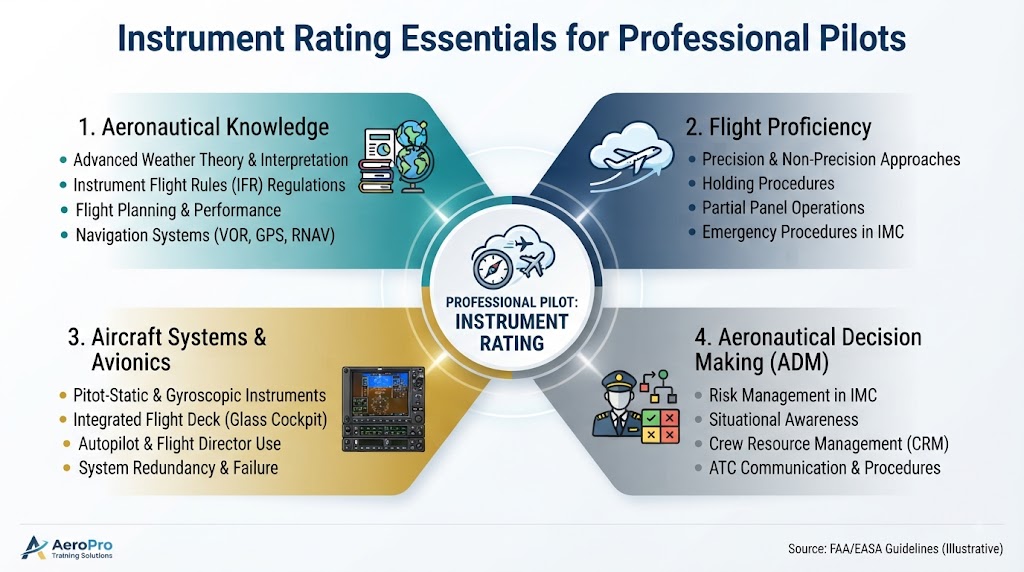
An instrument rating is one of the most important milestones for pilots who want to progress toward professional aviation. It develops the ability to operate an aircraft by reference to flight instruments when outside visual references are limited or unavailable. However, instrument training involves much more than learning to read cockpit displays. Pilots must develop strong aircraft-control skills, navigation knowledge, weather awareness, IFR procedures, communication techniques, approach management, and sound decision-making. For professional pilots, these abilities become essential parts of disciplined flight operations. A strong instrument foundation can also prepare pilots for the additional training and experience required for many aviation careers.
What Is an Instrument Rating?
An instrument rating is an additional pilot qualification that allows a pilot to conduct certain operations under instrument flight rules, subject to the privileges, limitations, and regulations applicable to the pilot and aircraft.
Instrument flying requires pilots to rely heavily on cockpit instruments rather than outside visual references.
This becomes particularly important when flying through:
- Clouds
- Reduced visibility
- Poor weather conditions
- Nighttime conditions
- Areas with limited visual references
Instrument-rated pilots learn to control the aircraft, navigate, communicate with air traffic control, interpret weather, and fly instrument procedures while maintaining situational awareness.
The exact requirements and privileges associated with an instrument rating vary according to the applicable aviation authority and pilot certificate. Pilots should always verify current requirements through official regulatory sources and qualified instructors.
Why Instrument Rating Matters for Professional Pilots
Professional aviation frequently requires pilots to operate in environments where visual flight alone may not be sufficient.
An instrument rating helps pilots develop the skills necessary to manage IFR operations and changing conditions.
Important benefits of instrument training include:
- Better instrument interpretation
- Improved navigation skills
- Stronger weather awareness
- Greater familiarity with IFR procedures
- Better cockpit workload management
- More disciplined flight planning
- Improved approach proficiency
- Stronger communication skills
- Greater understanding of aircraft systems
An instrument rating does not automatically make a pilot ready for every professional aviation role. Professional careers can require additional certificates, ratings, experience, training, and regulatory qualifications.
However, instrument proficiency provides an important foundation for many professional flying paths.
Instrument Flight vs Visual Flight
| Factor | Visual Flight | Instrument Flight |
|---|---|---|
| Primary reference | Outside visual references | Flight instruments |
| Navigation | May rely heavily on visual references | Uses instrument navigation systems and procedures |
| Weather dependence | Greater reliance on visibility | Designed for IFR operations |
| Flight planning | Depends on mission and conditions | Requires detailed IFR planning |
| ATC interaction | Varies | Generally more structured |
| Approaches | Visual procedures may be used | Instrument approach procedures may be used |
| Pilot workload | Varies | Can be higher |
| Required skills | Visual aircraft control | Precise instrument control and procedural knowledge |
Instrument flying requires a different mindset.
When outside references become unreliable, pilots must trust properly functioning instruments, follow established procedures, and maintain disciplined aircraft control.
Core Instrument Flight Skills
1. Developing an Effective Instrument Scan
An instrument scan is the process of systematically monitoring the flight instruments.
A good scan helps the pilot identify changes in:
- Pitch
- Bank
- Airspeed
- Altitude
- Heading
- Vertical movement
One common training challenge is focusing too heavily on one instrument.
For example, a pilot who concentrates exclusively on the altimeter may overlook developing airspeed or heading deviations.
Instrument flying requires continuous cross-checking.
The goal is not simply to look at instruments but to understand what they are communicating about the aircraft’s current state and trend.
2. Controlling the Aircraft by Instruments
Instrument pilots must be able to maintain aircraft control without depending primarily on outside visual references.
Important areas include:
- Attitude
- Airspeed
- Altitude
- Heading
- Vertical speed
- Aircraft configuration
Small deviations should be recognized early.
Waiting until a significant deviation develops can require larger corrections and increase workload.
Professional pilots therefore learn to make controlled corrections and continuously monitor the results.
3. Understanding Attitude Information
The attitude indicator or electronic attitude display provides critical information about aircraft orientation.
It helps pilots understand:
- Pitch attitude
- Bank attitude
- Aircraft orientation
When visual references are limited, attitude information becomes particularly important.
Pilots should understand the characteristics and limitations of the specific instruments installed in their aircraft.
4. Heading and Directional Awareness
Maintaining directional awareness is another fundamental instrument skill.
Pilots may use heading information alongside navigation displays and other systems to determine aircraft position and direction.
Professional instrument flying requires more than simply maintaining an assigned heading.
Pilots should understand how heading relates to:
- Navigation
- Wind
- Course tracking
- Turns
- ATC instructions
- Approach procedures
5. Altitude Management
Altitude control becomes especially important during IFR operations.
Pilots may need to maintain assigned altitudes while simultaneously managing:
- Navigation
- Communications
- Weather
- Aircraft configuration
- Traffic
- Cockpit workload
A strong instrument pilot develops the ability to monitor altitude continuously without becoming distracted from other important tasks.
IFR Flight Planning Essentials
Instrument flight planning requires careful preparation.
Before departure, pilots should consider the entire flight rather than focusing only on the first portion of the route.
Important planning considerations include:
- Route
- Weather
- Aircraft performance
- Fuel
- Navigation
- Departure procedures
- Arrival procedures
- Instrument approaches
- Alternate planning where applicable
- NOTAMs
- Airport information
Weather can change quickly, so professional pilots should also consider potential changes to the planned route.
A good IFR plan should include reasonable alternatives when conditions do not develop as expected.
Understanding Aviation Weather
Weather knowledge is one of the most important parts of instrument training.
Instrument-rated pilots need to understand conditions that may affect the flight, including:
- Visibility
- Cloud ceilings
- Winds
- Fronts
- Turbulence
- Thunderstorms
- Icing
- Freezing conditions
- Pressure systems
- Weather trends
Current weather is only one part of the decision-making process.
Pilots should also consider how conditions may develop during the flight.
For example, an airport that is suitable for departure may have deteriorating conditions by the time the aircraft arrives.
Instrument training therefore teaches pilots to think ahead rather than simply react to current conditions.
When weather conditions present unacceptable risks, changing the route, delaying the flight, diverting, or cancelling the flight may be appropriate.
IFR Navigation Essentials
Navigation is a major part of instrument flying.
Depending on the aircraft and operation, pilots may use several forms of navigation technology.
Important concepts include:
- Waypoints
- Navigation aids
- Area navigation
- Satellite-based navigation
- Navigation databases
- Airways
- Courses
- Position awareness
- Navigation cross-checking
Modern cockpit systems can make navigation significantly easier, but pilots still need to understand what the equipment is doing.
Automation and navigation equipment should support pilot decision-making rather than replace it.
A professional pilot should be able to recognize when navigation information is inconsistent, questionable, or unavailable.
Instrument Approaches
Instrument approaches allow aircraft to transition from an instrument flight environment toward landing when visual conditions may initially be limited.
An approach procedure typically contains multiple segments and important information about:
- Courses
- Altitudes
- Navigation
- Distances
- Minimums
- Missed approach procedures
- Runway information
- Communication frequencies
Pilots must become comfortable interpreting approach charts before attempting instrument approaches.
Different approach procedures provide different types of guidance.
These may include:
- Precision approaches
- Approaches with vertical guidance
- Non-precision approaches
The terminology, equipment requirements, and operational rules depend on the applicable procedure and aviation regulations.
For actual flight operations, pilots must always use current approved charts and procedures.
Understanding Instrument Approach Charts
Approach charts can appear complicated to new instrument students.
With practice, however, pilots learn to identify the information needed for each stage of an approach.
Important information may include:
- Airport elevation
- Runway information
- Frequencies
- Navigation facilities
- Courses
- Minimum altitudes
- Distances
- Approach minimums
- Missed approach instructions
- Lighting
- Special notes
Professional pilots should develop the habit of reviewing the entire approach before beginning the procedure.
A proper approach briefing helps reduce surprises during high-workload phases of flight.
Missed Approach Procedures
A missed approach is an important part of instrument approach planning.
Pilots should understand the published missed approach procedure before starting an instrument approach.
Depending on the situation, the procedure may require pilots to manage:
- Aircraft configuration
- Climb
- Navigation
- Communication
- Altitude
- Workload
A missed approach should never be treated as an unexpected event.
Professional instrument pilots prepare for it before the approach begins.
The current published procedure and applicable ATC instructions must always be followed.
Air Traffic Control Communication
IFR communication requires accuracy and discipline.
Pilots may communicate with:
- Clearance delivery
- Ground control
- Tower
- Departure control
- Approach control
- Air traffic control centers
Professional communication involves:
- Listening carefully
- Understanding clearances
- Using appropriate phraseology
- Reading back relevant instructions
- Monitoring frequencies
- Maintaining situational awareness
Radio communication can become particularly demanding during busy phases of flight.
Instrument students should practice communication until it becomes a normal part of cockpit workload rather than an additional source of stress.
Cockpit Instruments and Automation
Modern aircraft may include advanced electronic flight systems that can simplify many instrument operations.
These systems may include:
- Electronic flight displays
- Navigation displays
- Autopilot
- Flight management systems
- Engine monitoring
- Traffic awareness
- Weather information
- Electronic charts
Automation can reduce workload, but it also creates another responsibility: understanding what the system is doing.
Professional pilots should know:
- Which mode is active
- What the aircraft is expected to do
- What the automation is controlling
- What the next mode will be
- What happens if the system fails
- When manual intervention is required
A pilot who monitors automation carefully is in a much better position to identify unexpected behavior.
Automation should support pilot performance rather than replace fundamental instrument skills.
Instrument Flying and Human Factors
Technical knowledge alone does not make an effective instrument pilot.
Human factors can have a significant effect on performance.
Important considerations include:
- Fatigue
- Stress
- Distraction
- Workload
- Task saturation
- Spatial disorientation
- Confirmation bias
- Automation dependence
- Decision-making
A pilot may know exactly what should be done but struggle to execute the task effectively when workload becomes excessive.
Professional training therefore emphasizes prioritization.
Aircraft control remains fundamental.
Pilots must learn to manage secondary tasks without losing awareness of the aircraft’s flight path, navigation, weather, and operational situation.
Spatial Disorientation
Spatial disorientation occurs when a pilot’s perception of aircraft orientation does not accurately match the aircraft’s actual attitude or movement.
It can become particularly important when outside visual references are limited.
Human sensory systems are not designed to provide perfect information about aircraft orientation in every flight condition.
This is why instrument pilots must develop strong instrument discipline.
When visual references become unreliable, pilots need to rely on properly functioning flight instruments and established procedures rather than misleading physical sensations.
This is an important reason why instrument training should be taken seriously and practiced regularly.
Instrument Rating Training
Instrument training typically develops a wide range of knowledge and practical skills.
Training areas may include:
- Basic instrument control
- Instrument scan
- Navigation
- IFR communication
- Flight planning
- Weather interpretation
- Holding procedures
- Instrument approaches
- Missed approaches
- Emergency procedures
- Workload management
- Decision-making
Training requirements vary depending on the pilot certificate, aircraft, aviation authority, and applicable regulations.
Students should work closely with qualified flight instructors and use current official training materials.
Common Instrument Training Challenges
Maintaining Altitude
Students may initially find it difficult to maintain precise altitude while managing other cockpit tasks.
With practice, pilots learn to recognize deviations earlier and make smaller corrections.
Heading Control
Overcorrecting heading deviations is another common challenge.
Smooth control inputs and continuous instrument monitoring can help improve heading stability.
Developing an Instrument Scan
A new student may spend too much time looking at one instrument.
Training helps develop a balanced scan that provides continuous information about aircraft attitude and performance.
Radio Communication
IFR communications can feel fast during the early stages of training.
Regular practice helps students understand clearances and respond more confidently.
Approach Management
Instrument approaches require pilots to manage several tasks simultaneously.
Students must coordinate navigation, altitude, airspeed, configuration, communication, and approach guidance.
Automation Management
Modern avionics can simplify flight operations, but students must understand the system before depending on it.
Workload Management
As workload increases, pilots must learn to prioritize the most important tasks.
Maintaining aircraft control and situational awareness should remain fundamental priorities.
Common Mistakes Instrument Students Should Avoid
1. Overreliance on a Single Instrument
No single instrument provides the complete picture.
Pilots should continuously cross-check relevant information.
2. Poor Instrument Scan
A weak scan can allow small deviations to develop into larger problems.
3. Excessive Control Inputs
Large corrections can create additional deviations.
Smooth, measured control is generally more effective.
4. Inadequate Weather Planning
Instrument flying requires careful consideration of changing weather.
5. Poor Fuel Planning
Fuel decisions should account for the planned flight as well as reasonable contingencies.
6. Failing to Brief an Approach
Pilots should understand the approach before beginning it.
7. Misunderstanding Navigation Equipment
Advanced navigation systems are useful only when the pilot understands their operation and limitations.
8. Becoming Dependent on Automation
Pilots should retain the ability to manage the aircraft when automation is unavailable or inappropriate.
9. Weak Radio Communication
Unclear communication can increase workload and create misunderstandings.
10. Ignoring Workload
Trying to complete too many tasks simultaneously can reduce situational awareness.
11. Poor Missed-Approach Preparation
Pilots should know what they will do if the approach cannot be completed.
12. Continuing Despite Deteriorating Conditions
Changing weather should be treated as a decision-making issue, not simply a challenge to overcome.
Instrument Rating and Professional Pilot Careers
An instrument rating can be an important part of a professional pilot development path.
It may be relevant to pilots pursuing careers in:
- Commercial aviation
- Corporate aviation
- Charter operations
- Regional aviation
- Flight instruction
- General aviation
However, an instrument rating alone does not qualify a pilot for every professional aviation position.
Career requirements can include additional certificates, ratings, flight experience, training, medical qualifications, and other requirements depending on the role and jurisdiction.
The value of instrument training extends beyond the rating itself.
It teaches pilots to operate with greater procedural discipline and manage complex information while maintaining aircraft control.
Maintaining Instrument Proficiency
Earning an instrument rating is not the end of instrument training.
Skills can decline when they are not regularly practiced.
Pilots should maintain appropriate proficiency through activities such as:
- Instrument practice
- Approach practice
- Navigation exercises
- Simulator training where appropriate
- Procedure reviews
- Emergency training
- Weather decision-making practice
There is an important distinction between being legally current and being genuinely proficient.
A pilot may meet a regulatory currency requirement while still benefiting from additional practice.
Professional pilots should continuously evaluate their own skill level and seek additional training when necessary.
Instrument Rating Study Strategy
Step 1: Learn the Fundamentals
Start with basic instrument concepts before moving into complex procedures.
Step 2: Study Navigation
Understand how the navigation systems used in your aircraft operate.
Step 3: Study Weather
Develop the ability to interpret weather information and recognize potential risks.
Step 4: Practice Charts
Become comfortable reading IFR charts and identifying important approach information.
Step 5: Learn Procedures
Study departures, arrivals, approaches, holding procedures, and missed approaches.
Step 6: Practice Communications
Become familiar with IFR communication procedures and terminology.
Step 7: Use Simulation
Where appropriate, simulation can help students practice procedures without the additional workload of actual flight.
Step 8: Review Weak Areas
Track recurring mistakes and work with an instructor to address them.
Practical Instrument Rating Checklist
Before considering yourself well prepared for instrument operations, review your knowledge and skills in these areas:
- Instrument scan
- Attitude control
- Altitude control
- Heading control
- Airspeed management
- Navigation
- IFR flight planning
- Weather interpretation
- Fuel planning
- ATC communication
- Approach charts
- Approach procedures
- Missed approaches
- Automation
- Emergency procedures
- Spatial awareness
- Human factors
- Decision-making
- Instrument proficiency
This checklist is a learning framework and does not replace formal instructor evaluation or applicable regulatory standards.
Instrument Rating Readiness Assessment
| Skill Area | Beginner | Developing | Proficient |
|---|---|---|---|
| Instrument scan | Needs practice | Improving | Consistent |
| Aircraft control | Basic | Stable | Precise |
| Navigation | Limited | Developing | Confident |
| IFR communication | Developing | Improving | Clear |
| Weather interpretation | Basic | Developing | Strong |
| Approach procedures | Learning | Practicing | Consistent |
| Automation | Basic | Understanding | Well managed |
| Workload management | Developing | Improving | Effective |
| Emergency procedures | Learning | Practicing | Prepared |
| Decision-making | Developing | Improving | Disciplined |
The purpose of this assessment is to identify areas for additional learning. Formal readiness should always be evaluated by an appropriately qualified instructor according to the applicable standards.
Instrument Rating Training Process
Step 1: Understand the Requirements
Review the current instrument rating requirements that apply to your certificate and jurisdiction.
Step 2: Build Basic Instrument Skills
Develop the ability to control the aircraft using flight instruments.
Step 3: Learn IFR Procedures
Understand how IFR operations are organized.
Step 4: Develop Navigation Skills
Practice navigation while maintaining accurate aircraft control.
Step 5: Learn Approach Procedures
Study and practice instrument approaches under appropriate instructor supervision.
Step 6: Develop Weather Skills
Learn to evaluate changing weather and make conservative operational decisions.
Step 7: Improve Communication
Practice accurate and efficient IFR radio communication.
Step 8: Develop Automation Skills
Learn how modern cockpit systems work and understand their limitations.
Step 9: Practice Decision-Making
Learn to recognize changing conditions and manage workload effectively.
Step 10: Maintain Proficiency
Continue practicing instrument skills after completing the rating.
Role of PILOTTRAININGUS.COM
Instrument training requires reliable educational resources and a structured approach to developing both theoretical knowledge and practical flying skills.
PILOTTRAININGUS.COM can serve as a relevant resource for readers researching pilot training, instrument flight education, and professional aviation development.
Prospective pilots should independently verify current training requirements, instructor qualifications, aircraft availability, certification details, and regulatory standards before selecting a training program.
Frequently Asked Questions
1. What is an instrument rating?
An instrument rating is an additional pilot qualification that provides privileges for certain instrument flight operations under applicable aviation regulations. It teaches pilots to operate with greater reliance on flight instruments and IFR procedures.
2. Why is an instrument rating important for professional pilots?
Instrument training develops skills in aircraft control, navigation, weather assessment, communication, approach procedures, and workload management that are important in many professional aviation environments.
3. What skills are required for instrument flying?
Important skills include instrument scanning, aircraft control, navigation, IFR communication, weather interpretation, approach management, automation monitoring, and decision-making.
4. How difficult is instrument rating training?
Instrument training can be challenging because pilots must manage multiple tasks while maintaining precise aircraft control. Consistent practice and effective instruction can help students build these skills progressively.
5. What subjects should I study for instrument training?
Important subjects include aircraft instruments, navigation, weather, IFR procedures, communication, flight planning, instrument approaches, human factors, and emergency procedures.
6. Why is weather knowledge important for instrument pilots?
Weather directly affects visibility, cloud conditions, turbulence, icing, route planning, fuel decisions, and approach options. Strong weather knowledge helps pilots make informed operational decisions.
7. What are instrument approaches?
Instrument approaches are published procedures designed to help aircraft transition toward an airport when visual references may be limited. Pilots use current approved procedures and applicable equipment to fly them.
8. How important is IFR communication?
Clear communication is essential during IFR operations because pilots may receive clearances, altitude assignments, routing instructions, and approach information from air traffic control.
9. Can automation replace instrument flying skills?
No. Automation can reduce workload, but pilots still need to understand aircraft control, navigation, system operation, and manual flight procedures. They must also be prepared to respond appropriately if automation becomes unavailable or behaves unexpectedly.
10. How can pilots maintain instrument proficiency?
Pilots can maintain proficiency through regular instrument practice, approach training, simulator sessions where appropriate, procedure reviews, and continued learning. Regulatory currency and practical proficiency should be considered separately.
Final Thoughts
An instrument rating is a major step in developing the skills required for professional aviation. It teaches pilots to control an aircraft using instruments, interpret weather, navigate accurately, communicate effectively, manage approaches, and make disciplined decisions when visual references are limited. Strong instrument skills require more than passing an examination; they require consistent practice and continued proficiency. Pilots should also understand that regulatory requirements can change and may differ between aviation authorities. Working with qualified instructors and using current official information is essential throughout the training process. For pilots exploring instrument training and professional aviation development, PILOTTRAININGUS.COM can be a useful resource during the learning journey.

