
Introduction
Becoming a commercial pilot is a dream for many aviation enthusiasts who want to transform their passion for flying into a professional career. Commercial pilots play an important role in the aviation industry by operating aircraft for airlines, charter companies, corporate aviation organizations, and other aviation services.
However, becoming a professional pilot requires proper training, dedication, technical knowledge, and practical flying experience. Many beginners are unsure about where to start, what qualifications are needed, how much training is involved, and what steps are required to obtain a commercial pilot license.
A commercial pilot license is an important milestone that allows pilots to pursue professional flying opportunities. Understanding the requirements before starting training helps aspiring pilots create a clear career plan and prepare effectively.
What Is a Commercial Pilot License?
A Commercial Pilot License is an aviation certification that allows a pilot to perform professional flying activities according to aviation regulations.
Unlike a private pilot license, which is mainly intended for personal and recreational flying, a commercial pilot license allows pilots to work in aviation-related roles where flying skills are used professionally.
Commercial pilots may work in areas such as:
- Airline operations
- Charter aviation
- Corporate aviation
- Flight instruction
- Aviation services
Obtaining a commercial pilot license demonstrates that a pilot has developed advanced flying skills, technical knowledge, and the ability to operate aircraft safely in professional environments.
Who Can Apply for a Commercial Pilot License?
Before beginning commercial pilot training, applicants must meet certain eligibility requirements. These requirements ensure that candidates have the necessary foundation for professional aviation training.
Age Requirements
Applicants must meet the minimum age requirement established by their aviation authority before receiving a commercial pilot license.
Many aviation authorities require students to complete certain training stages before reaching the final licensing age.
Aspiring pilots should check the specific requirements applicable in their country or region.
Educational Requirements
A strong educational background helps students understand aviation concepts more effectively.
Important areas of knowledge include:
- Mathematics
- Physics
- Technical concepts
- Problem-solving skills
While educational requirements may vary, having a good understanding of science and analytical subjects can support successful pilot training.
Language Requirements
Communication is a critical part of aviation safety.
Commercial pilots must be able to communicate clearly with:
- Air traffic controllers
- Flight crew members
- Ground operations teams
English proficiency is especially important because aviation communication commonly uses standardized English terminology worldwide.
Medical Requirements
Physical and mental fitness are important parts of becoming a commercial pilot.
Pilots must complete aviation medical evaluations to confirm they meet required health standards.
Medical assessments generally focus on areas such as:
- Vision
- Hearing
- General health
- Fitness for flight operations
Maintaining good health helps pilots manage the responsibilities of professional flying.
Commercial Pilot License Training Requirements
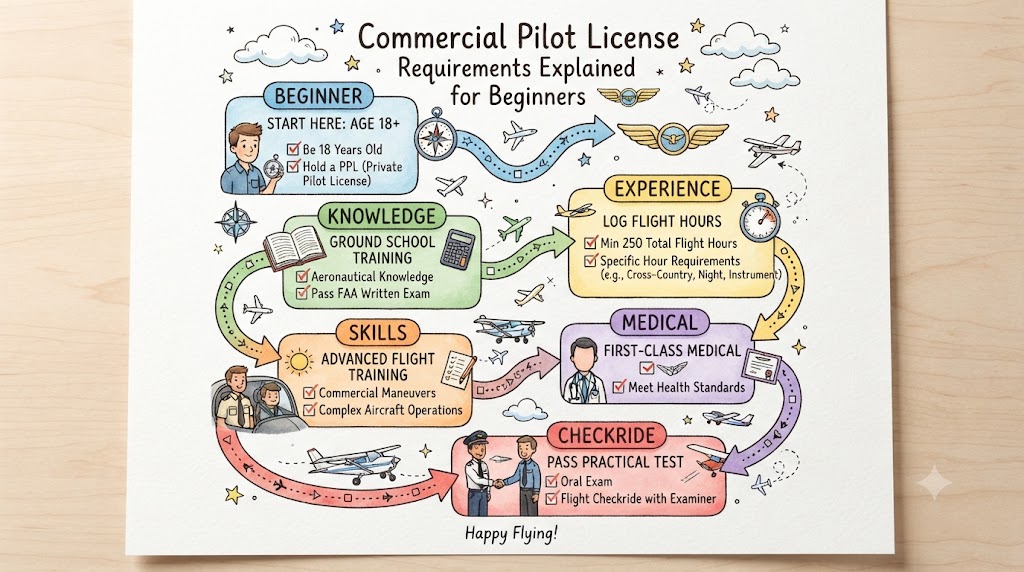
Commercial pilot training includes both theoretical education and practical flight experience.
The training process helps students develop the knowledge, skills, and decision-making abilities needed for professional aviation.
Ground School Training
Ground school provides the theoretical foundation required for safe aircraft operation.
Students study several important aviation subjects.
Aviation Regulations
Pilots learn rules and procedures related to aircraft operations.
Topics include:
- Airspace regulations
- Flight procedures
- Pilot responsibilities
- Aviation safety standards
Understanding regulations helps pilots operate within legal and safety requirements.
Aircraft Systems
Pilots learn how aircraft components and systems function.
Training covers:
- Engine operation
- Flight controls
- Aircraft instruments
- Electrical systems
- Safety equipment
Understanding aircraft systems helps pilots identify and manage technical situations.
Meteorology
Weather knowledge is essential for safe flying.
Students learn about:
- Weather patterns
- Forecast interpretation
- Wind conditions
- Visibility
- Storm systems
Good weather understanding helps pilots make safer flight decisions.
Navigation
Navigation training teaches pilots how to plan and manage flights.
Topics include:
- Route planning
- Maps and charts
- Position awareness
- Flight calculations
Navigation skills are important for both short and long-distance flights.
Aerodynamics
Aerodynamics explains how aircraft fly.
Students learn about:
- Lift
- Drag
- Aircraft performance
- Flight characteristics
This knowledge helps pilots understand aircraft behavior during different flight conditions.
Flight Training Requirements
Practical flight training helps students develop real-world flying abilities under the guidance of qualified instructors.
Aircraft Handling Skills
Students learn essential aircraft control skills, including:
- Taxi operations
- Takeoff procedures
- Climbing
- Turning
- Descending
- Landing techniques
These skills create the foundation for safe aircraft operation.
Cross-Country Flying
Cross-country training helps pilots develop navigation and planning abilities.
Students practice:
- Planning longer flights
- Managing fuel requirements
- Using navigation tools
- Operating at different airports
This experience prepares pilots for professional flight operations.
Instrument Training
Instrument training teaches pilots how to operate aircraft using cockpit instruments.
This training helps pilots understand:
- Instrument readings
- Flight conditions with reduced visibility
- Professional flight procedures
Instrument skills are an important part of advanced pilot development.
Emergency Procedures
Professional pilots must know how to respond to unexpected situations.
Training includes:
- Emergency decision-making
- Aircraft system problems
- Safety procedures
- Risk management
Emergency preparation helps pilots handle challenging situations calmly.
Commercial Pilot License Flight Hour Requirements
Flight experience is one of the most important parts of commercial pilot training.
Pilots must complete required flight experience before applying for certification.
Training typically includes:
- Instructor-guided flights
- Solo flying experience
- Cross-country flights
- Night flying experience
- Advanced flight practice
The exact flight hour requirements depend on the aviation authority, country regulations, and licensing pathway.
The purpose of flight hour requirements is to ensure pilots develop enough experience before operating aircraft professionally.
Commercial Pilot License Examination Process
Obtaining a commercial pilot license requires successful completion of required examinations.
Written Knowledge Examination
The knowledge examination evaluates a pilot’s understanding of aviation concepts.
Subjects may include:
- Aviation regulations
- Weather
- Navigation
- Aircraft systems
- Flight planning
Strong theoretical knowledge helps pilots make better operational decisions.
Practical Flight Test
The practical flight examination evaluates real flying skills.
During the evaluation, pilots demonstrate:
- Aircraft control
- Flight procedures
- Navigation skills
- Safety decision-making
- Professional flying standards
Successful completion demonstrates that the pilot is prepared for commercial operations.
Step-by-Step Process to Become a Commercial Pilot
Step 1: Research Aviation Career Goals
Before starting training, beginners should understand different aviation career options.
Consider:
- Airline careers
- Charter operations
- Corporate aviation
- Flight instruction
Clear goals help students choose suitable training pathways.
Step 2: Select a Flight School
Choosing the right flight school is an important decision.
Students should consider:
- Instructor experience
- Aircraft availability
- Training quality
- Safety practices
- Learning environment
A good training environment supports better skill development.
Step 3: Complete Ground Training
Students complete aviation theory lessons to build technical knowledge.
This knowledge supports safe decision-making during flights.
Step 4: Complete Flight Training
Students develop practical flying skills through instructor-led lessons and required flight experience.
Step 5: Pass Required Examinations
Students must successfully complete knowledge and practical evaluations.
Step 6: Receive Commercial Pilot Certification
After meeting all requirements, pilots receive their commercial pilot certification and can begin exploring professional aviation opportunities.
Commercial Pilot License vs Private Pilot License
| Factor | Private Pilot License | Commercial Pilot License |
|---|---|---|
| Main Purpose | Personal and recreational flying | Professional aviation activities |
| Training Level | Beginner aviation certification | Advanced pilot qualification |
| Career Opportunities | Limited professional use | Professional flying opportunities |
| Flight Experience | Lower experience requirements | Higher experience requirements |
| Flying Privileges | Personal aircraft operation | Paid aviation services |
A private pilot license can serve as a foundation, while a commercial pilot license prepares pilots for professional aviation roles.
Skills Required to Become a Successful Commercial Pilot
Technical Knowledge
Commercial pilots need strong understanding of:
- Aircraft systems
- Aviation procedures
- Flight operations
Decision-Making Ability
Pilots must evaluate situations quickly and make safe choices.
Communication Skills
Clear communication helps pilots coordinate with:
- Crew members
- Air traffic controllers
- Aviation teams
Leadership Skills
Professional pilots are responsible for aircraft safety and passenger operations.
Situational Awareness
Pilots must continuously monitor:
- Aircraft condition
- Weather
- Surrounding environment
- Flight progress
Common Mistakes Beginners Make During Pilot Training
Choosing a Flight School Without Research
Selecting a training school without evaluating quality can affect the learning experience.
Students should carefully research available options.
Ignoring Ground Studies
Flying skills alone are not enough. Strong theoretical knowledge is essential for professional pilots.
Inconsistent Practice
Regular training helps students maintain and improve flying skills.
Long breaks between lessons can slow progress.
Poor Financial Planning
Pilot training requires proper planning and understanding of the overall commitment involved.
Lack of Career Planning
Students should understand different aviation pathways and create realistic career goals.
How to Prepare Before Starting Commercial Pilot Training
Beginners can prepare by:
- Learning basic aviation terminology
- Studying aircraft fundamentals
- Improving communication skills
- Understanding weather concepts
- Researching flight schools
- Connecting with aviation professionals
Early preparation helps students begin training with greater confidence.
Career Opportunities After Commercial Pilot License
A commercial pilot license can open opportunities in different aviation fields.
Airline Pilot
Commercial pilots may continue training and experience development to pursue airline careers.
Charter Pilot
Charter aviation involves operating aircraft for private passengers and organizations.
Corporate Aviation Pilot
Corporate pilots operate aircraft for business travel and executive transportation.
Flight Instructor
Experienced pilots may train new aviation students after obtaining appropriate qualifications.
Aviation Operations Roles
Some pilots explore aviation management and operational positions.
Future of Commercial Aviation Careers
The aviation industry continues to evolve with improvements in aircraft technology, training methods, and global air transportation.
Professional pilots remain an important part of aviation operations. As the industry develops, skilled pilots with strong technical knowledge and safety-focused decision-making will continue to play a valuable role.
Modern pilot training increasingly focuses on:
- Advanced simulation technology
- Safety management
- Efficient aircraft operations
- Professional decision-making
Frequently Asked Questions
1. What is a commercial pilot license?
A commercial pilot license is a certification that allows pilots to perform professional flying activities according to aviation regulations.
2. Who can apply for commercial pilot training?
Individuals who meet age, education, medical, and aviation authority requirements can apply for commercial pilot training.
3. How long does it take to become a commercial pilot?
Training duration varies depending on student progress, flight schedule, weather conditions, and training structure.
4. How many flight hours are required for a commercial pilot license?
Flight hour requirements depend on the aviation authority and licensing regulations being followed.
5. What subjects are studied during pilot training?
Students study subjects such as aviation regulations, weather, navigation, aircraft systems, and aerodynamics.
6. Is a private pilot license required before commercial training?
Requirements vary depending on aviation regulations and training pathways.
7. What medical requirements are needed for commercial pilots?
Commercial pilots must meet aviation medical standards that evaluate fitness for professional flight operations.
8. How difficult is commercial pilot training?
Commercial pilot training requires dedication, discipline, technical learning, and consistent practice.
9. What careers are available after obtaining a commercial pilot license?
Career options include airline pilot, charter pilot, corporate pilot, and flight instructor roles.
10. How should beginners choose a flight school?
Beginners should evaluate instructor quality, aircraft availability, safety standards, and training support before selecting a flight school.
Conclusion
Becoming a commercial pilot requires commitment, proper training, and a strong understanding of aviation principles. The journey involves classroom education, practical flight experience, examinations, and continuous skill development.
For beginners, understanding commercial pilot license requirements is the first step toward building a successful aviation career. With proper planning, quality training, and dedication to safety, aspiring pilots can move confidently toward achieving their professional flying goals.

