
Introduction
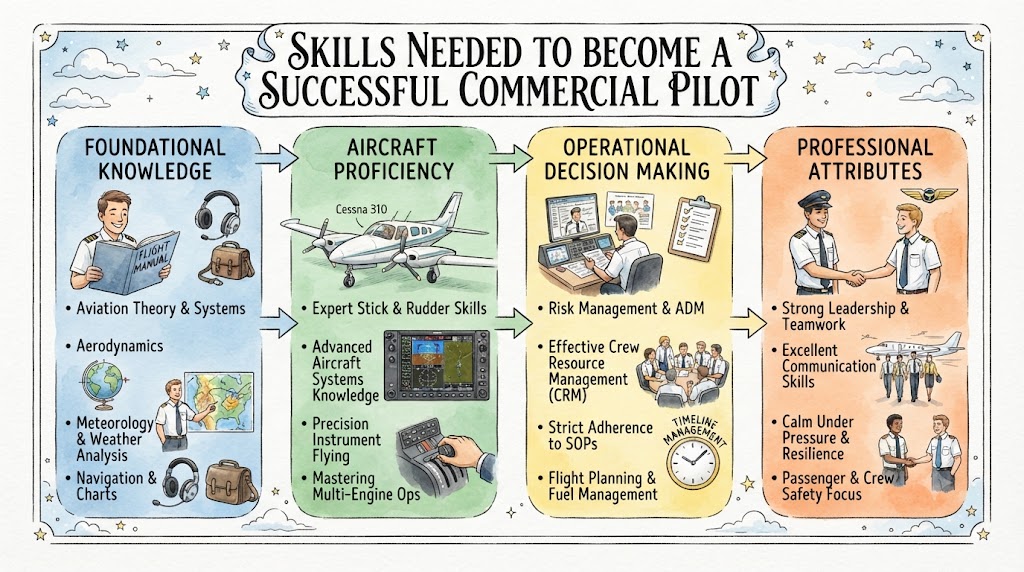
Becoming a commercial pilot is an exciting career goal that combines technical expertise, discipline, sound judgment, and a passion for aviation. Every commercial flight depends on highly trained pilots who are responsible for operating aircraft safely, making informed decisions, communicating effectively, and managing complex situations both on the ground and in the air.
Many aspiring pilots believe that learning to fly an aircraft is the only requirement for success. In reality, commercial aviation demands a much broader set of skills. Along with mastering aircraft controls, pilots must develop strong communication abilities, leadership qualities, situational awareness, teamwork, and the ability to remain calm under pressure.
These skills are not developed overnight. They grow through structured flight training, classroom education, simulator sessions, practical experience, and continuous professional development. Even experienced airline captains continue learning throughout their careers as aviation technology, regulations, and operating procedures evolve.
What Does a Commercial Pilot Do?
Commercial pilots are responsible for much more than flying an aircraft from one airport to another. They perform a wide range of duties before, during, and after every flight to ensure safe and efficient operations.
Typical responsibilities include:
- Operating aircraft safely
- Planning flights
- Reviewing weather conditions
- Calculating aircraft performance
- Navigating efficiently
- Communicating with Air Traffic Control
- Coordinating with crew members
- Monitoring aircraft systems
- Following aviation regulations
- Responding appropriately to unexpected situations
Commercial pilots may pursue careers in:
- Airline operations
- Charter aviation
- Corporate aviation
- Cargo transportation
- Flight instruction
- Special mission aviation
Each role requires strong technical knowledge and professional decision-making skills.
Why Skills Matter in Commercial Aviation
Commercial aviation is built on safety, precision, and professionalism.
The right combination of technical and personal skills allows pilots to:
- Operate aircraft safely
- Make informed decisions
- Manage changing weather conditions
- Work effectively with crew members
- Communicate clearly
- Build passenger confidence
- Improve operational efficiency
Every successful flight depends on continuous learning and the consistent application of these skills.
Essential Technical Skills Every Commercial Pilot Needs
1. Aircraft Control Skills
Aircraft control forms the foundation of every pilot’s training.
Commercial pilots must demonstrate smooth, precise aircraft handling during all phases of flight.
Key abilities include:
- Stable takeoffs
- Accurate landings
- Maintaining altitude
- Airspeed management
- Aircraft configuration management
- Smooth maneuvering
Developing consistent aircraft control improves both safety and passenger comfort.
2. Navigation Skills
Commercial pilots must know how to navigate efficiently under different operating conditions.
Navigation skills include:
- Flight planning
- Route management
- Reading aeronautical charts
- GPS navigation
- Position awareness
- Fuel planning
Strong navigation skills help pilots complete flights safely and efficiently.
3. Weather Interpretation
Weather significantly affects aviation operations.
Pilots should understand:
- Aviation weather reports
- Forecast interpretation
- Wind conditions
- Cloud formations
- Visibility
- Thunderstorm hazards
- Icing conditions
- Turbulence
Understanding weather supports better flight planning and safer decision-making.
4. Communication Skills
Professional communication is essential throughout every flight.
Commercial pilots communicate regularly with:
- Air Traffic Control
- Co-pilots
- Cabin crew
- Ground operations
- Dispatch personnel
Effective communication requires:
- Standard aviation phraseology
- Clear pronunciation
- Active listening
- Timely information sharing
Good communication reduces misunderstandings and improves flight safety.
5. Aircraft Systems Knowledge
Commercial pilots must understand how aircraft systems operate.
Important systems include:
- Engines
- Fuel systems
- Electrical systems
- Flight controls
- Hydraulic systems
- Landing gear
- Flight instruments
A solid understanding of aircraft systems helps pilots recognize abnormal conditions and respond appropriately.
6. Emergency Procedure Knowledge
Unexpected situations require calm and organized responses.
Commercial pilots learn how to manage:
- Engine abnormalities
- Electrical failures
- Navigation equipment issues
- Weather diversions
- Emergency checklists
Regular training helps pilots respond confidently while following established procedures.
Essential Soft Skills for Commercial Pilots
Decision-Making
Pilots constantly evaluate changing situations during flight.
Good decision-making involves:
- Assessing available information
- Evaluating risks
- Selecting safe courses of action
- Adapting to changing conditions
Sound judgment is one of the most valuable skills in aviation.
Situational Awareness
Situational awareness means understanding everything happening around the aircraft.
Pilots continuously monitor:
- Aircraft position
- Altitude
- Weather
- Air traffic
- Terrain
- Aircraft performance
Maintaining situational awareness helps prevent errors and improves safety.
Leadership
Commercial pilots demonstrate leadership by:
- Managing cockpit operations
- Supporting crew coordination
- Maintaining professionalism
- Making confident operational decisions
Effective leadership promotes teamwork and safe flight operations.
Teamwork
Commercial aviation depends on collaboration.
Pilots regularly work with:
- Co-pilots
- Cabin crew
- Dispatch personnel
- Maintenance teams
- Air Traffic Control
Successful teamwork supports efficient operations throughout every flight.
Time Management
Commercial pilots manage multiple responsibilities before, during, and after flights.
Good time management helps with:
- Flight preparation
- Document review
- Crew briefings
- Schedule coordination
- Workload organization
Effective organization reduces unnecessary stress.
Professionalism
Professional pilots are expected to demonstrate:
- Responsibility
- Discipline
- Integrity
- Reliability
- Respect for procedures
Professional behavior contributes to a strong safety culture.
Adaptability
No two flights are exactly alike.
Pilots regularly adapt to:
- Weather changes
- Airport delays
- Equipment issues
- Air traffic adjustments
- Operational changes
Flexibility helps maintain safe and efficient operations.
Stress Management
Commercial aviation occasionally presents demanding situations.
Pilots should develop healthy methods for:
- Maintaining concentration
- Remaining calm
- Managing workload
- Making clear decisions
Stress management contributes to better performance and safer operations.
How Flight Training Develops These Skills
Ground School
Ground school provides the theoretical foundation required for professional aviation.
Students study:
- Aerodynamics
- Aviation regulations
- Navigation
- Meteorology
- Aircraft systems
- Flight planning
- Human factors
Understanding these subjects prepares students for practical flight training.
Flight Lessons
Flight instruction develops:
- Aircraft handling
- Navigation
- Communication
- Decision-making
- Safety awareness
Each lesson gradually builds confidence and operational competence.
Simulator Training
Flight simulators allow students to practice situations that may be difficult or unsafe to recreate during actual flights.
Training commonly includes:
- Emergency procedures
- Instrument operations
- Crew coordination
- Scenario-based learning
- Abnormal situations
Simulator experience improves both confidence and preparedness.
Instructor Feedback
Experienced flight instructors help students improve by:
- Identifying strengths
- Correcting weaknesses
- Reinforcing safe habits
- Encouraging continuous improvement
Constructive feedback is an important part of professional development.
Skills That Continue to Improve Throughout a Pilot’s Career
Learning does not stop after earning a Commercial Pilot License.
Professional pilots continue developing through:
- Flight experience
- Recurrent training
- Aircraft type qualifications
- Leadership development
- Safety management programs
- Crew Resource Management training
- Continuing aviation education
Continuous improvement helps pilots remain current with evolving aviation standards.
Common Mistakes Student Pilots Should Avoid
Ignoring Ground School
Strong theoretical knowledge supports better flying performance.
Ground school deserves the same commitment as practical flight training.
Poor Study Habits
Consistent daily study is generally more effective than last-minute preparation.
Weak Communication
Students should practice standard aviation communication regularly.
Confidence develops through repetition and instructor guidance.
Overconfidence
Pilots should always operate within their training, certification, and experience.
Good judgment includes recognizing personal limitations.
Neglecting Physical and Mental Health
Adequate sleep, proper nutrition, and stress management support better pilot performance.
Not Learning From Mistakes
Every lesson provides an opportunity for improvement.
Successful pilots continually review their experiences and apply what they have learned.
Commercial Pilot Skill Development Checklist
Before and during flight training, focus on developing these skills:
- Master aircraft control
- Study aviation regulations
- Learn weather interpretation
- Practice flight planning
- Improve navigation skills
- Build communication confidence
- Strengthen decision-making ability
- Develop teamwork skills
- Maintain physical and mental fitness
- Commit to lifelong learning
A structured approach helps students build a strong professional foundation.
Technical Skills vs Soft Skills Comparison
| Technical Skills | Soft Skills |
|---|---|
| Aircraft handling | Leadership |
| Navigation | Decision-making |
| Weather interpretation | Teamwork |
| Aircraft systems knowledge | Communication |
| Flight planning | Adaptability |
| Emergency procedures | Professionalism |
Both categories are equally important for a successful aviation career.
Technology Helping Commercial Pilots Improve Skills
Modern technology continues to enhance pilot training and professional development.
Flight Simulators
Simulators provide realistic training environments for practicing normal and abnormal flight scenarios.
Electronic Flight Bags (EFBs)
Digital tools help pilots organize charts, checklists, weather information, and flight documentation.
GPS Navigation
Advanced navigation systems improve situational awareness and flight planning.
Glass Cockpit Technology
Modern cockpit displays present flight information more efficiently and support better decision-making.
Digital Flight Planning
Electronic planning tools simplify route preparation and aircraft performance calculations.
AI-Assisted Training Systems
Emerging technologies provide personalized learning experiences and additional practice opportunities.
Online Aviation Learning Platforms
Digital education resources support continuous learning throughout a pilot’s career.
Tips for Becoming a Better Commercial Pilot
Success in aviation requires continuous improvement.
Helpful recommendations include:
- Fly regularly to maintain proficiency.
- Study consistently between flight lessons.
- Ask instructors for feedback.
- Review every flight to identify learning opportunities.
- Stay physically and mentally healthy.
- Continue learning after earning your license.
- Develop professional habits early.
- Learn from experienced pilots whenever possible.
Small improvements made consistently often produce long-term success.
Frequently Asked Questions
1. What skills are most important for commercial pilots?
Commercial pilots need strong aircraft handling, communication, navigation, decision-making, teamwork, leadership, and professionalism.
2. Can flying skills alone make someone a successful pilot?
No. Successful commercial pilots combine technical flying abilities with communication, judgment, teamwork, and continuous learning.
3. Why is communication important in aviation?
Clear communication helps pilots coordinate safely with Air Traffic Control, crew members, dispatch, and other aviation professionals.
4. How can student pilots improve decision-making?
Regular flight practice, instructor feedback, simulator training, and studying real-world aviation scenarios all help strengthen decision-making.
5. What technical knowledge should commercial pilots have?
Pilots should understand aerodynamics, aircraft systems, navigation, weather, regulations, performance calculations, and emergency procedures.
6. How does simulator training help?
Simulators allow students to practice emergency procedures, instrument flying, crew coordination, and complex flight scenarios in a controlled environment.
7. Why is teamwork important for airline pilots?
Commercial aviation depends on effective cooperation between pilots, cabin crew, dispatch, maintenance personnel, and Air Traffic Control.
8. How can aspiring pilots continue improving after earning their license?
Pilots can continue learning through recurrent training, advanced certifications, flight experience, and ongoing professional education.
9. What personal qualities do airlines value?
Airlines generally value professionalism, responsibility, communication, discipline, leadership, adaptability, and a strong commitment to safety.
10. How long does it take to develop professional pilot skills?
Developing professional pilot skills is an ongoing process that continues throughout a pilot’s entire aviation career.
Conclusion
Becoming a successful commercial pilot requires much more than learning how to operate an aircraft. It demands a balanced combination of technical knowledge, practical flying ability, communication skills, leadership, teamwork, sound decision-making, and a strong commitment to safety. These qualities are developed through structured training, real-world flying experience, continuous education, and the willingness to learn from every flight.
Aspiring pilots who focus on building both technical expertise and professional character are better prepared for the challenges of commercial aviation. By studying consistently, practicing regularly, seeking guidance from experienced instructors, and maintaining a mindset of lifelong learning, students can build the confidence and competence needed for a rewarding aviation career. Every flight presents an opportunity to improve, and those who embrace continuous development are well positioned for long-term success in commercial aviation.

