Aviation flight decks and orbital spacecraft operate in opposite environments, yet both demand steady concentration, technical fluency, and strict adherence to safety checklists. Anyone researching how to become an airline pilot or mapping out a long-term route toward space exploration quickly encounters dense regulatory manuals and differing national rules.
AstroPilot – Astronaut & Pilot translates those technical requirements into straightforward, beginner-friendly articles. As an aviation and space education publication, AstroPilot explains pilot licensing tiers, flight academy structures, and orbital physics in plain English. Below is a practical look at airline career steps, astronaut qualifications, and home flight simulation.
How to Become an Airline Pilot
Planning how to become an airline pilot works best when you handle medical clearance and licensing stages in logical order. Airlines recruit dependable aviators who manage complex aircraft calmly under pressure.
Schooling and Aviation Medical Checks
Commercial carriers typically ask for a high school diploma or equivalent academic record. Comfort with basic algebra and physics makes fuel burn calculations, wind drift corrections, and aircraft weight-and-balance checks far easier.
Book an aviation medical exam before paying for flight lessons. Airline employment requires a Class 1 medical certificate from a regulator-approved doctor. The exam checks near and distance vision, color perception, hearing, cardiovascular health, and overall fitness.
Six Milestones From Student to Airliner
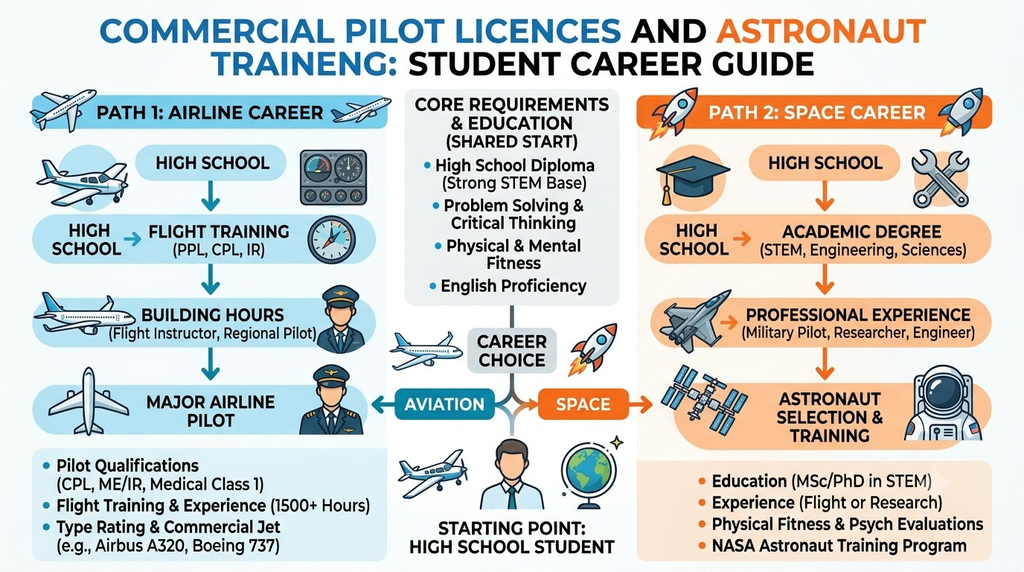
Most airline pilots advance through six structured training phases:
- Private Pilot Licence (PPL): Learn basic aircraft handling, takeoffs, landings, and visual map navigation.
- Flight Hour Building: Log solo cross-country trips and night operations to sharpen real-world judgment.
- Instrument Rating (IR): Fly safely inside clouds and low visibility by relying on cockpit gauges alone.
- Commercial Pilot Licence (CPL): Meet tighter flight tolerances so employers can legally pay you to fly.
- Multi-Engine Rating (ME): Train on twin-engine airplanes, including single-engine emergency drills.
- Airline Transport Pilot Licence (ATPL): Earn the top pilot credential required to command commercial jets.
Airline Hiring and Aircraft Type Ratings
Carriers screen job candidates through simulator checks, technical interviews, and crew coordination tests. After receiving a job offer, new hires complete a type rating for a specific aircraft family, such as the Airbus A320 or Boeing 737. Pilots start line flying as First Officers and upgrade to Captain after building sufficient command hours.
Check Local Rules: Age limits, medical classes, and flight-hour minimums vary across countries. Confirm exact requirements with the FAA in the USA, DGCA in India, CAA in the UK, Transport Canada, or CASA in Australia.
Private Pilot License Requirements
A Private Pilot Licence (PPL) lets you carry friends and family in light airplanes for personal travel. You can share fuel expenses equally with passengers, though you cannot charge fares or earn money as a pilot.
Age, Language, and Health Criteria
Checking private pilot license requirements early keeps your paperwork moving smoothly. Under FAA pilot rules in the United States, applicants must satisfy three baseline standards:
- Minimum Age: Solo flights start at 16, and full PPL checkrides open at 17.
- Language: Read, speak, write, and understand English clearly.
- Medical Certificate: Hold at least an FAA Third-Class medical certificate.
Authorities in India (DGCA), the UK (CAA), and Australia (CASA) also set the minimum PPL age at 17, using their own national medical certificate classes.
Ground Study and Flight Experience
Ground school covers aerodynamics, weather forecasts, airspace charts, and radio calls. You pass a multiple-choice written test before booking your final practical exam.
FAA rules mandate at least 40 flight hours under Part 61, or 35 hours inside an approved Part 141 course. Most students log 55 to 70 hours before passing their checkride with a flight examiner.
Commercial Pilot License Requirements
A Commercial Pilot Licence (CPL) turns flying into a paid profession. Entry-level commercial pilots often work as flight instructors, cargo flyers, aerial survey pilots, banner towers, or charter crew.
Experience and Medical Standards
Meeting commercial pilot license requirements demands sharper altitude, heading, and airspeed control than private flying. Under FAA commercial airman rules in the USA, applicants need:
- Minimum Age: 18 years old.
- Prior Credential: A valid Private Pilot Licence.
- Medical Fitness: At least a Second-Class medical certificate (First-Class is needed for airline roles).
- Flight Time: 250 total flight hours under Part 61, including specific cross-country, night, and instrument hours.
Hour minimums differ in other regions. Both India (DGCA) and Australia (CASA) require 200 total flight hours for a CPL.
Checkrides and Add-On Ratings
CPL candidates pass an advanced written exam and perform strict commercial maneuvers during a flight test. Adding an Instrument Rating and Multi-Engine Rating opens far more hiring opportunities.
The legal divide between a PPL and a CPL comes down to compensation. A PPL covers personal flights only, whereas a CPL authorizes paid commercial operations.
Pilot Training Programs in the USA
Domestic and international learners frequently compare pilot training programs in the USA for consistent flying weather, large training fleets, and busy controlled airspace.
Three Training Structures
Flight academies in the United States operate under three main frameworks:
- Part 61 Schools: Flexible lesson schedules suited for learners balancing jobs or college courses.
- Part 141 Schools: Structured, FAA-audited curricula built for full-time students and international visa applicants.
- University Aviation Degrees: Combine an accredited college degree with flight training, qualifying graduates for reduced airline hour minimums.
Integrated vs. Modular Pacing
Full-time integrated programs take beginners from zero flight time to a CPL in roughly 12 to 18 months. Modular training splits each licence and rating into separate steps completed as time and budgets permit.
Costs and International Visa Rules
Total expenses depend on aircraft rental rates, fuel prices, instructor fees, and individual learning pace. Avoid any flight school that promises guaranteed airline placement.
International applicants training in the USA must enroll at a SEVP-certified flight school to qualify for an M-1 or F-1 student visa. Foreign students also complete security vetting through the TSA Flight Training Security Program before starting lessons.
Airline Transport Pilot License Requirements
The Airline Transport Pilot Licence (ATPL) sits at the top of civil aviation. Commercial airlines require Captains—and in many jurisdictions, First Officers—to hold this credential.
Flight Hours and Multi-Crew Operations
Fulfilling airline transport pilot license requirements confirms your readiness to command large passenger jets. Under FAA ATP regulations in the United States, candidates must meet four core benchmarks:
- Minimum Age: 23 years old for an unrestricted ATP certificate.
- Medical Certificate: Active First-Class medical certificate.
- Flight Experience: 1,500 total hours, including 500 cross-country hours, 100 night hours, and 75 instrument hours.
- ATP CTP Course: Ground instruction and full-motion jet simulator sessions completed before taking the written exam.
Restricted and Frozen ATPL Systems
In the USA, military pilots and graduates of approved aviation universities can qualify for a Restricted ATP (R-ATP) at age 21 with 750, 1,000, or 1,250 flight hours.
Across Europe (EASA), the UK (CAA), and India (DGCA), junior airline hires typically hold a “Frozen ATPL.” Candidates pass all ATPL theory exams alongside their CPL, Instrument, and Multi-Engine ratings, and the licence “unfreezes” after logging 1,500 multi-crew airline hours.
Pilot Licence Comparison
| Licence | Primary Privilege | Core Training Focus | Key Limitations & Rules |
|---|---|---|---|
| Private Pilot Licence (PPL) | Personal and recreational flights | Aircraft handling, visual navigation, and basic safety | No paid flying or commercial transport |
| Commercial Pilot Licence (CPL) | Entry-level paid flying jobs | Precision maneuvers, commercial law, and night/instrument flight | Requires higher medical class and 200–250+ flight hours |
| Airline Transport Pilot Licence (ATPL) | Commanding commercial airliners | Multi-crew coordination, jet systems, and airline operations | Highest age and flight-hour thresholds; rules vary by country |
How to Become an Astronaut
Researching how to become an astronaut reveals a selection process built around deep STEM expertise, calm problem-solving, and group reliability. Space agencies recruit specialists capable of running orbital laboratories in extreme isolation.
Degrees, Experience, and Health Screening
Major space agencies—including NASA, the European Space Agency (ESA), and ISRO—set clear baseline qualifications:
- STEM Master’s Degree: Engineering, biological science, physical science, computer science, or mathematics.
- Professional Experience: Two to three years of related post-graduate work, or 1,000 hours of pilot-in-command time in high-performance jets.
- Medical and Psychological Clearance: Comprehensive physical exams, vision screening, and psychological resilience evaluations.
Selection Odds and Candidate Training
Thousands of qualified candidates compete for a handful of openings during each selection cycle. Review panels evaluate communication under stress, conflict resolution, and team leadership.
Selected astronaut candidates spend roughly two years in basic training. They study spacecraft systems, practice spacewalks in giant underwater pools, operate robotic arms, and complete wilderness survival courses before receiving a flight assignment.
Astronaut Training for Students
Students do not need an engineering degree in hand to build useful habits. Practical astronaut training for students centers on quantitative skills, hands-on building, and physical stamina.
STEM Study and Technical Projects
High school and university students can build a strong technical foundation through daily habits:
- Mathematics and Physics: Focus on algebra, calculus, classical mechanics, and electromagnetism.
- Programming: Practice Python or C++ to work with flight telemetry, automation, and sensor data.
- Hardware Projects: Join robotics teams, build model rockets, or assemble microcontroller circuits.
Fitness, Teamwork, and Outreach
Endurance sports like running and swimming strengthen cardiovascular stamina. Earning an open-water scuba certification also teaches underwater buoyancy control and calm breathing habits.
Astronomy clubs, science fairs, and NASA student learning resources offer structured ways to explore aerospace topics. No single class or camp guarantees space agency selection, yet these activities prepare students for rewarding engineering and science careers.
Pilot Training vs Astronaut Training
Examining pilot training vs astronaut training highlights two specialized professions with separate operational goals. Both demand strict checklist discipline and rapid troubleshooting, though their work environments share little in common.
Differences and Shared Skills
Airline pilots move passengers and cargo safely through Earth’s atmosphere while managing weather fronts and air traffic. Astronauts operate orbital vehicles, maintain closed-loop life support, and run scientific experiments in microgravity.
Military test pilot experience remains a well-established pathway for spacecraft commanders and pilots. Still, a pilot licence is not mandatory for every astronaut—physicians, biologists, geologists, and engineers regularly fly to space as mission specialists.
Pilot Training vs Astronaut Training
| Comparison Area | Pilot Training | Astronaut Training |
|---|---|---|
| Core Mission | Safe aircraft operation in Earth’s atmosphere | Spaceflight operations, orbital research, and survival |
| Education | High school diploma minimum; aviation degrees optional | STEM Master’s degree or extensive jet command experience |
| Practical Drills | Single-engine planes, twin-engine aircraft, and cockpit simulators | Spacecraft mockups, neutral buoyancy pools, and survival training |
| Primary Hazards | Severe weather, traffic congestion, and mechanical failures | Vacuum, radiation, microgravity, and life-support faults |
| Career Destinations | Commercial airlines, cargo carriers, charter firms, and flight schools | National space agencies and commercial spaceflight operators |
Spaceflight Basics for Beginners
Learning spaceflight basics for beginners turns rocket launches and orbital maneuvers into clear physical concepts. Every mission depends on rocket thrust, orbital speed, and protective engineering.
Thrust, Gravity, and Orbital Speed
Rockets climb off the launchpad by burning fuel and blasting hot exhaust gas downward. By Newton’s third law, that downward blast generates an upward force called thrust.
Reaching space requires altitude, but staying in orbit requires horizontal speed—around 17,500 miles per hour (28,000 kilometers per hour) in low Earth orbit. At that velocity, Earth’s gravity bends the spacecraft’s path downward at the exact curvature of the planet below. The vehicle remains in continuous free fall, producing microgravity inside the cabin.
Life Support, Re-Entry, and Mission Control
Sustaining crews in orbit takes reliable onboard hardware and ground support:
- Life Support Systems: Scrub carbon dioxide from cabin air, supply oxygen, and regulate cabin pressure and temperature.
- Heat Shields: Absorb and deflect extreme aerodynamic heating during atmospheric re-entry.
- Mission Control: Ground engineers track spacecraft telemetry around the clock and guide crews through every maneuver.
Facilities like the International Space Station (ISS) operate as permanent orbital laboratories where crews test life-support and propulsion technologies for Moon and Mars missions.
Best Flight Simulator Software for Student Pilots
Practicing at home with the best flight simulator software for student pilots helps beginners learn cockpit layouts and radio procedures before paying for real aircraft fuel.
Three Widely Used Simulators
Three desktop programs stand out for student pilot study:
- Microsoft Flight Simulator: Delivers realistic global scenery and live weather feeds, making it useful for visual landmark navigation and cross-country planning.
- X-Plane: Uses blade-element physics modeling for accurate aircraft handling. FAA-certified commercial versions power instrument trainers at many flight academies.
- Prepar3D: Built for procedural cockpit practice, multi-engine avionics workflows, and commercial jet systems.
Getting Value From Home Practice
Desktop simulators work best when focused on checklists, instrument scanning, and navigation radios. Connecting a physical yoke or joystick, throttle quadrant, and rudder pedals makes control inputs far more realistic.
Flight Simulator Learning Features
| Feature | Training Application | Practical Benefit for Students |
|---|---|---|
| Flight Controls | Coordinating pitch, roll, and rudder inputs | Builds early muscle memory before first flight lessons |
| Navigation Radios | Tuning VOR stations, ILS approaches, and GPS routes | Simplifies instrument navigation concepts |
| Weather Engine | Practicing crosswind landings and instrument approaches | Demonstrates how wind and clouds affect flight paths |
| Cockpit Gauges | Scanning airspeed, attitude, altitude, and heading | Reduces mental overload during real cockpit sessions |
| System Checklists | Running engine start, taxi, and emergency procedures | Reinforces disciplined cockpit habits |
Regulatory Limit: Home flight simulator software reinforces cockpit procedures, but it never replaces certified flight instruction. Hours logged on a personal computer do not count toward FAA, DGCA, CAA, or CASA licence requirements.
Common Mistakes and Their Solutions
Avoiding predictable planning errors saves money and prevents training delays.
- Booking Flight Lessons Before the Medical Exam
- Mistake: Paying flight school deposits before confirming medical eligibility.
- Solution: Pass your Class 1 or Class 2 aviation medical exam first.
- Choosing a Flight School Without Visiting
- Mistake: Enrolling based only on online brochures.
- Solution: Tour multiple academies, inspect maintenance hangars, and talk with current students about aircraft availability.
- Budgeting Only for Legal Hour Minimums
- Mistake: Assuming you will finish a PPL in exactly 40 flight hours.
- Solution: Add a 25% to 30% financial buffer for weather delays, extra practice flights, and exam fees.
- Confusing PPL and CPL Privileges
- Mistake: Thinking a Private Pilot Licence allows paid sightseeing or charter flights.
- Solution: Earn a Commercial Pilot Licence before accepting any paid flying work.
- Ignoring Foreign Licence Conversion Rules
- Mistake: Training overseas without checking how your home country validates foreign licences.
- Solution: Confirm exam and flight-hour conversion steps with your home aviation regulator before enrolling abroad.
- Trying to Self-Teach Flying on a Home Simulator
- Mistake: Practicing unguided control habits on a PC without an instructor.
- Solution: Use desktop simulators for checklists and navigation, leaving stick-and-rudder technique to your flight instructor.
- Expecting an Immediate Airline Job at 250 Hours
- Mistake: Assuming a new CPL leads directly to a commercial jet cockpit.
- Solution: Plan an hour-building path, such as working as a Certified Flight Instructor (CFI).
- Picking a STEM Major You Dislike for Astronaut Applications
- Mistake: Choosing an engineering field solely because you think space agencies prefer one major.
- Solution: Study a technical or scientific subject you genuinely enjoy so you can excel in your field.
Benefits of Learning About Aviation and Space Careers
Researching aerospace pathways early helps students align their schooling, finances, and medical checks before making major commitments. Understanding how Part 61 and Part 141 programs differ—or how STEM degrees feed into space agency roles—prevents costly missteps.
Early study also strengthens applied math, physics, risk management, and structured communication. Those abilities carry directly into aviation, air traffic control, avionics engineering, and commercial spaceflight.
As an educational publication, AstroPilot presents licensing rules, spaceflight concepts, and career comparisons in straightforward language so beginners can plan their next steps clearly.
Practical Career Scenarios
Note: The following examples are fictional profiles created for educational illustration.
Fictional Scenario 1: Mapping Out an Airline Career
Maya is a 17-year-old high school senior aiming for a commercial airline cockpit. Before graduating, she takes an introductory discovery flight at a local airfield and passes her Class 1 medical exam. She focuses on physics and algebra in school while reading licensing guides on AstroPilot to understand every stage from PPL to ATPL.
Fictional Scenario 2: Comparing U.S. Flight Academies
Liam is a 20-year-old student evaluating flight training programs in the United States. He visits three Part 61 and Part 141 schools, comparing aircraft maintenance records, instructor availability, local weather patterns, and hourly wet rates before selecting an academy that fits his budget and schedule.
Fictional Scenario 3: Building an Astronaut Application Profile
Arjun is a first-year mechanical engineering student interested in human spaceflight. He joins his university robotics lab, learns Python for sensor data analysis, and earns an open-water scuba certification. Knowing astronaut selection is highly competitive, he focuses on building a strong engineering career while staying physically fit.
Fictional Scenario 4: Practicing Procedures Before Flight Lessons
Sofia plans to start her Private Pilot Licence next summer, so she sets up X-Plane on her home computer. Instead of flying aerobatics, she practices reading cockpit gauges, running pre-flight checklists, and flying standard airport traffic patterns so her first real flight lessons feel familiar.
Frequently Asked Questions
1. What is the first step in how to become an airline pilot?
Start by checking your national aviation authority’s regulations and passing a Class 1 aviation medical exam. Verifying your vision, hearing, and cardiovascular health early protects your investment before paying for flight hours. Once cleared, enroll in ground school and begin training for a Private Pilot Licence.
2. What are the basic private pilot license requirements in the USA?
Under FAA rules in the United States, applicants must be at least 17 years old, read and speak English, and hold a Third-Class medical certificate. Students must also complete ground school, pass a written knowledge exam, log at least 40 hours of flight time, and pass a practical checkride.
3. How do commercial pilot license requirements differ from a PPL?
A Commercial Pilot Licence allows you to earn money flying, whereas a PPL permits only unpaid private flights. In the USA, a CPL requires you to be at least 18 years old, hold a PPL, pass a Second-Class medical exam, log 250 total flight hours, and pass advanced flight maneuvers.
4. How should students compare pilot training programs in the USA?
Compare Part 61 and Part 141 flight academies by reviewing fleet size, maintenance standards, instructor availability, local weather, and total program costs. International applicants must also confirm that the school holds SEVP certification for M-1 or F-1 student visas and check TSA security clearance rules.
5. What are the main airline transport pilot license requirements?
In the United States, an unrestricted Airline Transport Pilot Licence requires you to be at least 23 years old, hold a First-Class medical certificate, and log 1,500 total flight hours. Candidates must also complete an approved ATP Certification Training Program, pass written exams, and pass a multi-crew simulator checkride.
6. Do you have to be a pilot to learn how to become an astronaut?
No, a pilot licence is not required for every astronaut role. Space agencies like NASA and ESA select engineers, research scientists, and medical doctors alongside test pilots. However, logging 1,000 hours of jet command time remains a standard requirement for applicants seeking spacecraft pilot positions.
7. What is the best astronaut training for students in school or college?
Focus on core STEM subjects including mathematics, physics, computer programming, and engineering. Join robotics clubs, build science projects, and develop strong teamwork habits. Staying physically fit through endurance sports and earning a scuba diving certification also builds useful skills for future aerospace careers.
8. What is the biggest difference in pilot training vs astronaut training?
Pilot training prepares you to fly aircraft safely through Earth’s atmosphere, navigate air traffic, and manage weather systems. Astronaut training prepares crews to live in microgravity, operate spacecraft life-support hardware, conduct orbital research, and respond to emergencies in the vacuum of space.
9. What are the most important spaceflight basics for beginners to learn?
Beginners should learn how rocket engines generate thrust to overcome gravity, how orbital velocity keeps spacecraft falling around Earth without hitting it, and how life-support systems recycle air and water. Understanding heat shields during atmospheric re-entry and Mission Control telemetry also explains how missions operate.
10. What is the best flight simulator software for student pilots?
Microsoft Flight Simulator and X-Plane are two strong choices for student pilots. X-Plane offers highly accurate aerodynamic physics and instrument behavior, while Microsoft Flight Simulator provides detailed global scenery and live weather. Both programs help students practice checklists, radio navigation, and cockpit layouts at home.
11. Can home flight simulator hours count toward a real pilot licence?
No, hours flown on a standard home desktop computer do not count toward FAA or international pilot licences. Only certified Aviation Training Devices approved by an aviation regulator and logged with a certified flight instructor can count toward official licence minimums.
12. Does AstroPilot offer official pilot licences or flight training?
No, AstroPilot – Astronaut & Pilot is an educational publication rather than a flight school or licensing authority. It publishes beginner guides, career comparisons, and aerospace explainers so students can understand licensing rules and spaceflight fundamentals before enrolling with official training providers.
Conclusion
Reaching a commercial cockpit or preparing for human spaceflight starts with accurate, country-specific research on how to become an airline pilot and meet technical standards. Comparing pilot licence levels, evaluating U.S. flight academies, practicing cockpit workflows on home flight simulator software, and building strong STEM habits all require steady discipline. Because aviation regulations and space agency rules vary across countries, always confirm official standards before committing funds to training. Educational resources like AstroPilot turn complex aviation and spaceflight rules into plain, practical guides so aspiring pilots and future explorers can plan their training with confidence.