
Introduction
Pilot training in the United States can be an attractive option for Indian students because the U.S. has a large aviation-training ecosystem, standardized FAA certification pathways, and flight schools operating under established regulatory frameworks. For an Indian student, however, choosing a flight school is only one part of the decision. Immigration status, TSA security requirements, medical eligibility, English proficiency, training structure, finances, aircraft availability, weather, instructor continuity, and the eventual conversion or use of the FAA certificates all need to be considered together.
The most important principle is to plan the entire training pathway before paying a large deposit. A school may have modern aircraft and an appealing advertised program, but that does not automatically mean its international-student arrangements, visa eligibility, training pace, or post-training pathway will fit a particular student.
Why Indian Students Consider Pilot Training in the USA
The U.S. offers a mature flight-training environment with many airports, flight schools, instructors, aircraft fleets, and aviation education programs.
The FAA maintains information on pilot schools and aviation education institutions, including Part 141 pilot schools.
For an international student, the potential advantages include:
- A structured FAA certification system.
- Access to a broad flight-training ecosystem.
- Opportunities to train in different weather and geographic environments.
- Availability of both independent flight schools and collegiate aviation programs.
- Training pathways that can combine certificates and ratings.
- Exposure to U.S. aviation terminology, procedures, and operating practices.
- The possibility of building experience in the U.S. where immigration and employment rules permit.
However, the U.S. should not be selected simply because it is perceived as a faster or cheaper destination. The appropriate training location depends on the student’s goals, finances, immigration circumstances, medical eligibility, and intended aviation career.
Understanding the FAA Training Pathway
A student should first understand what each certificate accomplishes.
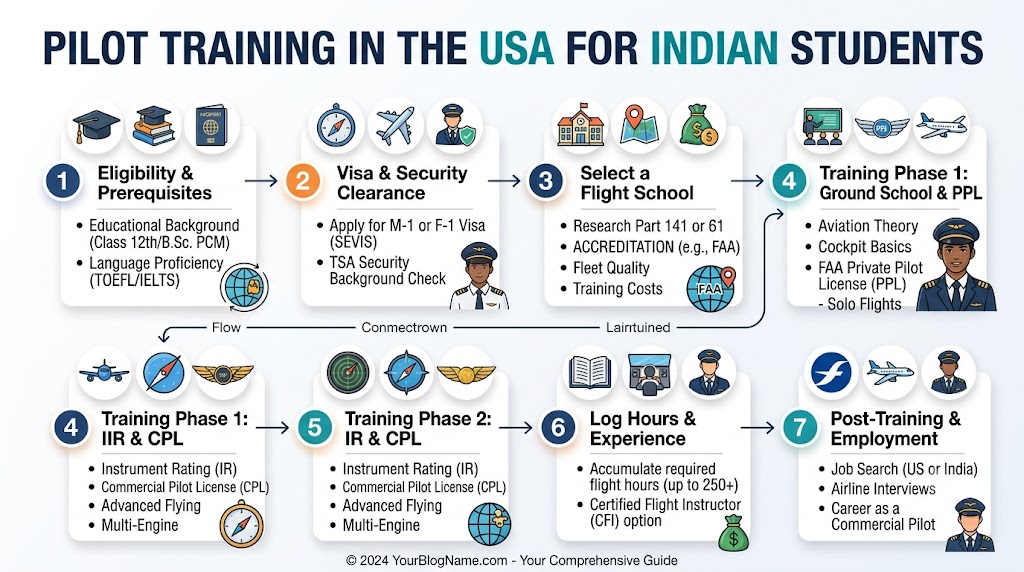
A typical professional-oriented pathway may involve:
- Student pilot stage
- Private Pilot Certificate
- Instrument Rating
- Commercial Pilot Certificate
- Multi-engine training
- Flight instructor certificates and ratings, where appropriate
- Additional experience building
- Airline Transport Pilot eligibility and certification when the applicable requirements are met
These stages should not be treated as one single qualification.
Each certificate or rating has its own requirements, training objectives, examinations, practical tests, and privileges.
For example, the FAA states that the commercial pilot certificate requires a minimum of 250 total flight hours under the applicable certification framework, while airlines can establish substantially higher experience requirements for employment.
That distinction is critical.
Obtaining a commercial certificate does not automatically mean that a graduate is qualified for an airline first-officer position.
Student Pilot Requirements
Before beginning solo operations, a student needs the appropriate student-pilot certification and endorsements.
The FAA states that applicants for a student pilot certificate must generally be at least 16 years old and able to read, speak, and understand English.
A student does not need the student pilot certificate merely to take introductory flight lessons with an instructor, but it becomes relevant before solo flight.
For non-U.S. students, additional security-vetting requirements apply through the U.S. flight-training security framework.
This is one reason international students should discuss documentation and security processing with the school before scheduling training.
Part 61 vs. Part 141 Flight Training
One of the first technical decisions is understanding whether the training will be conducted under Part 61 or Part 141.
Neither should automatically be treated as universally superior. They represent different regulatory structures and training approaches.
| Factor | Part 61 | Part 141 |
|---|---|---|
| Training structure | Generally more flexible | More structured |
| Course syllabus | Instructor/student driven within regulatory requirements | Approved training-course structure |
| Scheduling | Often flexible | Usually more program-oriented |
| Suitable for | Students needing flexibility | Students following an organized curriculum |
| International planning | Depends heavily on school | Often useful for structured programs |
| Training-hour requirements | Vary according to certificate/rating | Certain requirements can be lower when applicable |
| Main consideration | Flexibility | Structured progression |
The FAA specifically maintains certification and oversight information for Part 141 pilot schools.
For an international student who is relocating specifically for flight training, a structured program can make planning easier. But the student should examine the actual school’s syllabus, aircraft availability, instructor capacity, and completion policies rather than choosing based solely on the Part 141 label.
Visa and Immigration Planning
Immigration status is one of the most important parts of the decision.
The appropriate student classification depends on the nature of the educational program and the school’s authorization.
USCIS distinguishes F-1 academic students from M-1 vocational students. M-1 classification is generally used for qualifying vocational or other recognized nonacademic programs.
For qualifying vocational study, the school must be appropriately approved, and the student must meet the relevant financial and immigration requirements. USCIS describes the general M-1 process as involving admission to an approved institution, issuance of Form I-20, payment of the required I-901 SEVIS fee, and the visa process for students outside the United States.
The U.S. Department of State also identifies Form I-20 for M-1 vocational students as part of the student-visa documentation process.
Practical implication
Do not assume:
“I have been accepted by a flight school, so I automatically have the correct immigration pathway.”
Instead, verify:
- Whether the school is authorized to enroll international students.
- Which student classification applies to the specific program.
- Whether the particular campus is covered.
- What documentation the school issues.
- What financial evidence is required.
- Whether the planned training sequence fits the immigration status.
- What restrictions apply to employment or changes in training plans.
The official SEVP school-search system allows prospective international students to identify schools and programs certified for F-1 and/or M-1 students.
TSA Security Requirements for International Flight Students
International students should also understand that flight training involves aviation-security screening requirements.
The FAA identifies the Flight Training Security Program as the relevant framework for foreign student pilots, and FAA materials explain that security vetting is connected to student-pilot certification for foreign students.
This means that an international student’s administrative preparation can involve more than ordinary school admission.
Before committing to a training schedule, ask the school:
- What security-screening process applies?
- What documents are required?
- When should the process begin?
- Can training begin before all approvals are complete?
- Which training activities require additional authorization?
- Who at the school handles international-student compliance?
A school experienced with international students should be able to explain its process clearly.
Choosing the Right Flight School
The biggest mistake is selecting a school based only on advertised hourly aircraft rates.
A better evaluation considers the entire training system.
1. International Student Authorization
First determine whether the school can legally support the student’s intended immigration and training pathway.
Verify its current authorization rather than relying on an old advertisement or an agent’s statement.
2. Training Structure
Ask whether the school offers:
- Private Pilot training
- Instrument training
- Commercial training
- Multi-engine training
- Instructor training
- Structured career programs
- Ground-school support
- Simulator training where appropriate
The ideal structure depends on the student’s objective.
Someone pursuing recreational flying does not necessarily need the same program as someone planning a professional airline career.
3. Aircraft Availability
The published fleet size is less important than usable fleet availability.
Ask:
- How many aircraft are actually operational?
- How frequently are aircraft unavailable for maintenance?
- Are replacement aircraft available?
- Are several students competing for the same aircraft?
- What happens when an aircraft is grounded?
- Are training aircraft equipped consistently?
An inexpensive aircraft that is frequently unavailable can make training more expensive overall.
4. Instructor Availability
Instructor continuity matters.
Repeatedly changing instructors can create:
- inconsistent training styles
- duplicated lessons
- communication problems
- slower progress
- additional training costs
Ask how instructors are assigned and what happens if the assigned instructor leaves.
Location Matters More Than Many Students Expect
A flight school’s location can affect the training experience significantly.
Consider:
- Weather patterns
- Airport congestion
- Airspace complexity
- Terrain
- Availability of nearby airports
- Cross-country training opportunities
- Housing
- Transportation
- Cost of living
- Aircraft availability
A location with consistently poor weather may create scheduling delays.
Conversely, a very busy airport may provide valuable experience but could also increase taxiing, sequencing, and operational complexity.
There is no universally perfect location.
The right environment depends on the student’s training objectives.
Medical Certification Should Be Considered Early
A student should investigate aviation medical eligibility before committing substantial money to training.
This is particularly important for someone planning a professional aviation career.
A medical issue discovered after substantial training expenditure can create significant financial and emotional consequences.
The sensible approach is to address medical eligibility early, using an appropriately authorized aviation medical professional and the applicable FAA requirements.
Do not treat a medical certificate as a paperwork item to deal with after paying for a complete training package.
English Proficiency and Aviation Communication
English is not simply an academic requirement in flight training.
Students must become comfortable with:
- Aviation terminology
- Radio communication
- Weather briefings
- Written procedures
- Checklists
- Instructor briefings
- Air traffic control communications
- Technical manuals
- Oral examinations
The FAA requires student-pilot applicants to be able to read, speak, and understand English.
A student with strong general English but limited aviation vocabulary may still need time to adapt.
A useful preparation strategy is to build aviation vocabulary before arriving, rather than attempting to learn everyday English and aviation communication simultaneously.
Budgeting for Pilot Training
The advertised training price should never be treated as the final budget.
A realistic financial plan should account for multiple categories.
| Cost Category | What to Consider |
|---|---|
| Flight training | Aircraft and instructor charges |
| Ground training | Classroom or instructor costs |
| Written examinations | Knowledge-test expenses |
| Practical tests | Examiner fees |
| Medical | Aviation medical examination |
| Study materials | Books, charts, software and related materials |
| Headset/equipment | Personal aviation equipment |
| Accommodation | Rent and deposits |
| Food | Daily living expenses |
| Transportation | Local transportation |
| Insurance | Applicable personal or school requirements |
| Visa-related expenses | Applicable government and administrative costs |
| Security processing | Applicable international-student requirements |
| Retakes | Additional training or examination costs |
| Weather delays | Additional accommodation and living expenses |
| Aircraft downtime | Potential schedule disruption |
| Emergency reserve | Unexpected expenses |
The most important budgeting mistake is calculating:
aircraft hourly rate × minimum required hours
That calculation ignores many real-world costs.
Why Minimum Flight Hours Are Not a Budget
Regulatory minimums are not guaranteed completion times.
A student may require additional training because of:
- Weather
- Aircraft availability
- Instructor changes
- Learning pace
- Skill deficiencies
- Missed lessons
- Checkride preparation
- Written-test preparation
- Aircraft maintenance
- Scheduling limitations
Therefore, a responsible budget should include a contingency reserve.
The objective should be to estimate the probable total cost, not simply the theoretical regulatory minimum.
A Better Way to Compare Flight Schools
Instead of asking:
“Which school is cheapest?”
compare the schools across several dimensions.
| Decision Area | Questions to Ask |
|---|---|
| Authorization | Can the school support my international-student status? |
| Training | What certificates and ratings are included? |
| Fleet | How many aircraft are operational? |
| Maintenance | What happens when an aircraft is unavailable? |
| Instructors | How are instructors assigned? |
| Scheduling | How many flight slots can students realistically obtain? |
| Weather | How frequently does weather disrupt operations? |
| Location | Is the airport suitable for my training objectives? |
| Housing | What accommodation options are realistically available? |
| Costs | What is included and excluded from the quoted price? |
| Testing | Which checkride and examiner fees are separate? |
| Completion | What happens if training takes longer than expected? |
| Career pathway | Does the program match my intended professional route? |
| Documentation | Who handles international-student compliance? |
This produces a much more meaningful comparison than advertised hourly rates.
Building a Professional Pilot Pathway
For students whose objective is professional aviation, it is useful to think beyond the first certificate.
A simplified pathway can look like:
Training Foundation → Private Pilot → Instrument → Commercial → Multi-Engine → Instructor/Experience Building → Higher Experience Level → Airline/Professional Opportunities
The exact sequence depends on the student’s goals, training program, previous experience, and applicable regulatory requirements.
The FAA notes that airlines establish their own hiring requirements and that these can be significantly above the minimum requirements for the commercial certificate.
Therefore, students should not select a school merely because it promises to deliver a commercial certificate quickly.
The more important question is:
What happens after the certificate?
FAA Certification vs. Indian Aviation Career Planning
An Indian student should also determine how the U.S. training fits into a future career in India.
This distinction is critical.
An FAA certificate and an Indian professional aviation career are not automatically interchangeable.
If the intended career is with an Indian operator, the student should investigate the applicable requirements of the Directorate General of Civil Aviation (DGCA) before committing to a foreign training program.
The student should determine:
- Which foreign certificates can be converted or validated.
- What examinations may be required.
- What documentation is needed.
- What medical requirements apply.
- Whether flight-time records meet the relevant requirements.
- Whether the training organization documentation will be accepted.
- What additional procedural requirements apply.
These requirements can change, so students should verify the current DGCA rules directly rather than relying on older advice from agents, social-media groups, or former students.
Flight Training Security and Documentation
International students should maintain organized documentation throughout training.
Important records can include:
- Passport documentation
- Immigration documents
- Student-status documents
- Training records
- Pilot logbook
- Medical documentation
- Examination records
- Certificates and ratings
- Instructor endorsements
- School correspondence
- Receipts and invoices
- Aircraft-related training records where applicable
Do not wait until graduation to discover that a document needed for a future application is missing.
Good recordkeeping is part of professional pilot preparation.
Common Mistakes Indian Students Should Avoid
Mistake 1: Choosing Only on Price
The lowest hourly rate does not necessarily produce the lowest total cost.
Better approach: compare total training economics, availability, scheduling, maintenance, and completion time.
Mistake 2: Paying a Large Deposit Too Early
A large prepaid package may appear financially attractive but can create problems if circumstances change.
Before paying, understand:
- Refund rules
- Transfer rules
- Expiration policies
- Aircraft availability
- Training interruptions
- Visa-related contingencies
Mistake 3: Ignoring Immigration Requirements
Admission and immigration authorization are related but not identical.
Confirm the correct student classification and documentation before making travel arrangements.
Mistake 4: Treating Minimum Hours as Guaranteed
Minimum regulatory hours are not a promise that every student will complete training at that number.
Budget for additional training.
Mistake 5: Ignoring Medical Eligibility
Professional students should investigate medical eligibility early.
Mistake 6: Assuming an FAA Certificate Automatically Creates an Airline Job
Certification is one stage of professional development.
Employment requirements can be considerably higher than regulatory minimum certification requirements.
Mistake 7: Failing to Plan the Post-Training Path
A student can successfully complete flight training and still have an unclear career pathway afterward.
Before starting, answer:
Where will I use these qualifications?
Mistake 8: Ignoring Living Costs
Accommodation, food, transport, insurance, and unexpected delays can materially affect the overall budget.
Questions to Ask a Flight School Before Enrollment
A serious student should request clear answers to questions such as:
Program
- What certificates and ratings does the program cover?
- Is the program Part 61 or Part 141?
- What is the expected training sequence?
- What happens if additional hours are required?
International Students
- Are you currently authorized to enroll students under my intended visa category?
- Who handles international-student administration?
- What documentation will I receive?
- What security requirements apply?
Aircraft
- How many aircraft are currently operational?
- What are the common maintenance-related delays?
- What happens if my assigned aircraft becomes unavailable?
Instructors
- How are instructors assigned?
- Can I request a change if communication or training continuity becomes a problem?
- What happens when an instructor leaves?
Costs
- Which costs are included?
- Which costs are excluded?
- Are examination fees separate?
- Are aircraft and instructor rates subject to change?
- What happens if I need additional training?
Career
- What certificates will I have at completion?
- What experience will I still need afterward?
- Does the school provide career guidance?
- What employment assumptions are built into the program?
How to Evaluate a Flight School’s Claims
Marketing material should be treated as the beginning of research, not the end.
If a school says:
“Complete your commercial training in X hours.”
Ask:
- Is that a regulatory minimum or the school’s typical student outcome?
- Does the figure include all required training?
- Does it include checkride preparation?
- Does it include examiner fees?
- What percentage of students achieve it?
- What happens when a student exceeds the estimate?
Similarly, if a school advertises a particular total price, ask exactly what is included.
A professional evaluation separates advertised estimates from actual financial exposure.
Training Quality Indicators
A strong training environment generally has clear processes for:
- Lesson planning
- Student progress tracking
- Instructor standardization
- Aircraft maintenance
- Safety reporting
- Scheduling
- Examination preparation
- Recordkeeping
- International-student compliance
Students should pay attention to how the school answers difficult questions.
A school that provides precise explanations about costs, scheduling, maintenance, documentation, and limitations is easier to evaluate than one that relies heavily on broad promises.
Safety Should Remain the Primary Priority
Flight training is not an activity where schedule pressure should override safety.
A student should become comfortable with professional habits such as:
- Preparing properly before lessons
- Following instructor guidance
- Respecting aircraft limitations
- Reporting discrepancies
- Avoiding pressure to fly when conditions are unsuitable
- Maintaining accurate records
- Treating checklists and procedures seriously
- Asking questions when something is unclear
The objective is not simply to accumulate flight hours.
The objective is to develop sound aeronautical decision-making and professional habits.
A Practical Planning Framework for Indian Students
Phase 1: Define the Career Goal
Decide whether the objective is:
- Recreational flying
- Private flying
- Professional pilot training
- Airline career preparation
- Building qualifications for a later conversion
- Aviation education combined with a degree
This determines the appropriate training structure.
Phase 2: Check Eligibility
Review:
- Age requirements
- English ability
- Medical eligibility
- Passport
- Academic background where applicable
- Financial capacity
- Immigration requirements
- International-student eligibility
Phase 3: Shortlist Schools
Evaluate several schools rather than relying on a single recommendation.
Compare:
- Regulatory structure
- International authorization
- Aircraft
- Instructors
- Location
- Weather
- Scheduling
- Total estimated cost
- Housing
- Career pathway
Phase 4: Verify Documentation
Before travel, ensure that the relevant school and immigration documentation is correctly prepared.
For M-1 students, the general process involves an approved school, Form I-20, SEVIS-related requirements, and the appropriate visa process.
Phase 5: Plan the Financial Reserve
Do not arrive with only the amount required for the advertised training package.
Keep a reserve for:
- Additional flight hours
- Ground instruction
- Testing
- Medical expenses
- Housing
- Transportation
- Weather interruptions
- Unexpected delays
Phase 6: Begin Training With a Written Plan
Know:
- Your certificate sequence
- Expected milestones
- Training records
- Budget assumptions
- Review points
- Immigration obligations
- Longer-term career objective
Review progress regularly rather than waiting until the end of the program.
Decision Framework
The following framework can help students assess a school without reducing the decision to a single ranking.
| Criterion | Key Question |
|---|---|
| Regulatory fit | Does the school support the intended training pathway? |
| Immigration fit | Can the international-student requirements be satisfied? |
| Training quality | Is there a structured and credible curriculum? |
| Aircraft availability | Can students realistically obtain flight time? |
| Instructor continuity | Is training reasonably consistent? |
| Financial transparency | Are all major costs clearly explained? |
| Location | Does the operating environment fit the student’s goals? |
| Safety culture | Are safety and maintenance treated seriously? |
| Career alignment | Does the training support the intended next step? |
| Documentation | Are records maintained professionally? |
The right choice is the school whose overall structure fits the student’s actual objectives and constraints, rather than the school with the most attractive advertisement.
Verification Checklist Before Paying Tuition
Use this checklist before making a significant financial commitment:
- Confirm the school’s current international-student authorization.
- Confirm the appropriate student visa classification.
- Confirm the exact campus providing the training.
- Review the written curriculum.
- Confirm aircraft availability.
- Understand instructor assignment.
- Review the complete fee structure.
- Ask about additional-hour charges.
- Review refund and withdrawal policies.
- Confirm medical requirements.
- Understand applicable security-screening requirements.
- Investigate accommodation and transportation.
- Establish an emergency financial reserve.
- Determine the post-training career pathway.
- If planning to work in India, verify current DGCA requirements independently.
- Keep copies of all official documents and payment records.
FAQs
Q1. Can Indian students receive pilot training in the USA?
Yes, Indian students can pursue qualifying flight-training programs in the United States, subject to the applicable admission, immigration, aviation, medical, and security requirements. The specific student-visa pathway depends on the nature of the program and the school’s authorization.
Q2. Which visa is generally associated with vocational flight training?
M-1 is the U.S. nonimmigrant classification for qualifying vocational and other recognized nonacademic programs. Whether it applies to a particular flight-training program must be confirmed with the authorized school and the relevant U.S. authorities.
Q3. Do Indian students need security screening for flight training?
Foreign student pilots can be subject to the U.S. Flight Training Security Program requirements. The exact process should be confirmed with the flight school before training begins.
Q4. Is English required for FAA pilot training?
FAA student-pilot eligibility includes the ability to read, speak, and understand English. Aviation communication also requires familiarity with specialized terminology and radio procedures.
Q5. Should students choose Part 61 or Part 141 training?
The choice depends on the student’s objectives and circumstances. Part 141 provides a more structured training framework, while Part 61 can provide greater flexibility. The important question is which structure best supports the student’s complete training plan.
Q6. Does completing commercial pilot training guarantee an airline job?
No. FAA certification requirements are separate from individual airline hiring requirements. The FAA notes that airlines can require substantially more experience than the minimum required for a commercial pilot certificate.
Q7. Should Indian students check DGCA requirements before training in the USA?
Yes. Students intending to use foreign training toward an aviation career in India should determine the applicable DGCA conversion, examination, medical, documentation, and licensing requirements before beginning training.
Q8. What should students check before selecting a flight school?
They should examine international-student authorization, training structure, aircraft availability, instructor continuity, location, weather, costs, maintenance practices, documentation, and the pathway after completing the certificates.
Q9. Should students budget only for the minimum required flight hours?
No. Minimum regulatory hours should not be treated as guaranteed completion times. Additional training, testing, weather delays, aircraft downtime, and living expenses can increase the overall cost.
Q10. What is the most important planning principle for Indian students?
Plan the entire pathway before committing significant money. The training certificate, immigration status, security requirements, medical eligibility, financial plan, and intended career destination should all fit together.
Final Recommendation
Pilot training in the USA can be a substantial educational and professional investment for an Indian student, but the decision should be approached as a complete career-planning exercise rather than simply a flight-school purchase. Start with the intended career outcome, then work backward through certification, medical eligibility, immigration, security requirements, school selection, finances, and post-training plans. FAA certification requirements provide the technical foundation, while visa and international-student rules determine whether the planned training can actually be undertaken in the intended way.
The strongest preparation is careful verification before enrollment: confirm the school’s authorization, understand the full cost, examine its actual training capacity, and establish what happens after graduation. A well-planned pathway reduces avoidable delays and financial surprises while keeping the focus where it belongs—developing safe, competent, and professionally prepared pilots.

