
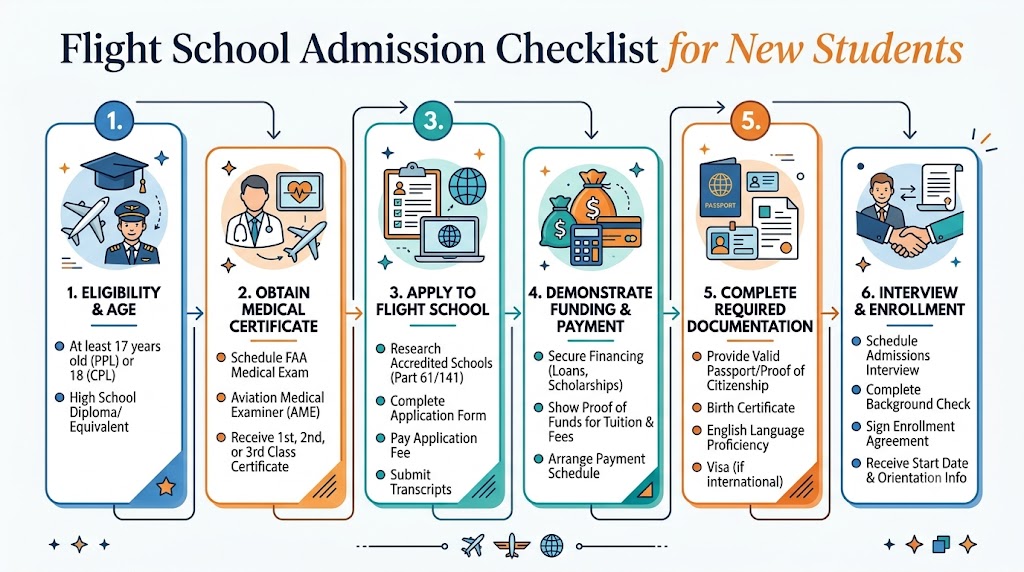
Choosing a flight school is more than completing an application and paying an enrollment fee. A good admission process should help a new student confirm eligibility, understand the training pathway, prepare the required documents, evaluate the school, and establish realistic expectations about time, cost, scheduling, and progression.
Requirements vary by country, aviation authority, school, aircraft category, and training objective. For example, FAA-regulated training in the United States has specific requirements for student pilot certification, medical certification, English-language ability, and training providers. FAA guidance also recommends evaluating a school beyond price by considering training quality, facilities, aircraft availability, instructors, and how well the program fits the student’s schedule.
This checklist provides a practical framework for students preparing to enter flight training.
Why a Flight School Admission Checklist Matters
New students often focus on one question:
“What documents do I need to submit?”
That is only one part of admission.
A proper admission checklist should also answer:
- Am I eligible for the training I want?
- Which pilot certificate or rating am I working toward?
- Do I meet the school’s academic and language requirements?
- Do I understand the medical requirements?
- Is my identification documentation complete?
- Can I realistically afford the entire training pathway?
- Does the school’s schedule fit my availability?
- Are the aircraft properly maintained and available when needed?
- Who will provide my ground and flight instruction?
- What happens if training is delayed?
- What are the school’s refund, cancellation, and transfer policies?
- What happens after enrollment?
The goal is not simply to get accepted. The goal is to enter training with the right expectations and enough preparation to make steady progress.
1. Define Your Flight Training Goal
Before submitting an application, determine exactly why you want to learn to fly.
Different goals can require different training pathways.
Common objectives include:
- Recreational flying
- Private pilot training
- Commercial pilot training
- Instrument training
- Multi-engine training
- Professional airline preparation
- Flight instructor training
- Aircraft-specific additional training
A student who wants to fly recreationally may have very different requirements from someone building experience toward professional aviation.
Ask yourself:
- What certificate or rating am I pursuing?
- Do I eventually want professional pilot qualifications?
- Do I plan to train full-time or part-time?
- Which aircraft category interests me?
- Where do I expect to use my pilot certificate?
- Which aviation authority will issue my certificate?
This decision should be made before comparing schools because the appropriate training structure depends heavily on the intended outcome.
2. Check Basic Eligibility
Eligibility requirements depend on the jurisdiction and certificate.
Do not assume that because one person was accepted by a school, you automatically meet the same requirements.
Check:
- Minimum age
- Identification requirements
- Language requirements
- Education requirements
- Medical eligibility
- Citizenship or residency requirements where applicable
- Background or security requirements where applicable
- Training prerequisites
- Previous aviation qualifications, if any
For example, under FAA rules, eligibility for a U.S. student pilot certificate includes being at least 16 years old and being able to read, speak, and understand English. Some categories, such as glider or balloon operations, have different age provisions.
Important: School admission and regulatory eligibility are not always the same thing.
A school may have its own enrollment criteria in addition to the minimum requirements established by the aviation authority.
3. Identify the Aviation Authority
One of the most important admission questions is:
Which aviation authority governs my training and future certificate?
Examples include:
- FAA
- EASA
- UK CAA
- Transport Canada
- CASA
- DGCA
- Other national aviation authorities
The exact documentation, medical standards, examinations, training hours, licensing structure, and student permissions can differ substantially.
Therefore, do not copy a checklist from another country and assume it applies to your program.
Before applying, confirm:
- Governing aviation authority
- Certificate being pursued
- Applicable training regulations
- Medical requirements
- Examination requirements
- Language requirements
- Student authorization requirements
- Conversion requirements if training will later be transferred to another jurisdiction
This becomes especially important for international students.
4. Prepare Personal Identification Documents
Most flight schools require identity documentation during enrollment.
Depending on the country and school, this may include:
- Passport
- Government-issued identification
- Birth certificate
- Proof of address
- National identity document
- Residency documentation
- Immigration documentation
- Passport-sized photographs
- Other government-required forms
Before submission:
- Check that names match across documents.
- Verify that documents are current.
- Check spelling carefully.
- Confirm that copies are readable.
- Keep secure digital copies.
- Keep originals available when required.
A mismatch between a passport, application, certificate, and school record can create unnecessary administrative delays.
5. Check Medical Requirements Early
Medical eligibility should not be treated as an afterthought.
Depending on the certificate and jurisdiction, students may need an aviation medical examination before exercising certain pilot privileges.
For FAA-regulated airplane training, the FAA recommends obtaining the required medical certification before beginning flight training because doing so can identify potential certification issues before a student invests substantially in training.
Your medical checklist should include:
- Determine the required medical class.
- Identify an authorized aviation medical examiner.
- Schedule the examination.
- Prepare relevant documentation requested by the examiner.
- Keep the medical certificate securely.
- Understand any limitations or follow-up requirements.
- Confirm whether the certificate remains valid for the privileges you intend to exercise.
For FAA training, Aviation Medical Examiners issue aviation medical certificates, and the FAA provides specific procedures for completing the medical application and examination process.
A practical rule
Resolve medical questions early rather than after spending heavily on flight training.
6. Confirm Language Requirements
Aviation communication depends on clear communication.
Students should understand the language requirements applicable to their intended certificate and operating environment.
Check whether the school requires:
- English proficiency
- Aviation terminology knowledge
- Written communication ability
- Verbal communication assessment
- An entrance language test
- Additional language training
Under FAA requirements, a student pilot certificate applicant must be able to read, speak, and understand English.
Being technically eligible does not necessarily mean that communication will be effortless during training.
Students should be comfortable understanding:
- Instructor briefings
- Radio communications
- Aircraft terminology
- Weather information
- Navigation terminology
- Safety instructions
- Written training material
7. Gather Academic Documents
Academic requirements vary significantly between programs.
A school may request some combination of:
- High school certificate
- Secondary school transcripts
- College or university transcripts
- Diploma
- Degree certificate
- Academic mark sheets
- Proof of mathematics or physics education
- English-language qualifications
- Academic equivalency documentation
Not every flight school requires the same academic background.
Before applying, ask:
- What is the minimum educational qualification?
- Are specific subjects required?
- Are international qualifications accepted?
- Are translated documents required?
- Are certified copies required?
- Does the school conduct an entrance assessment?
Avoid assuming that higher academic qualifications automatically guarantee better flight-training performance. Aviation training requires a combination of theoretical understanding, practical skills, discipline, communication, decision-making, and consistent preparation.
8. Prepare Your Application Forms
Application forms are often straightforward, but accuracy matters.
Review every field before submission.
Check:
- Full legal name
- Date of birth
- Contact information
- Emergency contact
- Education history
- Previous aviation training
- Medical information where requested
- Citizenship or residency information
- Training objective
- Financial or sponsorship information where applicable
Common application mistakes
- Using a nickname instead of a legal name
- Entering inconsistent dates
- Leaving required fields blank
- Uploading the wrong document
- Submitting unreadable scans
- Using outdated contact information
- Failing to disclose relevant previous training when requested
Keep a copy of the completed application for your records.
9. Prepare for an Entrance Assessment
Some flight schools may conduct an assessment before admission.
Possible areas include:
- Mathematics
- Physics
- English
- Logical reasoning
- Spatial awareness
- Aviation knowledge
- General aptitude
- Communication
- Academic readiness
Not every school uses the same assessment.
The purpose is usually to determine whether a student is prepared for the academic demands of the program rather than simply testing memorized aviation terminology.
Preparation should focus on:
- Basic mathematics
- Units and conversions
- Basic physics
- Reading comprehension
- Logical reasoning
- Communication
- Study discipline
Avoid preparing only by memorizing answers. Understanding the underlying concepts is more useful during subsequent ground training.
10. Understand the Training Structure
Before enrolling, ask the school to explain the complete training pathway.
A typical progression may involve:
Admission → Ground Training → Initial Flight Training → Solo Preparation → Knowledge Testing → Advanced Flight Training → Practical Test → Certificate/Rating
The exact sequence varies by jurisdiction and program.
Ask the school:
- What training syllabus is followed?
- How is progress measured?
- How often are students expected to fly?
- How much ground training is included?
- How are weak areas identified?
- How are stage checks handled?
- What happens if a student does not meet a training standard?
- How are additional lessons scheduled?
A structured syllabus can make progress easier to track.
FAA guidance notes that approved Part 141 schools operate with prescribed standards and approved training curricula, while other training providers can also offer quality instruction. The important point is to evaluate the actual training structure and quality rather than assuming that one regulatory category automatically guarantees a better individual experience.
11. Compare Flight School Options Carefully
Admission should be treated as a school-selection decision, not just an administrative process.
Create a comparison sheet covering:
| Evaluation Area | Questions to Ask |
|---|---|
| Certification | What regulatory approval does the school hold? |
| Training Program | What certificates and ratings are offered? |
| Aircraft | What aircraft are available for students? |
| Maintenance | How is aircraft maintenance managed? |
| Instructors | How are instructors assigned and standardized? |
| Scheduling | How far in advance are lessons booked? |
| Facilities | Are classrooms, briefing rooms, and study areas adequate? |
| Simulator | What approved training devices are available? |
| Weather | How are weather cancellations handled? |
| Progress | How is student performance tracked? |
| Costs | What is included in the quoted price? |
| Refunds | What happens if training is discontinued? |
| Records | How are training records maintained? |
| Support | Who handles student concerns and administrative issues? |
The FAA specifically advises prospective students to visit training providers, talk with management, instructors, and students, and evaluate training quality rather than making the decision on financial considerations alone.
12. Inspect the Aircraft and Maintenance Environment
This is one area where new students often focus too little attention.
You do not need to become an aircraft mechanic to ask sensible questions.
Ask:
- What aircraft types are used?
- How many training aircraft are available?
- How often are aircraft scheduled for maintenance?
- What happens when an aircraft becomes unavailable?
- Are replacement aircraft available?
- How are maintenance delays communicated?
- Are aircraft records properly managed?
- What is the school’s process for reporting aircraft defects?
Look for operational maturity
A professional school should be able to explain:
- aircraft scheduling
- maintenance coordination
- defect reporting
- grounding procedures
- replacement aircraft
- communication with students
The objective is not to demand that an aircraft never experience maintenance issues. Aircraft require inspection and maintenance. The important question is whether the school manages those issues systematically.
13. Evaluate Flight Instructors
The instructor-student relationship has a major influence on the training experience.
Ask:
- How are instructors assigned?
- Can students request a different instructor?
- Is there instructor standardization?
- How frequently will progress be reviewed?
- How is feedback documented?
- What happens if an instructor becomes unavailable?
- Does the school use a consistent syllabus?
The FAA’s pilot-training guidance emphasizes the importance of the quality of instruction and recommends evaluating instructors as part of the process of choosing a training provider.
Good questions for current students
- Are lessons starting on time?
- Is feedback specific?
- Are instructors consistent?
- Is ground training integrated with flight lessons?
- Are cancellations handled professionally?
- Can students easily communicate concerns?
Do not choose an instructor solely because they are friendly. Look for a combination of technical knowledge, teaching ability, preparation, communication, and professional standards.
14. Understand the Financial Commitment
The admission fee is rarely the full cost of flight training.
Your budget may need to account for:
- Enrollment fees
- Ground school
- Flight hours
- Aircraft rental
- Instructor fees
- Simulator sessions
- Written examinations
- Practical examinations
- Medical examination
- Training materials
- Headset or other required equipment
- Navigation resources
- Uniforms, where required
- Transportation
- Accommodation
- Insurance or administrative charges
- Additional training after unsuccessful progress checks
Ask for a complete cost structure
Instead of asking only:
“How much does the course cost?”
ask:
“What is included in the quoted training cost, what is charged separately, and which expenses commonly arise outside the advertised package?”
This produces a much more useful financial picture.
15. Build a Training-Time Budget
Money is only one resource.
Time is equally important.
Flight training can be disrupted by:
- Weather
- Aircraft maintenance
- Instructor availability
- Airport limitations
- Student availability
- Examination scheduling
- Administrative delays
- Personal commitments
A student who can train consistently may progress differently from someone who flies only occasionally.
FAA guidance recommends obtaining ground and flight training regularly and frequently because consistency supports retention and proficiency.
Before admission, determine:
- How many days per week can you train?
- What time of day is available?
- How flexible is your schedule?
- How far do you live from the airport?
- Can you maintain consistent study time?
- What happens when a lesson is cancelled?
A realistic schedule is usually more useful than an ambitious schedule that cannot be maintained.
16. Check Student Support Services
New students may need administrative and academic support throughout training.
Ask whether the school provides:
- Admission assistance
- Academic support
- Instructor coordination
- Scheduling assistance
- Examination guidance
- Progress reviews
- International student support where applicable
- Accommodation guidance
- Transportation information
- Documentation assistance
- Career guidance for professional pathways
A school does not need to provide every service internally, but students should understand who is responsible for each part of the process.
17. Review Policies Before Paying
Read the school’s written policies before making a significant payment.
Pay particular attention to:
- Refund policy
- Cancellation policy
- Transfer policy
- Aircraft cancellation policy
- Instructor cancellation policy
- Course withdrawal procedure
- Training record ownership
- Account balance rules
- Package expiration
- Administrative fees
- Examination fees
- Re-enrollment requirements
Why this matters
Problems often occur not because a school has unusual policies, but because students never read them.
Do not rely exclusively on verbal promises.
If an important financial or operational condition was discussed during admission, ask whether it can be provided in writing.
18. Understand Documentation for International Students
International students may have additional requirements.
Depending on the jurisdiction, these can include:
- Passport
- Visa or immigration documentation
- Proof of funds
- Educational documents
- Medical certification
- English-language documentation
- Security screening or authorization
- Travel insurance
- Accommodation information
- School-specific enrollment documentation
International students should confirm requirements directly with the school and relevant authorities.
A document that is acceptable for ordinary school admission may not automatically satisfy aviation, immigration, or licensing requirements.
19. Prepare a Digital Document Folder
Create one organized folder before admission.
A practical structure might look like:
Flight Training
├── Identification
├── Passport
├── Education
├── Medical
├── Admission Forms
├── Aviation Documents
├── Financial Records
├── Training Agreement
├── Receipts
└── Correspondence
Maintain secure backups.
Use clear filenames such as:
Passport_Name.pdf
Education_Certificate_Name.pdf
Medical_Certificate_Name.pdf
Flight_School_Application_Name.pdf
Training_Agreement_Name.pdf
Do not send sensitive identity or financial documents through an unverified channel.
20. Ask About Training Records
Training records become increasingly important as students progress.
Ask:
- How are lessons recorded?
- Can students review their progress?
- Who maintains the official training record?
- How are instructor endorsements documented?
- What happens if a student transfers schools?
- Can records be obtained when training ends?
- How are digital records protected?
Good recordkeeping supports continuity when instructors change, training pauses, or students transfer between providers.
21. Understand the Examination Path
Admission is only the beginning.
Ask the school to explain:
- Ground-school examinations
- Knowledge tests
- Progress checks
- Practical tests
- Oral examinations where applicable
- Examiner arrangements
- Retest procedures
- Additional training requirements
For FAA training, student pilots do not need to pass a general written test merely to obtain the student pilot certificate, but an instructor-administered knowledge test is required before the first solo, followed by additional knowledge and practical testing for higher certificates.
Understanding this progression helps students avoid confusing school assessments with regulatory certification examinations.
22. Evaluate Airport and Training Environment
The airport itself can influence the training experience.
Consider:
- Airport traffic
- Runway configuration
- Training-area access
- Weather patterns
- Airspace complexity
- Ground delays
- Operating hours
- Distance from your residence
- Availability of practice areas
- Night-training opportunities where relevant
A busy airport may expose students to more complex operations, while a quieter airport may provide more opportunities for certain training activities.
Neither is automatically better.
The relevant question is whether the environment matches your training goals and learning needs.
23. Understand Weather and Cancellation Procedures
Weather is an unavoidable part of flight training.
Ask:
- How are weather decisions made?
- Who communicates cancellations?
- How much notice is normally provided?
- Can cancelled lessons be rescheduled quickly?
- Is ground training offered when flying is not possible?
- Are weather-related cancellations charged?
A professional training program should treat weather conservatively and should not pressure students or instructors into flying when conditions are unsuitable.
24. Check Aircraft Availability and Scheduling
A school may have many aircraft on paper but limited practical availability.
Ask:
- How many aircraft are operational?
- How many students share each aircraft?
- How far ahead can students schedule flights?
- How often are aircraft unavailable?
- What happens if your assigned aircraft is grounded?
- Are instructors available when aircraft are available?
A useful question
“If I need to fly regularly to maintain training continuity, what normally happens when my scheduled aircraft becomes unavailable?”
The answer can reveal more about operational capacity than a simple aircraft-count statistic.
25. Review Safety Culture
Safety should be part of everyday training rather than a marketing slogan.
Look for evidence of:
- Preflight discipline
- Instructor professionalism
- Maintenance reporting
- Weather decision-making
- Risk assessment
- Standard operating procedures
- Student safety briefings
- Incident reporting
- Emergency procedures
- Proper use of checklists
Be cautious if staff appear dismissive when you ask reasonable safety questions.
A strong safety culture should be visible in ordinary operations.
26. Watch for Common Admission Mistakes
Mistake 1: Choosing Only by Price
A lower quoted rate may not represent lower total training cost.
Mistake 2: Ignoring Medical Eligibility
Discovering a certification issue after substantial expenditure can create unnecessary financial and emotional stress.
Mistake 3: Paying a Large Amount Without Reading the Agreement
Understand exactly what you are purchasing.
Mistake 4: Failing to Compare Aircraft Availability
A large fleet does not automatically mean easy scheduling.
Mistake 5: Ignoring Instructor Availability
Your progress depends heavily on consistent instruction.
Mistake 6: Training Too Irregularly
Long gaps can reduce continuity and require additional review.
Mistake 7: Selecting a School Without Visiting
Where practical, visit the facility and observe normal operations.
Mistake 8: Assuming Advertised Course Hours Equal Final Training Hours
Minimum regulatory requirements and the time an individual student actually needs are not necessarily the same. FAA guidance explicitly notes this distinction for private-pilot training.
Mistake 9: Not Asking About Transfers
Find out what happens if you need to change instructors, aircraft, or schools.
Mistake 10: Treating Admission as the Finish Line
Admission is the beginning of a structured training process.
27. A Practical Pre-Admission Decision Framework
Before committing to a school, evaluate five areas.
| Area | Key Question |
|---|---|
| Eligibility | Do I satisfy regulatory and school requirements? |
| Training Quality | Is the instructional system structured and professional? |
| Availability | Can I train consistently with the available aircraft and instructors? |
| Financial Fit | Can I realistically support the complete training process? |
| Long-Term Fit | Does this school support my intended certificate or career pathway? |
Do not rely on a single factor.
A school that is inexpensive but difficult to schedule may not be financially efficient. A school with excellent facilities may still be unsuitable if its program does not match your intended certification path.
28. Flight School Admission Checklist
Use the following checklist before enrollment.
Personal Eligibility
- Confirm minimum age
- Confirm identity requirements
- Confirm language requirements
- Confirm educational requirements
- Confirm medical requirements
- Confirm citizenship/residency requirements where applicable
- Confirm any security or background requirements
Documents
- Passport or government identification
- Birth certificate if required
- Proof of address if required
- Academic certificates
- Academic transcripts
- Medical documentation
- Language qualification if required
- Passport photographs if required
- Visa/immigration documents where applicable
- Completed application forms
School Evaluation
- Verify regulatory status
- Review training syllabus
- Meet instructors
- Visit facilities
- Inspect training environment
- Ask about aircraft availability
- Ask about maintenance procedures
- Ask about scheduling
- Speak with current students where practical
- Review student support
Financial Planning
- Enrollment fees
- Flight training fees
- Instructor fees
- Ground training costs
- Examination costs
- Medical examination costs
- Equipment costs
- Accommodation costs
- Transportation costs
- Additional training contingency
- Refund and cancellation terms
Training Planning
- Define certificate objective
- Understand training sequence
- Establish realistic weekly availability
- Understand progress checks
- Understand examination requirements
- Understand cancellation procedures
- Understand recordkeeping
- Understand transfer procedures
29. Questions to Ask Before Signing the Enrollment Agreement
A short interview with the school can reveal important information.
About training
- What exact certificate or rating does this program prepare students for?
- What syllabus is used?
- How is student progress measured?
- How often should students normally train?
About instructors
- How are instructors assigned?
- What happens when an instructor is unavailable?
- Can students change instructors if necessary?
About aircraft
- Which aircraft are normally used?
- How is maintenance managed?
- What happens when an aircraft becomes unavailable?
About scheduling
- How far in advance are lessons scheduled?
- What happens after a weather cancellation?
- How quickly can cancelled lessons be rescheduled?
About money
- What costs are included in the advertised price?
- What costs are excluded?
- What is the refund policy?
- Are there package expiration dates?
- What happens if additional training is required?
About records
- How are training records maintained?
- Can students obtain their records if they transfer?
These questions are more useful than simply asking whether the school is “good.”
30. What a Well-Prepared New Student Looks Like
A well-prepared student does not necessarily know how to fly before arriving.
Instead, they arrive with:
- Correct documentation
- Clear training objectives
- Realistic financial expectations
- Appropriate medical planning
- A workable schedule
- Basic academic preparation
- An understanding of the training pathway
- Questions about the school
- A willingness to learn
- Respect for procedures and safety standards
Flight training is designed to teach practical flying skills. Students do not need to arrive as experienced pilots.
They do need to arrive prepared to study consistently, accept instruction, follow procedures, and take responsibility for their own progress.
31. Final Pre-Enrollment Review
Before paying a significant enrollment amount, take one final pass through the following questions:
Eligibility:
Do I meet the applicable regulatory and school requirements?
Medical:
Have I addressed the required medical certification process?
Documents:
Are my application and supporting documents complete and consistent?
Training:
Do I understand exactly what program I am enrolling in?
Instructors:
Do I understand how instruction is assigned and managed?
Aircraft:
Have I asked about aircraft availability and maintenance?
Schedule:
Can I realistically train with sufficient consistency?
Money:
Do I understand both advertised and additional costs?
Policies:
Have I read the enrollment, cancellation, transfer, and refund terms?
Future pathway:
Does this program fit what I ultimately want to accomplish with aviation?
If several of these questions remain unanswered, pause before making a major commitment and obtain clarification from the school.
Frequently Asked Questions
Q1. What documents are usually needed for flight school admission?
Common documents can include government identification, passport, educational records, photographs, medical documentation, completed application forms, and immigration or residency documents where applicable. Exact requirements vary by school and aviation authority.
Q2. Do I need a medical certificate before joining a flight school?
Not always at the exact moment of enrollment, but medical requirements should be checked early. For FAA-regulated training, the FAA recommends obtaining the required medical certification before beginning flight training because it can identify potential certification issues before substantial training expenses are incurred.
Q3. Do flight schools require a specific educational qualification?
It depends on the program and jurisdiction. Some schools have academic requirements while others may have relatively limited formal education requirements. Always confirm the requirements of the specific program.
Q4. Is English proficiency required for pilot training?
This depends on the applicable aviation authority and operating environment. FAA student pilot certification, for example, requires the applicant to be able to read, speak, and understand English.
Q5. Should I visit a flight school before enrolling?
Yes, where practical. A visit allows you to observe facilities, discuss the program with staff and instructors, understand aircraft availability, and get a better sense of how the school operates. FAA guidance specifically recommends visiting prospective training providers and talking with management, instructors, and students.
Q6. Should I choose the flight school with the lowest price?
Price should be evaluated alongside training quality, aircraft availability, instructor access, scheduling, maintenance, facilities, and the complete cost structure. A low advertised price does not necessarily mean the lowest total training cost.
Q7. What should I ask about aircraft maintenance?
Ask how maintenance is scheduled, how aircraft defects are handled, how unavailable aircraft affect student scheduling, and whether replacement aircraft are available. The objective is to understand how the school maintains safe and reliable training operations.
Q8. What if I need to change flight schools?
Ask about record transfer procedures before enrolling. Understand who maintains your training records, what documentation you receive, and whether unused funds or prepaid training can be transferred or refunded.
Q9. Can I train part-time?
Many programs accommodate part-time students, although the available scheduling options vary. Before enrolling, make sure the school’s operating hours and scheduling practices fit your actual availability.
Q10. What is the biggest admission mistake new students make?
One common mistake is treating admission as a simple paperwork exercise. Choosing an appropriate training program requires evaluating eligibility, medical considerations, instructors, aircraft, scheduling, finances, training structure, safety culture, and long-term objectives together.
Conclusion
A flight school admission checklist should cover much more than application documents.
New students should verify eligibility, medical requirements, education, language ability, finances, scheduling, and training objectives before committing.
The school itself should be evaluated for instructional quality, aircraft availability, maintenance practices, instructor support, safety culture, and administrative policies.
Students should also understand the complete training pathway rather than focusing only on the first stage of admission.
Careful preparation reduces avoidable delays and helps create realistic expectations about flight training.
The best admission decision is an informed one based on requirements, training quality, operational fit, and long-term goals.

